metacool

thoughts on the art & science of bringing cool stuff to life, by Diego Rodriguez

More d.schooling

A few posts back I mentioned a flashmob created by students at the Stanford d.school.  Here's another article about the class behind that event.  Some of my favorite soundbites:

"Design thinking is a different way of thinking," said Alex Kazaks, a member of the course's teaching team. "There are all different kinds of intelligences, and one of these is creative intelligence. Design thinking is an analog for that. This is not something usually taught in a university setting, and we're trying to make it available to students."

"In the GSB, we look at case studies and analyze and talk," said Management Science and Engineering Prof. Bob Sutton, a founding member of the d.school. "The whole d.school is based on doing stuff in interdisciplinary teams."

"This is a class for students interested in leading teams and leading innovation within teams," said teaching team member Perry Klebahn.

"We had to spend eight hours making changes that are meant to increase bike safety on campus, and we had to actually do something, not just plan it," said second-year GSB student Max Pulido London - one of the group that staged the White Plaza bike accident.
08 February 2006 | Permalink | Comments (0) | TrackBack (0)

| |

Unabashed Gearhead Gnarlyness

Thermodynamics 101, brought to you by the warmup sequence of a Formula 1 motor.

If you "get" why I find this compelling, then... well, you're probably a gearhead!

If you don't understand the attraction of a V-10 motor spinning up to 18,000 RPM while shrieking loud enough to make ears bleed, then consider this a good example of our irrational fascination with technological aesthetics (where "our" means the human species).  We just love this stuff.  It just manifests itself in different ways.  If you're proud of your Prius, you're expressing something irrational, because the Prius is certainly not about an economically justifiable technology choice, no more than a Formula 1 car is. 

In the end, it's worth going back to Norman's Visceral-Behavioral-Reflective model of cognition.  This video is all about the power of the visceral.  It's absolutely, postively worth designing for, no matter if you're working on a financial website or a F1 car.

this video footage via Google Video

01 February 2006 | Permalink | Comments (35) | TrackBack (6)

| |

Design Thinking at Davos

Bruce Nussbaum obviously had a great time at Davos, and this post sums it all up quite nicely.

It's a good time to be doing design thinking.

30 January 2006 | Permalink | Comments (0) | TrackBack (0)

| |

Slow Design

In Praise of Slow Design, by Michael Beirut

Really worth a read and some soak time. 

How long should it, does it, take to design something really good?  To create an innovation of lasting value?

18 January 2006 | Permalink | Comments (1) | TrackBack (0)

| |

On Seth and prototypes and storytelling

Seth Godin wrote an interesting post about prototypes today.  I disagree with where he went with this argument, but being of a Voltaire-ish world view, I'm really happy with him saying it.

Here's how my email response to Seth went:

Hi Seth,

Part of the problem is that there are many, many levels of prototypes.   There are sketchy prototypes, rough prototypes, works-like prototypes, looks-like prototypes, works-looks-like prototypes, launched product prototypes (Gmail), you know what I’m talking about.

What I find is that prototype owners aren’t very good about setting context for their audiences.  They focus too much on the prototype and don’t tell enough of a story about it.  In fact, I’ve found the best way to get people to understand a prototype isn’t to show them the prototype on a table, but to shoot a video of someone using that prototype, or to use the prototype as a prop in a skit.  Then you can show how and why it creates value in someone’s life, which is the point of the whole exercise anyway.

So, I guess I disagree that prototypes need to be better than the real thing.  It’s the storytelling that needs to be better than reality.

Best,

Diego

So, kind metacool reader, what do YOU think?  Let's have a comment fiesta below.

13 January 2006 | Permalink | Comments (12) | TrackBack (2)

| |

Unabashed Gearhead Gnarlyness

37459439_e27d6ddd2b_o_1

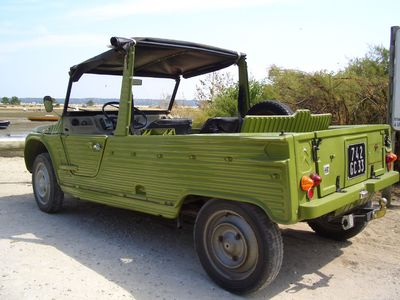
The Citroën Mehari

A variant of the famed 2CV, the plastic-bodied Mehari is a wonderful example of the kind of aesthetic that results from a design point of view which is more concerned with materials, end use scenarios, manufacturing processes, and -- above all -- cost, rather than with the vagaries of style.  It's the same type of point of view that gave us such classics as the original Jeep, Land Rover, and  Mini.  When done in a more conscious mode, it's really hard to do this kind of design. 

The new Mini does a good job of it, but modern Jeeps just don't have it.  Wouldn't it be wonderful to see  a modern Mehari?  Maybe it will happen.

I'm very emotional about the Mehari.  For me, it's evocative of the summer I spent as a boy staying with family in Spain.  My uncle Valentin Sama took me on a whirlwind tour of Southern Spain (in the summer, in a SEAT Panda, with three other people and our luggage and two dogs, and of course, no A/C.  We were hot) which included a few days relaxing in Agua Amarga.  Your quintessential fishing village with no phones, lots of beach dogs, and more than a few Meharis. 

I spent hours in Agua Amarga looking at an orange Mehari and a red 2CV.  Those two made for an aesthetic feast from Mars for this suburban Colorado boy.  I'm still figuring out how to get back there.

photo credit: Jacques Froissant, Creative Commons license, via Flickr

10 January 2006 | Permalink | Comments (5) | TrackBack (0)

| |

Bespoke

Here's a wonderful bit of storytelling  which helps illustrate the true nature of the word bespoke.

From English Cut, of course.

07 January 2006 | Permalink | Comments (0) | TrackBack (0)

| |

The case of the disappearing cup blurb

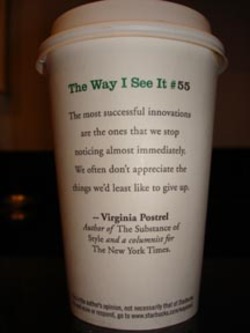
Virginia Postrel tells this tale of her contribution to Starbuck's "The Way I See It" campaign:

Cupquote11

Due to an unfortunate interaction between the sleeve and the cup, it's Virginia's writing that we stop noticing almost immediately:

Cupcover2

As is always the case here at metacool, my intent is not to poke fun at these kinds of sitiuations.  I'm much more interested in what there is to learn from this. 

I think the lesson here is how hard it is to successfully deliver an integrated offering.  Even for an experience delivery master such as Starbucks.   It's these kind of snafus that make the routine performance of something like a Boeing 767 all the more extraordinary. 

The remedy?  It's a bit of a cliche, but it comes back to the kind of multi-functional, multi-disciplinary teams fostered by Design Thinking.  Why not, for instance, put Virginia's quote on the sleeve in addition to the cup?  Well, that would probably require a new set of manufacturing, graphic design, marcomm, legal, supply chain, and channel experts to meet and reach agreement.  But it could happen.   Design Thinking is a team activity.

06 January 2006 | Permalink | Comments (6) | TrackBack (0)

| |

2006: The Year of Total Design

If you're any kind of soccer fan, you know the meaning of Total Football.  Wikipedia defines it as "... a system where a player who moves out of his position is replaced by another from his team, thus retaining their intended organizational structure. In this fluid system no footballer is fixed in their intended outfield role... Total Football depends largely on the adaptability of each footballer within the team to succeed."

In the world of soccer, Total Football created an entirely new paradigm for how the game should be played.  The fluidity, adaptability, and ultimately, the creativity it engendered markedly raised the performance of teams who adopted it.  And while the system of Total Football is what enabled players to play better than they ever had before, for the system to work required a special type of player.  Soccer legend Rinus Michels put it this way:

Total Football... places great demands on individual and team tactical excellence... An absolute prerequisite, to master such a team tactical aspect, is that all the players possess a positive mentality...

Back to the world of metacool.  I believe there's something called Total Design.  Total Design is to normal design as Total Football is to normal soccer.  It's what happens when you combine wickedly good design thinkers with a human-centered, business-sensitive design process.  Design thinkers who know how to work across professional boundaries, who can play any position, who are flexible, adaptable, yet capable of driving toward a unified goal.  Total Design is about tangible results that change the world for the better, and those results can be, should be, will be, awesome.

You heard it here first:  2006 is the year of Total Design.


04 January 2006 | Permalink | Comments (1) | TrackBack (0)

| |

Unabashed Gearhead Gnarlyness

Sr2_atl_wdog

The Rivendell Atlantis
from the Rivendell website:

"Form follows function" works for nature, but too often with people, it's used as an excuse to rush to market something that's fully functional but still not so good looking.  (Have you noticed that old things usually look good? Manhole covers, typewriters, '50s station wagons, chairs, hand-saw handles, buildings, bells, letter openers, kitchen appliances, almost anything.  They were designed slowly, on a real drawing board, by people who were part industrial designer, part artist, part engineer.  When you mix those qualities with manual involvement and patience, what finally hatches usually looks good.)"

15 December 2005 | Permalink | Comments (0) | TrackBack (0)

| |

Studio 360

Here's something I hadn't heard before:  Studio 360 Design for the Real World

A nice bento box of audio insights.

12 December 2005 | Permalink | Comments (0) | TrackBack (0)

| |

metacool Thought of the Day

"My inspiration comes from my childhood. I have a theory: As a child, you do a lot of things, you soak in the most; 20 or 30 years later you are in a position where you can make these things that you dreamed of or thought of back when you were a kid. You can make them happen. The color turquoise became very fashionable when the iMac came out. The designer who designed it was 35, my age then.  I remember that turquoise was all over when I was 9 or 10. It was a color from my childhood. Orange was a color of my childhood. The minimalism from the 60s came back. The 80's are coming back in the work of the younger guys."

- Markus Diebel

08 December 2005 | Permalink | Comments (0) | TrackBack (0)

| |

By any other word would smell as sweet?

Mappa_air_1

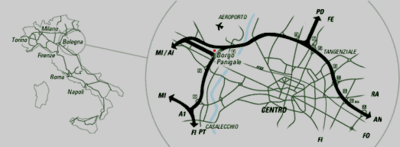
Following my post last week about the meaning of Ducati, here's some breaking news on Ducati: a majority stake has been sold by Texas Pacific Group (an American firm) to Investindustrial Holdings (an Italian firm). 

What's interesting about this from a meaning point of view is that Ducati is now owned by an Italian corporate entity, rather than by an American corporate entity.  Does it matter that the firm is now in Italian hands?  On the one hand, Ducati has certainly thrived for the past decade under American ownership.  On the other, the Ducatisti seem to think so -- they're already saying something along the lines of "Finally, Ducati is Italian".

I'm not so sure the nationality of ownership really matters to the meaning of a very nationality-centric brand like Ducati, so long as its deep roots in Borgo Panigale continue to be celebrated.  Mini, the quintessential British car, is owned and produced by a very Bavarian company called BMW.  Nor do I think it's really important where the nationality-centric object gets made.  For example, the BMW M Coupe, perhaps the most radical expression of BMW brand values ever produced, was made in the United States.  But critically, it was designed in Germany, by German Engineers.

So what matters?  I think what matters is that the people designing the offering really "get" -- and have control over -- all the tacit cultural markers that end up embedded in any designed object.  To the extent that one needs to live in a culture to really understand it, designers should probably live there if they are engaged in creating offerings that are largely differentiated on the basis of meaning, rather than functionality.

What do you think?

04 December 2005 | Permalink | Comments (2) | TrackBack (0)

| |

Unabashed Gearhead Gnarlyness

1115822459

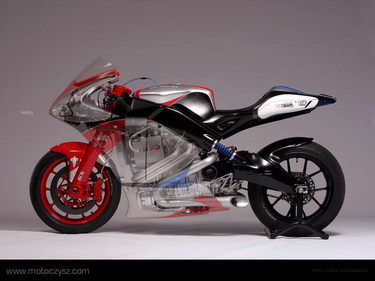
Any startup is hard.  Startups involving internal combustion engines are even more difficult to pull off than the usual venture.  Demanding distribution, sales, service, and support logistics, not to mention the sheer complexity of a modern vehicle, makes a vehicular startup an endeavor for the very brave of heart, the very wealthy, or (hopefully) both.

The Motoczysz company of Portland, Oregon, is working to market the innovative motorcycle shown above.  It's full of innovative mechancial design elements, and the aesthetics ain't bad, either.

Let's wish them luck.

07 November 2005 | Permalink | Comments (0) | TrackBack (0)

| |

More cool blogs

My Cool Stuff blogroll is a dynamic mix of favorites and others which reflect topical areas of interest.

Here are some highly recommended additions:

  • TEDBlog:  TED + Blog = cool
  • Presentation Zen:  Fantastic know-how about being a better presenter, but much more than that, too, such as this post on Wabi-Sabi.
  • english cut:  Everything you want to know about quality.  Period.

01 November 2005 | Permalink | Comments (0) | TrackBack (0)

| |

Beausage?

Img_6841
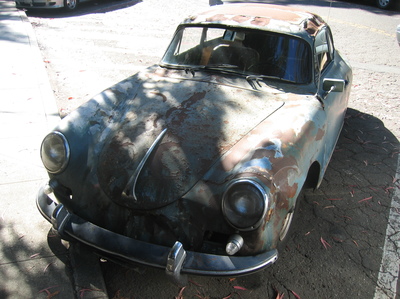
Is this beausage?

No.  Beausage is the confluence of beauty and usage.

This rusty Porsche 356 is just plain usage. 

What I can't believe is that there's a FastPass RFID beacon in the windshield.  Clearly the owner is an optimist.

25 October 2005 | Permalink | Comments (0) | TrackBack (0)

| |

Unabashed Gearhead Gnarlyness

Brillluxus
The Brill Luxus 38 lawn mower

19 October 2005 | Permalink | Comments (0) | TrackBack (0)

| |

Time and Design

Time and design -- what happens to your offering as it lives in the world?  How can you design with that in mind?  That might mean optimizing for beausage, or perhaps recognizing that the dynamic experience of your offering -- as exemplified by the Rivendell SpeedBlend bike tire -- can be so much more interesting than that provided by a static object.

And then there's the Kumho Ecsta MX-C automobile tire, which puts an entirely new spin on tire smoke.   When spun faster than the corresponding groundspeed of the car they're attached to, tires burn.  Burning rubber emits lots of smoke, generally of a bluish-white variety. 

Kumho's innovation was to recognize that, as with SpeedBlend, the experience of a tire in motion could be designed.  In this case, that meant formulating the rubber compound such that it emits dense red smoke when burned.  Here's a photo and video of the tire in action from Automobile Magazine (I highly recommend the video -- if Pontiac made GTO ads like this, their sales would be oh so much higher):

0510_pontiac_gto_04_445

Please recognize that while I find the Kumho tire interesting from a "how in the world are we going to differentiate our product in this market?" point of view, I'm not an advocate of crazy driving.  In fact, I hate it when people speed in the wrong context, such as all the cell-phone-porting-latte-quafing-fast-driving jerks who drive down my suburban street at ten over the posted speed limit. 

But for the time and the place where a well-laid patch of rubber is just what the doctor ordered, why not make it a red one?


09 October 2005 | Permalink | Comments (2) | TrackBack (3)

| |

metacool Thought of the Day

"The guitar for me is a translation device.  It's not a goal. And in some ways jazz isn't a destination for me. For me, jazz is a vehicle that takes you to the true destination - a musical one that describes all kinds of stuff about the human condition and the way music works." 
- Pat Metheny

(Metheny's take on jazz isn't so far from how Ettore Sottsass thinks about design.  If there's such a thing as "jazz thinking", I think it shares many elements with "design thinking".)


03 October 2005 | Permalink | Comments (0) | TrackBack (0)

| |

A Welcome Voice in the World of Design Thinking

Bruce Nussbaum is blogging:  NussbaumOnDesign

28 September 2005 | Permalink | Comments (1) | TrackBack (0)

| |

Making Things Make Things Beautiful

I had a casual, brief water-cooler-type conversation yesterday, which went something like this:

Me:  I noticed you're using Keynote instead of PowerPoint.  How do you like it?

Them:  It's great.

Me:  Did it take a lot of time to make your presentation look so designerly?

Them:  No.  I think Apple designed it so that you can't produce anything that's not beautiful.

That really blew my mind.  What a simple yet utterly audacious vision for any offering: help your customers make their lives more beautiful. 

What if your car made you drive with the smoothness of Fangio?  If your food processor helped you cook with the elegance of Batali?  As Virgina Postrel has been saying for a while, the desire for beauty in our lives is more basic than we think.  Perhaps those of us who create things for other people to use should be going beyond functionality, usability and visceral aesthetic concerns to deliver the realm of the poetic existence. 

24 September 2005 | Permalink | Comments (3) | TrackBack (0)

| |

Unabashed Gearhead Gnarlyness

Large10
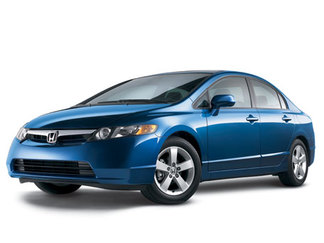
The 2006 Honda Civic Sedan

After seeing one pass me on the street, I have to admit I'm head-over-heels for the new Civic.  The shape and proportions represent a huge improvement over somewhat dowdy 2005 model, and there's more than a little Alfa Romeo Giulia Berlina in the trunk section, which is no bad thing.  This is the first Honda sedan since the famed pop-up headlight Accord of the late 80's to make you wonder why people bother with two-door coupes.  Sweet.

photo copyright Honda

22 September 2005 | Permalink | Comments (2) | TrackBack (0)

| |

The Return of Jolie-Laide

Bmw_z4_rear
The new BMW Z4 Coupe. 

This is fantastic.  It's the return of Jolie-Laide, and it's about design that takes guts.  Love it or leave it, you have to admire BMW's willingness to take a point of view and run with it.  In that sense, it's beautiful.

(via Jalopnik)

13 September 2005 | Permalink | Comments (1) | TrackBack (0)

| |

Design Manifestos: Eva Zeisel

"The designer must understand that form does not follow function, nor does form follow a production process. For every use and for every production process there are innumerable equally attractive possibilities."
- Eva Zeisel

Read more about Eva Zeisel's point of view on the design process in this wonderful profile written by Virginia Postrel.

08 September 2005 | Permalink | Comments (2) | TrackBack (0)

| |

metacool Thought of the Day

"NetGens think of the computer as a door, not a box.  When they are on, they have 5-7 IM windows open and multiple tabs into different communities. Each community provides a way of being, to express facets of their identity while engaging in an activity. Most activities are centered around objects to spin stories and hold conversations. They don't go to places, it's more likely they augment plazes in the real world. With increasing mobility they tap groups for what they need to get done no matter where they are and make where they are matter... In other words, the web is increasingly less about places and other nouns, but verbs."

- Ross Mayfield

04 September 2005 | Permalink | Comments (0) | TrackBack (0)

| |

Unabashed Gearhead Gnarlyness

Mayexe006_tcm2304708
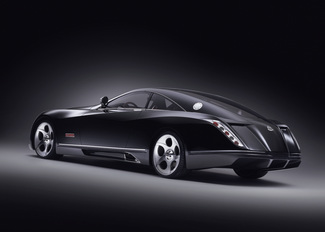
The Maybach Fulda Exelero

17 August 2005 | Permalink | Comments (0) | TrackBack (0)

| |

Design Thinking on Ice

External_view_01
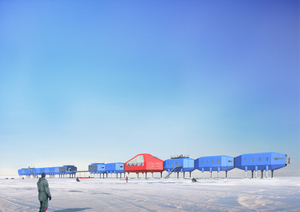
Could this be the oft-rumored winter under-ice exploration HQ of Team Zissou?  Or perhaps the Banzai Institute's secret computational genomics R&D lab?

Nothing so cool.  But on the other hand, something designed with surviving the cool as a key consideration.  Or in this case, being in Antarctica and not getting buried by it.

For this is Haley VI, the latest in a series of Antarctic research stations created by the British Antarctic Survey.  Haley VI is an extremely clever answer to the question, "How should humans live in the cold?".  Among other things, it features:

  • A modular architecture which allows multiple units to be combined and recombined
  • Renewable energy supplies
  • A thoughtful approach to dealing with doo-doo
  • Ski stilts which enable the module to avoid burial by layers of snow by being towed away

It's a good example of the holistic nature of design thinking at work.  A traditional, building-centric worldview would have responded to the challenge of snow burial with a "build it stronger and heavier" dictum, because buildings can't move, right?.  But Haley VI shows us that sliding modules gather no ice, and that's a breakthrough informed by a fundamentally optimistic view of the world: slide a building across the ground in the middle of nowhere, then snap it to another modular building?  Let's build it!

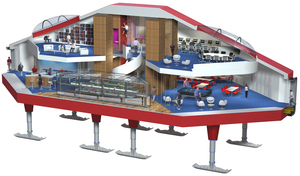
And you just gotta love the clubhouse module - it's enough to start an Antarctic housing bubble:

Central_module_iso_1


15 August 2005 | Permalink | Comments (0) | TrackBack (0)

| |

metacool Thought of the Day

2005_yzfr1_photo_07_tcm2650996

"To be successful in motorcycle product planning, you need to have enthusiasm and at the same time you need to have an enormous curiosity to dig deeper and see what's behind people's motivation, combined with an open mind for creativity. It is a difficult balance between logic & facts and creativity & vision. I believe you either have this ability or you don't. Just like a good painter, you either have the ability to make great paintings or you don't. This job requires a lot of intuition, which one cannot learn from schoolbooks."
- Masahiro Inumaru

11 August 2005 | Permalink | Comments (0) | TrackBack (0)

| |

Design Manifestos: The Cathedral and the Bazaar

This is start of a new feature of metacool, which I'm calling Design Manifestos.  These are pieces of design thinking that really had (or continue to have) a big impact on my own thinking.  Longer than a Thought of the Day, many more words than an Unabashed Gearhead Gnarlyness entry.

A great place to start is Eric Raymond's The Cathedral and the Bazaar, a wonderful essay about the "bazaar" (AKA "open source") approach to creating cool stuff.  Please do read it, but in case you can't, here are my favorite bits: 

  • "...you often don't really understand the problem until after the first time you implement a solution. The second time, maybe you know enough to do it right. So if you want to get it right, be ready to start over at least once."
  • "...I think Linus' cleverest and most consequential hack was not the construction of the Linux kernel itself, but rather his invention of the Linux development model."
  • "Release early. Release often. And listen to your customers."
  • "Given enough eyeballs, all bugs are shallow...  In the cathedral-builder view of programming, bugs and development problems are tricky, insidious, deep phenomena. It takes months of scrutiny by a dedicated few to develop confidence that you've winkled them all out. Thus the long release intervals, and the inevitable disappointment when long-awaited releases are not perfect.  In the bazaar view, on the other hand, you assume that bugs are generally shallow phenomena - or, at least, that they turn shallow pretty quick when exposed to a thousand eager co-developers pounding on every single new release. Accordingly you release often in order to get more corrections, and as a beneficial side effect you have less to lose if an occasional botch gets out the door."
  • "Often, the most striking and innovative solutions come from realizing that your concept of the problem was wrong."
  • "I think it is not critical that the coordinator be able to originate designs of exceptional brilliance, but it is absolutely critical that the coordinator be able to recognize good design ideas from others."

These are great thoughts about the process of creating good stuff.  It's important to keep in mind that this isn't just about software.  The challenge is to figure out how to make the bazaar part of your own way of getting things done.

03 August 2005 | Permalink | Comments (3) | TrackBack (0)

| |

metacool Thought of the Day

"Sell the Honda Odyssey. Buy a 1955 Alfa Romeo Spider Veloce.
And let the kids take a bus."
-- P.J. O'Rourke

27 July 2005 | Permalink | Comments (0) | TrackBack (0)

| |

Unabashed Gearhead Gnarlyness

timdesign

25 July 2005 | Permalink | TrackBack (0)

| |

metacool Thought of the Day

"Is having ideas considered design? ... I would argue no. The idea is not the design. Only an embodiment of the idea is design. It is this important distinction that people so often overlook in organizations as they work on what they want to bring to market next. Everytime ideas are debated verbally, an organization wastes resources."

- Chris Conley

06 July 2005 | Permalink | TrackBack (0)

| |

Unabashed Gearhead Gnarlyness

2005chevroletcorvettec6rracecarratop1920
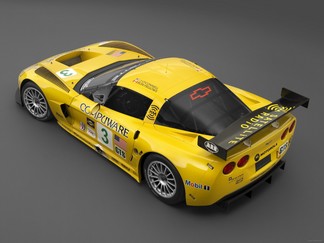
The Corvette C6.R


(running the 24 Hours of Le Mans this weekend)

18 June 2005 | Permalink | TrackBack (0)

| |

How to survive Art 60...

Top10

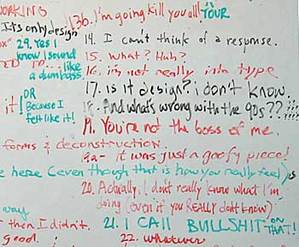
... things never to say during a design critique

(via Boing Boing)

11 June 2005 | Permalink | Comments (1) | TrackBack (0)

| |

Jolie-Laide, part 6

Subaru_tribeca_lg_2
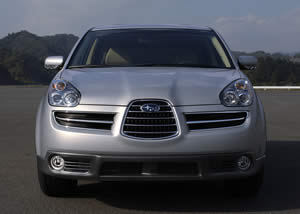
The 2006 Subaru B9 Tribeca

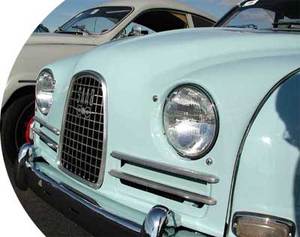
(I really like the new Tribeca.  Yes, it's definitely another example of jolie-laide, and I certainly suffer from ugly-car-itus, but I quite fancy this new Subaru.  Last year I wrote that "Subaru is the New Saab".  With the introduction of the B9, that sentiment has become aesthetically true:

Saab96snout
The 1963 Saab 96


10 June 2005 | Permalink | Comments (3) | TrackBack (0)

| |

Form Ever Follows Function - NOT

If you've been reading metacool for a while, you know how much I like Don Norman's Visceral-Behavioral-Reflective model of design.  It's a nice way to reach a deeper understanding of the design of things as varied as cars, jeans, and shopping bags.

Or even fingers (or more precisely, the lack thereof).  Here's a great example of the importance of reflective design, from Joi Ito: Differences in the meaning of finger chopping in Korea and Japan

It's fascinating how an absent digit can communicate so differently depending on cultural context.  Clearly, there's more meaning in a missing finger than can be captured in its lack of visual presence (Visceral Design) and/or its functional absence (Behavioral Design).  Reflective design is about meaning and culture and is where things get interesting in the art and science of bringing cool stuff to life.

08 June 2005 | Permalink | Comments (1) | TrackBack (0)

| |

metacool Thought of the Day

"I'm a storyteller.  I think of a designer as a processor of information -- like a scriptwriter or a novelist."

- Freeman Thomas

07 June 2005 | Permalink | Comments (0) | TrackBack (0)

| |

Beausage For Sale

5d_1_b_1

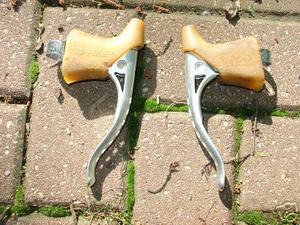
Want some Suntour Superbe brake levers with a sprinkling of beausage?

eBay auction # 716160266
(no, it's not my sale)

05 June 2005 | Permalink | Comments (0) | TrackBack (0)

| |

More Beausage, please

Okay, so it's a neologism; that won't keep me from liking the word beausage a whole helluva lot.

Here are some more examples of beausage (the beauty that comes with usage):

  • Wrinkles on a grandfather's face
  • Gouges and dents on the bed of a 1955 Chevy pickup
  • Wear patterns on a boot tread

Would love to hear about more beausage -- leave a comment below with your own example.

02 June 2005 | Permalink | Comments (16) | TrackBack (0)

| |

Jolie-Laide, part 5

Flavia_059

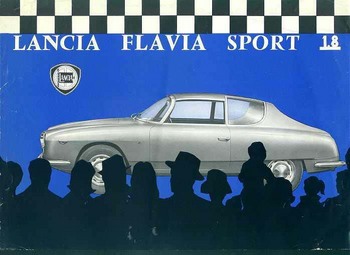
The Lancia Flavia Sport

Jolie-laide
: why worry about being beautiful when you could be interesting?

31 May 2005 | Permalink | Comments (6) | TrackBack (0)

| |

Seth Godin at metacool: Stuff he digs

metacool:
In All Marketers are Liars you provide lots of examples of offerings with great stories. If we were to spend a day in your shoes, what are the great products with great stories that make up the life of Seth Godin?  What do you dig?

Seth Godin:
Even though I'm a little more attuned to marketing bullshit because
that's what I write about, I still like to believe it. I like to
believe that food from the Union Square Market tastes better. I like to
believe that the small advantage in UI that the Mac delivers is cause
for joy. I like to believe that driving a Prius instead of a Lotus
Convertible is an important contribution to our planet's longevity.

Psychology is filled with cleverly constructed tests that demonstrate
that even when people "know" the truth, they choose to believe a story
instead.

26 May 2005 | Permalink | Comments (0) | TrackBack (0)

| |

Seth Godin at metacool: Emotional Design

metacool:
I'm a big fan of Donald Norman's book Emotional Design, and was
happy to see it on your recommended reading list in All Marketers are Liars. What's the connection between Don's thinking and your own?

Seth Godin:
I met Don at TED and was blown away at how deeply he understood the
'why' behind design. Not to make things pretty, but to build an
emotional story into what we do and how we feel about it.

26 May 2005 | Permalink | Comments (2) | TrackBack (0)

| |

Seth Godin at metacool: Design & Authenticity

Seth Godin is gracing the pixels of metacool today from The Business Blog Book Tour to talk about creating cool stuff, remarkable stuff, and his new book All Marketers are Liars. 

I'll be posting Seth's answers to my questions over the next few hours, so let's get started, and be sure to check back later for more of his thinking.

metacool:
Can a good story be used as a substitute for bad design? Many of
the examples in All Marketers are Liars communicate their story through good design, from message to product to package. Does a good story make up for lousy aesthetics and/or functionality?

Seth Godin:
A story is worthless without authenticity. You can't say, "Well, this
was designed by Phillipe Starck, therefore it's easy to use," and
expect that to work if, in the long run, people hate using it. Sure,
some people will fall for it, but what really delivers is something
like OXO. The OXO design is totally overdone, emphasizing at every turn
just how USEFUL this must be. But it IS useful! So the story works.

There are plenty of products where bad design is part of the story. The
Drudge Report, say, or the Hummer.

26 May 2005 | Permalink | Comments (1) | TrackBack (0)

| |

metacool Thought of the Day

"It's much harder to make stuff versus just talking about it like you know what you're doing."
-- John Maeda

23 May 2005 | Permalink | Comments (2) | TrackBack (0)

| |

Beausage

I'd like to tell you about a new aesthetic term called "beausage".  It sounds French but it's not; instead it's a synthetic combination of the words beauty and usage, and describes the beauty that comes with using something.

Metacool1914mercedes

Beausage is:

  • Roman amphitheater steps whose faces are worn away by the tread of thousands and thousands of shoes
  • Stone chips on the hood of a Ferrari 250 which has been run hard and put away wet
  • A bike seat whose adapted form reflects that of its owner's posterior
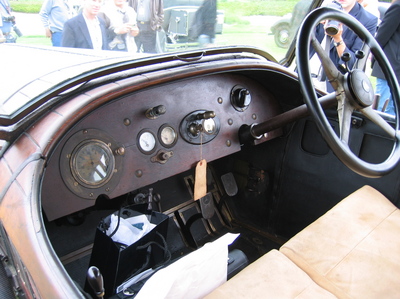
  • The look and feel of the cockpit of the old Mercedes pictured above (a jumble of replacement gauges and parts, obviously used a lot) -- that's 91 years of beausage!

How, you may ask, is beausage any different than patina?  Well, it's certainly related, but different.  Patina is really more about surface level changes happening at a chemical level: oxidation, chemical stripping, and so on.  Beausage describes changes that happen in 3D where atoms get torn and stripped away, as occurs with scratches, tears, chips, and wear marks.  I used to say "patina" when what I really meant was "beausage".  It's nice to have both.

I wish I could say I coined it, but the term beausage is the brainchild of Grant Petersen, grand pooh-bah of Rivendell Bicycle Works and probably the single most brilliant, holistic, and intuitive brand creator out there.  I mention Grant not only for intellectual attribution, but because he's going to help us bring this back into the world of creating cool stuff.  Grant states that "In general, real materials develop beausage, and synthetics look like old junk.  It's like a cowpokes's old denim jacket, versus an old polyester leisure suit...". 

Beausage is something for all products and their designers to aspire to.  When the chrome on the back of my iPod scratched away, the resulting exposed grey plastic made the thing feel cheap and ephemeral -- the opposite of what a good chrome finish should have done.  Imagine an iPod that looked better (beausage) the more it got used.  When you start to conceive of finishes not as veneers but as reservoirs of meaning via beausage, then you're giving your customers something that will continue to provide satisfaction through the ages.

16 May 2005 | Permalink | Comments (5) | TrackBack (6)

| |

The importance of being non-trivial

My friend George sent me a link to this great set of joke product concepts from the Onion.

It's very funny stuff -- but also a good reminder that bringing non-trivial value propositions to market is often a non-trival undertaking. 

11 May 2005 | Permalink | Comments (0) | TrackBack (1)

| |

Unabashed Gearhead Gnarlyness

The CarBone carbon fiber pet bowl

06 May 2005 | Permalink | Comments (1) | TrackBack (1)

| |

metacool Thought of the Day

"It's the vehicle's design that first forges that emotional bond between product and consumer... So often it simply boils down to this:

'Do I like the way this car looks or not?' 

And I think that's part of the reason this industry is headed for a new golden age of design. That's great news for all of us who dream about beautiful cars and trucks. It makes it a very exciting time to be in this business. Because we're getting back to what it's all about: Building the stuff that dreams are made of."

- Bob Lutz

01 May 2005 | Permalink | Comments (3) | TrackBack (0)

| |

David H. Liu Memorial Lecture Series in Design

Topbanner1_1

The 2005 David H. Liu Memorial Lecture Series in Design is here again at Stanford starting Thursday, April 21.  The list of speakers scheduled so far is impressive:

  • Paul Saffo
  • Amelia Rudolph
  • Ned Kahn

Last year's lecture series was inspiring, so I'm looking forward to this new season.

20 April 2005 | Permalink | Comments (0) | TrackBack (0)

| |

Venture Design, part 7

In an effort to resuscitate a riff about venture design that I wrote about a few months ago, I'm going to point you (and myself) to this nice Bill Breen Fast Company piece about design thinking, Roger Martin, and the Stanford d.school.  Here are two paragraphs I particularly like:

The trouble is, when confronted with a mystery, most linear business types resort to what they know best: They crunch the numbers, analyze, and ultimately redefine the problem "so it isn't a mystery anymore; it's something they've done 12 times before," Martin says. Most don't avail themselves of the designer's tools -- they don't think like designers -- and so they are ill-prepared for an economy where the winners are determined by design.

And:

Organizations that embrace a design-based strategy also employ the practice of rapid prototyping. Whereas conventional companies won't bring a product to market until it's "just right," the design shop is unafraid to move when the product is unfinished but "good enough." Designers learn by doing: They identify weaknesses and make midflight corrections along the way.

The subtlety here is that "design shops" don't typically ship products, they only create them.  The trick is to create a culture within a product organization that is willing and able to ship products that are only "good enough", as this is the enlightened path to creating products that are "wow".  I think this may require having design thinkers working across every discipline in the organization -- finance, marketing, sales, service, manufacturing, engineering, etc...  one needs to design a venture that can only be staffed with design thinkers.  I'll be revisiting this topic as I get into Dan Pink's new book.  Stay tuned.

08 April 2005 | Permalink | Comments (2) | TrackBack (0)

| |

« Previous | Next »

Categories

  • designing
  • innovating
  • leading
  • marketing
  • meta metacool

search


About

Subscribe to this blog's feed

    follow me on Twitter

    Favorite Posts

    • A million reasons why...
    • Mo Cheeks and a fundamental question of leadership
    • Innovation Lessons from Garage Majal
    • From Obama to Pink to Oprah
    • Shinya Kimura and the primacy of doing
    • A tribute to friends and friendship
    • Strategy that makes your hands bleed
    • Quality in a switch
    • Travis Pastrana and the future of the world economy

    on the nightstand

    • : The Great Bridge

      The Great Bridge

    • : Porsche - Origin of the Species

      Porsche - Origin of the Species

    Principles for Innovating

    • 1: Experience the world instead of talking about experiencing the world
    • 2: See and hear with the mind of a child
    • 3: Always ask: "How do we want people to feel after they experience this?"
    • 4: Prototype as if you are right. Listen as if you are wrong.
    • 5: Anything can be prototyped. You can prototype with anything.
    • 6: Live life at the intersection
    • 7: Develop a taste for the many flavors of innovation
    • 8: Most new ideas aren't
    • 9: Killing good ideas is a good idea
    • 10: Baby steps often lead to big leaps
    • 11: Everyone needs time to innovate
    • 12: Instead of managing, try cultivating
    • 13: Do everything right, and you'll still fail
    • 14: Failure sucks, but instructs
    • 15: Celebrate errors of commission. Stamp out errors of omission.
    • 16: Grok the gestalt of teams
    • 17. It's not the years, it's the mileage
    • 18: Learn to orbit the hairball
    • 19: Have a point of view
    • 20: Be remarkable

    CC

    • Creative Commons License