metacool

thoughts on the art & science of bringing cool stuff to life, by Diego Rodriguez

On Authentic Lies

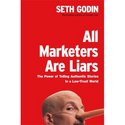
159184100301_aa400_sclzzzzzzz__1I just finished reading Seth Godin's All Marketers are Liars, an ode to the art of crafting, telling, and transmitting authentic stories (or lies).  Seth was kind enough to set me up with a galley of his new book, and if you have even one iota of interest in storytelling as a tool to create good stuff, put this one on your reading list. 

But, you may ask, is Liars really about design?  Yes.  Think of it as Purple Cow II: if Purple Cow was about mindfully applying visceral, behavioral, and reflective design to create remarkable offerings, then Liars is an extended riff upon the subtle art of reflective design alone.  Reflective design is about creating meaning, and in Liars Godin offers a design process to help make your stories sing.  As usual, you always know where Seth stands on an issue, and as a result the stories he tells, such as one about the genesis of Fox News, are engaging and instructive all at once.  The companion blog for the book is nifty, too. 

06 April 2005 | Permalink | Comments (0) | TrackBack (0)

| |

Creatiing Cool Stuff with Storytelling, part 5

What would happen if you approached your next presentation as a design challenge?

05 April 2005 | Permalink | Comments (0) | TrackBack (0)

| |

Some cool new blogs

When not blogging, or thinking about blogging, all of us here at metacool spend our waking hours scouring the net for other blogs that might help all of us get to a better place vis a vis the art and science of creating cool stuff.  In short, metacool aims to provide you with a fully edited user experience, saving you time and energy.  Kind of like Costco.

So, here are the latest additions to that most dynamic of lists, COOL BLOGS (at lower left):

  • Future of Marketing:  from the people at IFTF, this is Gizmodo for marketing types.
  • Noise Between Stations: thoughts on design & business.  Like metacool without the fluff.  Oh, wait, I just scanned his site and he's linking to me.  Ships that pass in the night, indeed.
  • Orange is the New Pink:  Daniel Pink's blog about this new book.  Should be interesting!
  • Simplicity:  I wrote about John Maeda's simplicity workshop last year.  Here's the blog -- it'll blow your mind.

31 March 2005 | Permalink | Comments (3) | TrackBack (0)

| |

Unabashed Gearhead Gnarlyness

The Bugaboo Frog

30 March 2005 | Permalink | Comments (2) | TrackBack (2)

| |

Marketing = Design = Marketing

If caskets can be made sexy and interesting, well, maybe there's still room for innovation in the realm of vacuum cleaners:

The Ball

If you're Dyson, how do you make a better vacuum cleaner?  You can't make it lose less suction, because it doesn't lose any to begin with.  Instead, you break the existing paradigm of maneuverability, producing something that broadcasts its unique value proposition loud and clear. 

Does The Ball need mega advertising to succeed?  No way, because its marketability is embedded in the remarkability of its design. 
Marketing = Design = Marketing.

24 March 2005 | Permalink | Comments (4) | TrackBack (1)

| |

Design = Marketing = Design

Tim Manners, whose Cool News is listed in the metacool blog roll, has an interesting column in Fast Company called "Marketing to Death".  In it he expounds upon the theme of Godin's Purple Cow: it's not about marketing something that sucks, it's about building things so remarkable that they market themselves (and make you look even better if you spend some additional marketing bucks, too).  Along the way, he tells some pithy stories about things like:

  • Caskets
  • A library
  • Artificial Xmas trees
  • A trip to the dentist

All of these seemingly moribund market offerings can be transformed into delightful human experiences if you just spend some time and energy to listen, take notes, and invest in making them have intrinsic value.  Such as the Seattle Public Library pictured above.  It's the zone where design = marketing = design.

23 March 2005 | Permalink | Comments (2) | TrackBack (0)

| |

How about a Sound and Smell Tasting session?

In both professional and academic settings I've had good success helping non-designers partially "get" what the whole design/brand/quality/experience furball is all about just by having them bring in their favorite object and then talk a bit about what makes it good.  There's something about the process of having to articulate mushy subjects like quality, heft, smell, taste, and feel that wakes the formerly dormant "goodness sensitivity" gene in people.  Deep down inside our modern brain, we all know what good is all about, but somewhere along the line we forget how to listen to our senses.  It's there, can you here it whispering?

I'll never forget the time a co-worker brought a piece of her underwear (okay, okay -- it was just a t-shirt) to one of these meetings.  She spoke from the heart about why this was the absolute best undergarment in the world for her.  It taught everyone in the room about quality in a deep way, and we just couldn't have gotten there via PowerPoint.

A little while ago I wrote yet another episode in my "Sound Matters" series.  It generated some good feedback and ideas: 

  • Ryan suggested that we also add "smell" to products to push them over the top.  Absolutely, man!  I got a whiff of a 1962 Porsche 356 the other day, and it smelled like Germany!!  Now that's what I call brand essence!  What if you could buy a new 911 that really smelled the way a Porsche should, instead of smelling exactly the same as a 2005 Camry?
  • Valentin came up with the nifty, nifty idea of holding a "sound tasting" party.  I can just imagine it: you walk into a room, you get blindfolded, and then you listen to a series of 20 or so vintage mechanical cameras being put through the paces...  Voigtlaender Bessamatic, Leica II, Exakta Varex VX IIa, Robor Star.... it would be an aural fiesta, a feast for the ears.  The sound of quality.

I think design thinkers need to be able to feel design quality in their bones.  Why not hold a sound and smell tasting party of your own?

17 March 2005 | Permalink | Comments (1) | TrackBack (0)

| |

Unabashed Gearhead Gnarlyness

The Senft Tandem

(The world's largest tandem bike.  While you're at it, why not do it to the hilt?)

11 March 2005 | Permalink | Comments (1) | TrackBack (0)

| |

The Stanford Institute of Design in TIME

School of Bright Ideas

09 March 2005 | Permalink | Comments (0) | TrackBack (0)

| |

"Just enough is more", and other pearls of wisdom

Here's some deep wisdom from Milton Glaser, who says, "I am going to tell you everything that I know about the practice of design. It is a sort of collage of bits and pieces that I have assembled over 50 years...This is what I’ve learned."  You'll need at least an hour to soak all of this in.  Here's an overview:

  1. You can only work for people that you like
  2. If you have a choice never have a job
  3. Some people are toxic; avoid them
  4. The good is the enemy of the great
  5. Less is not necessarily more
  6. Style is not to be trusted
  7. How you live changes your brain
  8. Doubt is better than certainty
  9. Solving the problem is more important than being right
  10. Tell the truth

I particularly like no. 5:  "Just enough is more". 

via Seth Godin

09 March 2005 | Permalink | Comments (0) | TrackBack (1)

| |

Nike Considered: Simply Remarkable

Nike has just launched its new Considered family of shoes, designed from a Cradle-to-Cradle-ish Point of View.  To create the Considered line, Nike's designers went back to first prinicples, questioning basic design traditions in order to get to a new and better product outcome which addresses the environmental footprint required to source, manufacture, and recycle shoes.  Here are some highlights:

  • Leather (a renewable resource) pieces are stiched in an overlapping fashion so as to produce smooth internal seams, obviating the need for comfort liners and reducing the shoes's material mass.
  • All of those leather pieces are tanned using a vegetable-based process
  • Again, to save material mass, metal eyelets aren't used
  • The two-piece outsole is designed to snap together, eliminating harmful adhesives and simplifying recyclability
  • No use of PVC
  • Where possible, materials are sourced locally to reduce transportation energy use

The result?  Considered shoes generate 63% less waste in manufacturing than a typical Nike design.  The use of solvents has been cut by 80%.  And a stunning 37% less energy is required to create a pair of shoes. 

Is Considered a perfect example of green design?  No, but when was the last time anyone did anything to perfection?  I'm just happy to see a big, public company like Nike -- with everything to lose, and not so much to gain -- take a leadership role in trying to forge a new market space for environmentally friendly, socially relevant products.  This is a wonderful first step.

The result is a new sub-brand of shoes whose differentiation is rooted not in the multi-million dollar marketing endorsement of a basketball player, but in the physical makeup and design of the offering itself.  That's real, and I hope it's for keeps.

08 March 2005 | Permalink | Comments (3) | TrackBack (1)

| |

Unabashed Gearhead Gnarlyness

The Laverda SFC 1000

02 March 2005 | Permalink | Comments (0) | TrackBack (0)

| |

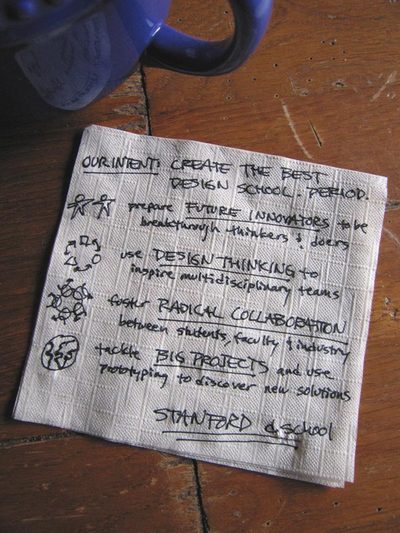
Stanford's new Institute of Design (aka the "d.school")

Ds_manifesto_1

A secret informant slipped me this manifesto from Stanford's new Institute of Design (aka the "d.school"). 

Pass it along to your friends!  Join the design thinking movement!

27 February 2005 | Permalink | Comments (1) | TrackBack (2)

| |

Jolie-Laide, part 4

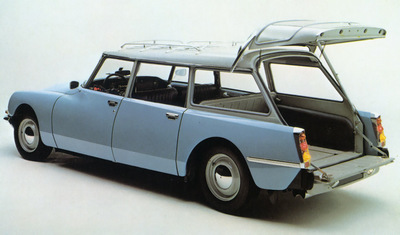
1971_citroen_ds_break
The Citroen ID Break

(why settle for beautiful when you could be interesting?)

24 February 2005 | Permalink | Comments (0) | TrackBack (0)

| |

metacool Thought of the Day

"To me, doing design doesn't mean giving form to a more or less stupid product for a more or less sophisticated industry.  Design for me is a way of discussing life, sociality, politics, food and even design."

- Ettore Sottsass

23 February 2005 | Permalink | Comments (1) | TrackBack (0)

| |

Sound Matters, part 3

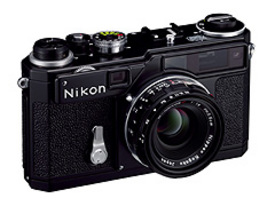
Niksv

Do you care -- really care -- about expressing your brand as best you can?

The people at Nikon really care.  They recently reissued their famed SP 35mm camera from 1957, and it's incredible the length they went to make this new offering look, feel, and even sound like the brand-defining original. 

How incredible?  Well, Nikon engineers used computers to create a sonic "fingerprint" of the original and then fine-tuned the materials of the new SP to make it sound exactly the same.  For example, rather than using modern titanium for the focal plane shutter, they chose to employ rubberized silk -- the way things were circa 1957.  This is an expensive design decision, not to be taken lightly.  Assembly lines for this kind of shutter are way more expensive to run because the fabric precludes a modular, streamlined production flow, and demands a very tricky fine tuning of each unit.  By the way, this is not the sort of thing they teach you at Harvard Business School.  Can you imagine standing up in your next marketing meeting and saying "We're going to go with this production method from the Eisenhower decade because it's the best thing for our brand.  Oh, and it costs a bundle and isn't technically advanced, either."?  It would be tough for me, too.

But it's absolutely the right choice, because it makes the new SP sound right, and that's worth everything here.  Sound really does matter.  How far would you go to make your brand sound the way it needs to sound?

Read Sound Matters & Sound Matters, part 2

thanks to Valentin Sama for the reference

15 February 2005 | Permalink | Comments (7) | TrackBack (0)

| |

Title Inflation: Do it to the hilt!

Seth Godin is blogging about English Cut's bespoke suits.   "In an era where you don't have to wear a suit," says Seth, "a $3,000 suit is nothing but remarkable."

He has a point, but at a time where progressive organizations have dumped formal job titles, and where title inflation runs rampant in those companies where they're still in use, to be truly remarkable one needs to go beyond mere Savile Row tailoring.  No, in this era of the post-modern economy, to be well and truly remarkable demands nothing less than a good old fashioned peerage.  If it's clothes that make the man, it's a royal title which makes The Man.

I'd quite fancy an org chart tag like Consignore Rodriguez. 

Want to be remarkable?  Why not do it to the hilt?

thanks to Alex for the tip

13 February 2005 | Permalink | Comments (0) | TrackBack (0)

| |

Blogging and the Creative Process

I get quite a few questions that go something like this: "How does a busy fellow like you find the time to blog?"

To which I answer,  "Blogito ergo sum" -- "I blog therefore I am (creative)". 

I try to make blogging an integral part of my creative process.  I find it a great way to slosh thoughts across the right and left sides of my brain and, on occasion, come up with something interesting.  This humble blog of mine is a sandbox, a place for creating quick idea probes which I launch on a whim.  Blogging is a nice way to be fast, cheap and out of control.

It does take time, but a lot less than you might think.  Along with flying planes and racing cars, being a writer was something I aspired to even as young boy.  Actually, books, writing, and literature have always played a more central role in my life than even cars (and if you know me, that's really saying something).  However, though I wanted to be a writer, I never thought I had the time to be a good writer.  But while perusing William Gibson's blog early last year, I came to understand why it might be worthwhile to start doing even a little bit of writing here and there.  And how little time it might take.  Says Gibson:

I suspect I have spent just about exactly as much time actually writing as the average person my age has spent watching television, and that, as much as anything, may be the real secret here.

That's a remarkable thought, isn't it?  And so I took Gibson's word for it and started writing this blog.  I don't know what I dropped in my schedule to make it happen, for I wasn't a big watcher of TV, nor did I feel like I had oodles of empty time sitting around waiting to be used.  But still, I find the time and by finding it, I make the time.

I honestly believe that blogging has made me more creative, if creativity can be defined the ability to see patterns and make connections.  Forcing myself to write on an almost daily basis about foggy topics has been like an injection of neural lube for my design-thinking brain cells.  I may not actually be creative, but for sure my fingers are more limber and thoughts flow more easily through to full expression -- much as they did musically back when I used to play my saxophone at least three hours a day.

Perhaps blogging is a perfect form of structured procrastination, a term coined by Stanford professor John Perry.  Structured procrastination, Perry says, is a way to ".. be motivated to do difficult, timely and important tasks, as long as these tasks are a way of not doing something more important."  Think about that.  Instead of procrastinating and not getting anything done, why not procrastinate as a way to get some other cool stuff done while you're mustering the will to tackle that big gnarly thing slouched over in the corner?  Per Perry's definition, blogging certainly qualifies as difficult, and if you believe that at least one soul, somewhere, somehow is hoping that you'll post something soon, well, then you've got the timely and important part there, too.

Blogging isn't the most important or urgent or important/urgent thing I do.  Far from it. But it is a way of getting to good stuff that makes the really important stuff I do work better. 
11 February 2005 | Permalink | Comments (2) | TrackBack (0)

| |

Unabashed Gearhead Gnarlyness

The Yamaha Chivicker  

03 February 2005 | Permalink | Comments (0) | TrackBack (0)

| |

Five alternatives to a keyboard

Menu_2003_o_1_1
Some Sony designers have come up with five prototypes showing alternatives to the standard keyboard/mouse computer interface.

I find the Gummi-Bend concept particularly compelling.  With commercially viable flexible electronic "paper" right around the corner, Gummi shows how this technology could be used to help people get more out of maps.  Having recently spent four days tromping around Manhattan with only one, fixed-scale map in my pocket, Gummi would have been very useful.  It looks like a lot of fun to use, too.  And when it comes to designing interfaces, pleasure matters.

19 January 2005 | Permalink | Comments (0) | TrackBack (0)

| |

A Brand in a Starter Button

All of a sudden, Aston Martin is the "It" brand of the automotive world.  To be sure, the Aston Martin of the 70's, 80's and 90's had a certain cachet, but it was a cigar-smoke-and-over-stuffed-leather-chairs-British-men's-club kind of cachet.  No more.  Now Aston Martin is sexier than Ferrari, sportier than Porsche, manlier than Lamborghini.  The new DB9 is the first modern GT car design of the 21st century. 

This is a true brand renaissance, brought about not by the machinations of a branding firm or an advertising agency, but via  a product development team that reached back to the golden days of Roy Salvadori and James Bond, distilled the essence of Aston Martin into something actionable, and then went to work. 

Easy for me to say, but what does it mean, and how did they do it?  They did it by taking something as familiar as the process of starting the motor and asking "What could be uniquely Aston Martin about this experience?"  Here's what Aston Martin designer Sarah Maynard says about the start button on the new DB9:

It seemed wrong to us that most car starter buttons - the first point of contact between driver and engine - is a plastic button. We wanted something better so decided on crystal-like glass. The Aston Martin logo is sand etched into it. It's lit red when the ignition is on, and afterwards changes to light blue. I think it's a really cool piece of design.

Glass.  Etching.  Not the usual way of doing business.  More expensive than plastic.  But special, and evocative of the way British cars used to be.  And incredibly good for the Aston Martin brand, and perhaps even a good reason to spend so much on a car.  This is great example of decisions made using not the data of a cost accountant, but with the judgment and deep experience of a trained designer who lives and feels and loves brand.

12 January 2005 | Permalink | Comments (2) | TrackBack (0)

| |

Unabashed Gearhead Gnarlyness

The Wally 118 wallypower

read more about the 118

10 January 2005 | Permalink | Comments (0) | TrackBack (0)

| |

Bob Lutz in the FastLane Blog

Stop the presses!

Bob Lutz (aka The Man) is blogging up a storm over at FastLane Blog. 

So far as I can tell, the content (if not the typing) really does come from Lutz, not from some junior MBA over at GM.  And as one would expect from the premier product guy of the Known Universe, his blog, though young, already contains many tasty bits, such as this thought about Saturn:

What would you do if you had a brand whose customer service  reputation was that high for that long despite having a narrow, aging product lineup? I, for one, would first get down on my knees and thank the Maker for the finest retail network in the industry. Then, I would set to work replenishing the product portfolio.

And this one on design thinking:

The creative process is not, nor will it ever be, “scientific.” You cannot start with quantitative research to find the “big idea.” Whether it’s cars or movies or clothes, a company needs inspired, free-ranging discussion among its top creative people.

Beyond the massive wisdom about design, innovation, marketing, and leadership to be found in Mr. Lutz's blog, we also need to celebrate FastLane as a milestone in the history of corporate blogging.  A while ago I praised the actions of Honda CEO Takeo Fukui, and asked the question "What if the CEO knew his products?"  With Lutz raising the ante, maybe the right question to ask now is "What if the CEO could write a believable blog about his products?"

Bob Lutz blogging?  This bodes well for the future of mankind.

09 January 2005 | Permalink | Comments (0) | TrackBack (0)

| |

Green Eye for the Conventional Guy

Green Eye for the Conventional Guy

Let's face it: as a society we're never going to have our environmental act together 100%.  So instead of waiting for that magic day when everthing goes cradle-to-cradle, why not start making better purchase decisions today?

For example, I'm going to make a personal eco-babystep by finding a way to reduce the quantity of paper cups and plastic lids I use from Peet's.  And while I'm there I'll ask for a fillup with Fair Trade brew.

05 January 2005 | Permalink | Comments (0) | TrackBack (0)

| |

Tsunami Overview

The New York Times has designed an excellent overview of the physics, timeline, and impact on humanity of the tsunami.  More than any report I've read in the paper or seen on television, this multidisciplinary piece of design work makes me feel and understand what has happened there. 

In some sense it's shallow to crow about the power of integrative, design-led thinking in the context of such a disaster.  On the other hand, perhaps our future ability to reduce the damage from this type of disaster will be realized using just this sort of integrative thinking and doing.

link awareness courtesy of Design Observer

02 January 2005 | Permalink | Comments (0) | TrackBack (0)

| |

Cool Books of 2004

Another list.  Here are my favorite reads of 2004. No claims to comprehensiveness or consistency, and not all were published in the past year; just a list of books that made me think different in 2004:

On Intelligence, by Jeff Hawkins:  an elegant book on the nature of intelligence and how the brain works.  The good news for metacool readers is that "real intelligence" is the way that designers think.

The System of the World, by Neil Stephenson: third in the baroque triology, capable of stimulating latent nerdism, and a helluva of a long book, it continues Stephenson's fascinating journey through the origins of modern finance and computing.  I loved every page of it.  Not for everyone, which is refreshing.

The Innovator's Solution, by Clayton Christensen: forget the hype, the content is outstanding.  Clay tested the ideas in this book on my class at Harvard Business School, and yet I still find something fresh and interesting each time I go back to its pages.  The chapters on need-based market segmentation strategies are excellent.

Porsche: Excellence was Expected, by Karl Ludvigsen:  perhaps the best business book of 2004, unfortunately Excellence is marketed as a car book, which will keep it out of the mainstream.  In a world where marketing-led "brand building" is an oxymoron, Ludvigsen shows how Porsche built a brand with deep integrity piece by piece, slowly evolving it over time.  His discussion of the genesis of the Porsche Cayenne SUV also shows how quickly a brand can be diluted and maimed by managers out to make a quick buck.

Orbiting the Giant Hairball, by Gordon MacKenzie:  any book recommended by both Richard Tait and Bob Sutton (both proponents of humane business practices, and really good guys themselves) has to be good, and Hairball delivers.  Look, any organization will have its problems, and those problems can seem particularly nasty when seen from the inside.  The real question is: do you care enough about those problems do something about them?  Hairball is a guide to engaging with an organization to help solve its problems without losing your soul.  It also contains some great advice about dealing with nasty behaviors in the workplace, including teasing, which has run rampant in every org I've ever worked in.

Emotional Design, by Donald Norman:  if you haven't noticed, I'm quite taken by this wonderful piece of thinking.  His Visceral-Behavioral-Reflective model of human cognition is a powerful way to understand slippery concepts like brand and meaning, making this one of the most important books on marketing (where marketing is the process of understanding human needs and creating offerings to meet those needs) to come out in years.  His message about beautiful things working better is important, too.  Read this one.

30 December 2004 | Permalink | Comments (0) | TrackBack (0)

| |

Designing Adidas, Designing Zissou

Wes Anderson designs every element of his movies.  While most motion pictures are staged sets overlaid with a thin veneer of reality, Anderson's movies are true portraits of alternate realities where every detail is premeditated.  In The Royal Tenenbaums, for example, he needed to film the Tenenbaums in a home-like setting, so he went out and converted a grand old New York house into a functioning movie set.  The Real Deal.  Part of the pleasure watching an Anderson movie is picking out all the interesting stuff on screen -- he has an eye for interesting designs. 

That's why I'm so stoked to see The Life Aquatic with Steve Zissou.  It looks to be full of cool stuff from the golden age of Cousteau.

10jan04 Zissou Update:  for those of you trying to find Team Zissou Adidas shoes, they don't exist.  But they might soon if you bug Adidas enough.  Go to Josh Rubin's blog to send them an email, or sign Reuel Alvarez's online petition.  Customer evangelism, indeed!

21 December 2004 | Permalink | Comments (3) | TrackBack (1)

| |

What will it be like in motion?

A while back I argued that the temporal aspects of design often get ignored by designers.  Most designers, I'd wager, don't think about how their design will look in a year, let along five or ten.  Similarly, many don't think about what their design will look like during use -- what will it be like in motion?

There are exceptions.  Good software designers obsess over this question.  After all, the quality of a user interface is dictated in no small part by the way in which it helps a user move through a single task, and then from one task to another.  Spend any amount of time designing a software interface, such as a website, and you'll become very sensitized to how your solution works when it is in motion.

In my opinion, not many designers of physical products think about their product in motion, but they should.  Most products get designed on a piece of paper or on a screen, so it becomes easy and normal to think of them as Platonic forms existing on a still life of white or black.  But when designers do take into account motion, cool things can happen.  For example, some cars that seem ugly sitting in the driveway become objects of beauty when seen carving their way up a curvy, mountain road.  A knife can have a more or less appealing form, but its true beauty comes with use.

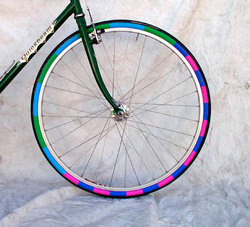
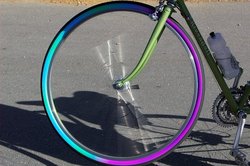
So what would happen if we thought of all designs in terms of movement?  Grant Petersen of Rivendell Bicycle Works (the most vibrant, real brand on the planet, in my opinion) took that idea and came up with a patented innovation, the SpeedBlend bike tire:

10054

The colors on the SpeedBlend tire sidewall are interesting when seen standing still, but come alive when spun -- which takes Petersen's design from just another eccentric bike tire to something more about magic and fun:

Fa1g3679

20 December 2004 | Permalink | Comments (0) | TrackBack (1)

| |

Design for Free Culture

In early November I attended the pod casting discussion at BloggerCon.  Toward the end of the pod casting session, Larry Lessig pointed out that it would be great if technologists driving the design of podcasting software could do it in such a way as to make the entire domain of pod casting hard for would-be naysayers to grok.  Essentially, his point was that technology creators and facilitators should think about the larger societal context in which pod-casting operates in order to keep the copyright fun sponges out of the picture. 

Too often designers and technologists completely avoid asking the question "Who will expend energy actively blocking this innovation of mine?".  It would be a great thing if that question started getting asked with more frequency.  Even better would be to involve legal types in the early design phase of a new technology so as to design in barriers to prevent the naysayers from dictating how people should and can use a particular technology innovation.

17 December 2004 | Permalink | Comments (0) | TrackBack (1)

| |

Unabashed Gearhead Gnarlyness

The 2005 Aston Martin DBR9

15 December 2004 | Permalink | Comments (0) | TrackBack (0)

| |

Choose Happiness

"Any person or nation can grow fatter and fatter, richer and richer, sleepwalking toward disaster. Or we can choose to remain lean and quick, wealthy in beauty and time  and, that word that inspired our forefathers, wealthy in happiness."
-- Yvon Chouinard & Nora Gallagher

Get Chouinard's complete ChangeThis manifesto here: Download 10.02.DontBuyThisShirt.pdf .

13 December 2004 | Permalink | Comments (0) | TrackBack (0)

| |

metacool Thought of the Day

Cont7_1

"I never knew I was going to get to the result until I got there." -- Pablo Pardo

09 December 2004 | Permalink | Comments (0) | TrackBack (0)

| |

Pagani, Successful Automotive Startup

I was fortunate enough to spend an afternoon hanging around the Pagani factory a couple of years ago.  Actually, to call Pagani's facility an automobile factory is quite misleading, as the term conjures up visions of dirty wrenches, flying sparks, and piles of sheetmetal.  If anything, the Pagani factory resembles an Intel chip fab -- clean, quiet, and orderly.  And the cars produced inside are exquisite.

Located a short drive outside of Bologna, Pagani sits but a stone's throw from the headquarters of Ferrari and Lamborghini -- part of the high performance internal combustion industry cluster that's existed in Emilia-Romagna since the 1920's.  The factory is very compact and sits, almost invisible, in a quiet suburban neighborhood.  It is divided into three main areas, each sitting side-by-side: a carbon fiber fabrication area with several autoclaves, an assembly area (big enough to fit three cars on jack stands) and an entrance lobby/museum.  The design offices sit above the museum, and the entire facility oozes quality and attention to detail, as do the fabulous cars that roll out the front door.  For example, most Pagani owners choose to have their car painted, but one car being assembled during my tour had been left in its natural carbon fiber finish.  Why?  Because the carbon fiber layup at Pagani is done with care and workmanship worthy of fine jewelry; every adjoining weave pattern met up with its neighbor with the unwavering precision of a Savile Row pinstripe.  Simply gorgeous, technically superb, utterly and completely to the hilt:

How to the hilt?  Well, when you order a Pagani Zonda, you also receive, at no additional cost, a pair of achingly beautiful leather shoes crafted in Bologna out of the same custom leather used to cover the interior of your car.

Amazingly, Horacio Pagani has been able to buck the odds (I reckon the last successful automotive startups were Honda and Ferrari, and those started in the unusual economic circumstances of the aftermath of WWII) to create a real, going automotive concern not unlike the famed atelier of Ettore Bugatti.  Conventional wisdom tells us that it's impossible to start a new car company.  Perhaps.  But Horacio Pagani built his venture in a smart, calculated way not unlike that of Burt Rutan at Scaled Composites: first, he paid his dues (learned the trade at Lamborghini) to pick up tacit knowledge, then started a composites fabrication business to get some cash flow and create option value.  Only once those steps were successful did he begin making cars with the passion of someone doing what he truly loves. 

Pagani is a great example of designing a venture and building it via an iterative process.

01 December 2004 | Permalink | Comments (0) | TrackBack (0)

| |

Unabashed Gearhead Gnarliness

The 2005 Ducati 999R
to my new friends at Ducati North America, all I can say is, "You guys rock!"  Forza Ducati!

29 November 2004 | Permalink | Comments (0) | TrackBack (2)

| |

Sixten Sason, Brand Creator

Swedish designer Sixten Sason was the man responsible for creating the aesthetics of of the Hasselblad camera in the late 1940's, a design so compelling that today it defines not just a product but an entire brand:

501cms_1

A remarkably prolific and flexible designer, Sason also drove the aesthetic design of Saab automobiles up through the 1960's.  The unique design language he coined lived on into the early 90's before GM bought Saab and lost the trace.  He started it all off with this iconic piece of work, the 1949 Saab 92001, which pretty much says all you need to know about what Saab-ness is:

Saab20001_1

Where do brands come from?  What we call "brand" is the sum of all the decisions you make to shape a user's experience of your offerings.  Brands are designed and built layer by layer over time.  As I've written before, your brand does not define the character of your offerings. Instead, your offerings (and the layers of sales, service, support, and meaning creation surrounding them) define your brand.

Want a strong, vibrant brand?  Make “brand building” the job of your product development group and your brand team.  If you still need convincing, just think about the incredible amount of brand equity created by Sixten Sason over the course of his career at Hasselblad and Saab, and how quickly Saab lost it once his influence was gone. 

28 November 2004 | Permalink | Comments (1) | TrackBack (0)

| |

10x10

10x10

Frequency

Color

Pattern

Gesture

Ranking

Form

History

10x10 is a good example of how innovations in interface design can take us beyond accepted communication norms such as the newspaper headline.  And it demonstrates the potential of RSS feeds very well.

I can think of several examples where a 10x10-type interface would open up new possibilities for insight and understanding:

  • An email inbox
  • A 360 degree performance review report
  • The seat assignment screen on United's self-serve check in kiosks
  • An accounts receivable aging report

Can you think of others?  Drop me a line or leave a comment below.

18 November 2004 | Permalink | Comments (2) | TrackBack (0)

| |

Simplicity of Use

A second (see prior discussion here) way to explore the future of the sports car is via the concept of simplicity of use. 

Simplicity of use involves creating an offering experience accessible by non-expert users. As the Stanford historian Joe Corn notes, one hundred years ago the car was an ornery beast, and its “users” had to bring their own “IT department” along in the form of a riding mechanic or chauffeur.  In the intervening years, automobile designers have added layers of technology between the driver and the base mechanicals so that the overall use experience became less complex; mechanical and electrical complexity went up, but experiential complexity dropped.  For example, these days it’s possible to maneuver a bling-bling three-ton Cadillac Escalade with no more than your right foot, index finger and thumb – all due to the miracles of integrated circuits, advanced hydraulics, and servo motors.  The trick in designing sports cars is to achieve simplicity of use without adding weight – the source of the wide experiential gulf between a 2005 Porsche 911 and its 40-year-old great-grandfather, the 356C.

Perhaps the best example of simplicity of use in the sports car realm was the first-generation Mazda Miata.  The MG TC may have been fun to drive because of agricultural directness, but keeping it on the road required a high level of mechanical skill, or at least a good relationship with a mechanic named Nigel.  In terms of reliability, the 356 was much better, but only so far as contemporary state of the art would allow: park one in your garage, and your living room will soon reek of Shell’s finest!  The Miata raised the standard of simplicity for the sports car ownership experience by adding a layer of sophisticated Japanese engineering between motor and driver to make everything as reliable and bulletproof, yet lightweight, as possible.  Want a motor that only really gets broken in around the 100,000-mile mark?  Check.  No more oil leaks?  Check.  A top that keeps the rain out?  Check.  All with delicious handling?  Check.  If that isn’t simplicity of use, I don’t know what is.  The magic of the Miata is that the sophistication was engineered in without creating a lardy car. 

Simplicity of use and simplicity of specification must inform the point of view for the sports car of the future. That car is many ways already here: the Lotus Elise, which employs an elegant aluminum chassis, simple plastic body panels, a reliable Toyota four-cylinder motor, and lots of lightness to create the delicious feel of a MG TC or 356, only better.

17 November 2004 | Permalink | Comments (0) | TrackBack (0)

| |

metacool Thought of the Day

"If you are a marketer who doesn't know how to invent, design, influence, adapt, and ultimately discard products, then you're no longer a marketer.  You're deadwood."

- Seth Godin

16 November 2004 | Permalink | Comments (0) | TrackBack (0)

| |

Retro Design the Right Way: the 2005 Ford Mustang

This week the New York Times talks about the intensely emotional reaction people are having to the new Mustang.  While the 2005 Mustang doesn't deliver innovation at the Behavioral level of design (it still has a live rear axle -- so 1960's, eh?), it is a sublime mix of Visceral and Reflective design.  Viscerally, the shape is compelling in and of itself (love those tailights); Reflectively, it says "I'm a Mustang and you can project all the good things you know and feel about Mustangs on to me."  It's a great example of the product marketing itself -- meaning is embedded into every curve, rather than being forced on the design via a copywriter's slogan.

Retro design has its critics, but as evidenced by the overwhelmingly positive reaction to its new Mustang and GT designs, Ford is striking a decent balance between something new and something old.  Better than Chrysler and its PT Cruiser, as good as VW and the New Beetle.  Not quite as brilliant as the BMW Mini.

PS:  If you're asking "Why so many cars on this blog?", here's my answer.

13 November 2004 | Permalink | Comments (0) | TrackBack (0)

| |

Simplicity of Specification

Simplicity provides a good frame for yet another answer to the question “Will sports cars die?”  As I stated earlier, a better question is “What form will the sports car take?”, and simplicity, expressed two ways, also provides answers.

The first answer comes from the idea of simplicity of specification.  The MG TC, which introduced the sports car idea virus to the United States, was an incredibly simple machine, almost to the point of being crude and agricultural.  Four cylinders, ladder frame, cycle fenders, and little to no weather protection, it was an elemental design.  But its very simplicity created its value: next to the average American lead sled, the MG TC was light and nimble and immersed its pilot in an intensely visceral driving experience: wind, noise, oil everywhere, steering kickback, blatting exhaust. 

Joining the MG TC in the ranks of all-time great sports cars is the Porsche 356, also a machine of simple specification, a far cry from lardy descendants such as the Porsche Cayenne.  A sophisticated design for its epoch, the 356 was derived from one of the simplest of cars, the VW Beetle.  The 356 provided a drive with more protection from the elements than did the MG TC, but still made him a full participant in the process of getting down the road.  356Even today, to drive a 356 is to experience a car as almost a living, breathing animal. To illustrate how compelling the 356 driving experience is, I have several friends who own both a modern Porsche 911 and a 40- to 50-year-old 356.  These are cars separated by 1000+ pounds of curb weight, as well as by two extra cylinders and 200 horsepower.  But to a person, they prefer the 356.  Simply put, its Visceral-Behavioral-Reflective signature hits the enthusiast driver’s sweet spot. 

Both the MG TC and 356 were simple machines, even for their time. Where they excelled was in the sense of lightness that comes with a simple (but elegantly executed) mechanical specification, resulting in a direct, stimulating driving experience.  From a pure feel point of view, there’s no substitute for “adding lightness” to a car.  Heavy designs can be made to handle well – and elephants can be taught to dance – but if you want to float like a butterfly, why not start with a butterfly? Significantly, neither car was about heaps of horsepower.  Both, in fact, were rather slow relative to contemporary family sedans.  There’s a lesson here for designers of future sports cars: as I’ve noted earlier on this blog, the automotive world is in a wild upward spiral of horsepower; it’s a place where a $32,000 Subaru can give a $70,000 Porsche a run for its money.  Within a few years, any marque, be it Ford or Ferrari, will be able to deliver a reliable, 600 horsepower street car, and at that point, the only way to create a truly differentiated driving experience will be via feel.  And the best way to create good feel is by designing around a simple, even spartan, point of view. 

As such, the Porsche 356 is the template for future sports cars. 

I’ll discuss the second expression of simplicity later this week.

12 November 2004 | Permalink | Comments (0) | TrackBack (0)

| |

Unabashed Gearhead Gnarlyness

The Ducati PaulSmart 1000

09 November 2004 | Permalink | Comments (0) | TrackBack (0)

| |

James Dyson on Alec Issigonis

CNN is running a nice piece on Alec Issigonis, father of the (original) Mini.  What's notable about this brief bio is its author, James Dyson, father of the eponymous vacuum that never loses suction.

Issigonis was a genius on many levels.  As Dyson notes, the father of the Mini was nothing if not elegant in both his design solutions and his structured approach to problem solving:

Sir Alec Issigonis... came up with his ingenious idea while sipping on a gin in a hotel in Cannes -- a very civilized approach to engineering.

If this article is indeed written by Dyson and not some pathetic PR flak, it poses an interesting question: why not have real, working designers write the history of design?  Why leave it up to non-pracitioners who don't know really understand the design process?  I'd like to see more designers follow Dyson's lead.  Gin or no gin.

08 November 2004 | Permalink | Comments (1) | TrackBack (1)

| |

metacool Thought of the Day

Eamesstuhl

"We used to bring a piece of furniture we were working on home to look at it, because at the office everything was out of scale."  - Ray Eames

[You've got to get out and see how your offerings work in context.  Needs are verbs, and your end users probably don't speak the same language you do.  Get out and see, hear, listen.]


06 November 2004 | Permalink | Comments (2) | TrackBack (0)

| |

Apple, could you design a simple voting process for us?

Ivotedstars_1What's that sound? Oh, it's just my hand patting myself on the back.

But seriously, folks, I just voted, and what I saw, heard and experienced scared the bejeezus out of me. I'm talking about the electronic, touchscreen voting booth which I just used to decide the fate of the planet. So many aspects of the design sucked, it's hard to know where to start. Here are the problems I had:

1) I was issued a magnetic card "key" to allow me to use the voting machine. It fit into a slot on the front of the voting machine. I expected the machine to grab the card upon insertion and pull it in, much like an ATM machine would (as a society, we've been trained to have cards sucked in). But it didn't. My card just sat there, limp and inert. Finally, my inner mechanical engineer spoke up and I rammed the card home. Bling bling! The touch screen awoke and I could now do my civic duty.

2) Each screen had two or more votable items displayed at a time, which a big yellow "next screen" arrow in the lower right. Thing is, I was able to press the yellow arrow and skip a votable item without the system giving me any feedback that I had skipped an item. Folks, the self-serve kiosks at United Airlines work better than this. Lucky for me I'm a software industry veteran and was able to go back a page. But what if I was an "analog", part of the population who has never used a computer, let alone a web browser-style interface? What if, for example, I was an 80+ year-old woman wearing those big wraparound sunglasses and trying to vote with this damned thing?

And there she was: next to me an elderly woman sat there trying to stick her card in for about 45 seconds. She muttered and cursed and finally called an attendant for help.

Then there was the elderly gentleman on the other side of me. He stood there motionless the entire time I was voting, and then asked the attendant for help. Seems he couldn't find his candidate on the touchscreen (video monitors are hard to read -- we read better on paper). It took a while for the local "IT department" to sort of his problem. The answer? The poor guy was trying to vote for "Laura Magenta", one of the sample candidates from the paper instructions he had in his hand. It wasn't his fault. Just a stupid, poorly-conceived and implemented voting process.

God help this country of mine. Or better yet, get Steve Jobs and crew to design a simple, effective voting process for us.

02 November 2004 | Permalink | Comments (0) | TrackBack (1)

| |

Unabashed Gearhead Gnarlyness

Imaged58e9f07fe9d11d8

1964 Ferrari 250LM

29 October 2004 | Permalink | TrackBack (0)

| |

It's Cool to be Keen

Keen shoes have tipped. In a repeat of the Doc Martens phenomenon of the late 80's, we're going to start seeing them everywhere, on everyone. The thing about a pair of Keen shoes is that you can't help but notice them when they stroll by -- their designers took a risk and added a big old ugly toe-protecting bumper to the front of the tried-and-true Teva, and came up with something which screams "Look! I'm different and kind of cool." That toe bumper may be ugly, but it represents Keen's entire "brand", and no amount of money thrown away on awareness building could come even close to the word of mouth (message of foot?) buzz generated by this aesthetic oddity. Now, I'm a TiVo guy, so I don't watch many commercials, but to the best of my knowledge Keen doesn't spend anything on advertising. I saw my first pair at REI, then I saw another set on the toes of a friend... and... and I had to have a pair.

The lesson here is to build your marketing into your offering. Make something great, something interesting, and make sure that you design that offering such that private usage is made unavoidably public.

Keen. All the cool kids are wearing them.

26 October 2004 | Permalink | Comments (8) | TrackBack (0)

| |

Visceral, Behavioral, Reflective: Understanding Cool

In this brief essay on the 1939 Mercury, Donald Norman shows how powerful his Visceral, Behavioral, Reflective model is as a tool to understand designed objects (especially cool ones). 

24 October 2004 | Permalink | Comments (0) | TrackBack (0)

| |

metacool Thought of the Day

“Research should be defined as doing something where half of the people think it’s impossible – impossible!  And half of them think hmmmmm, maybe that will work, right?  When there’s ever a breakthrough, a true breakthrough, you can go back and find a time period when the consensus was, ‘Well, that’s nonsense.’  So what that means is that a true, creative researcher has to have confidence in nonsense.”

– Burt Rutan

18 October 2004 | Permalink | Comments (0) | TrackBack (0)

| |

Mis Zapatos de Batman

Zapatobatman3
© Valentin Sama  (taken with a 1936 Leica)

Photographer, teacher, writer, and raconteur extraordinaire Valentin Sama has a cool new blog.  It’s concerned with all aspects of photography, from tools to techniques to philosophy.

It’s also full of beautiful photos like the one above (“My Batman Shoes”).

CYA Notice No. 658 from the metacool legal team:  Sama is my uncle
CYA Notice No. 659 from the metacool legal team: Your experience may vary, but Sama’s blog works best if you read it in Spanish.

14 October 2004 | Permalink | Comments (4) | TrackBack (0)

| |

metacool Thought of the Day

"We try to evolve and evolve a product until the inevitability of it almost appears undesigned."
- Jonathan Ive

12 October 2004 | Permalink | Comments (0) | TrackBack (0)

| |

« Previous | Next »

Categories

  • designing
  • innovating
  • leading
  • marketing
  • meta metacool

search


About

Subscribe to this blog's feed

    follow me on Twitter

    Favorite Posts

    • A million reasons why...
    • Mo Cheeks and a fundamental question of leadership
    • Innovation Lessons from Garage Majal
    • From Obama to Pink to Oprah
    • Shinya Kimura and the primacy of doing
    • A tribute to friends and friendship
    • Strategy that makes your hands bleed
    • Quality in a switch
    • Travis Pastrana and the future of the world economy

    on the nightstand

    • : The Great Bridge

      The Great Bridge

    • : Porsche - Origin of the Species

      Porsche - Origin of the Species

    Principles for Innovating

    • 1: Experience the world instead of talking about experiencing the world
    • 2: See and hear with the mind of a child
    • 3: Always ask: "How do we want people to feel after they experience this?"
    • 4: Prototype as if you are right. Listen as if you are wrong.
    • 5: Anything can be prototyped. You can prototype with anything.
    • 6: Live life at the intersection
    • 7: Develop a taste for the many flavors of innovation
    • 8: Most new ideas aren't
    • 9: Killing good ideas is a good idea
    • 10: Baby steps often lead to big leaps
    • 11: Everyone needs time to innovate
    • 12: Instead of managing, try cultivating
    • 13: Do everything right, and you'll still fail
    • 14: Failure sucks, but instructs
    • 15: Celebrate errors of commission. Stamp out errors of omission.
    • 16: Grok the gestalt of teams
    • 17. It's not the years, it's the mileage
    • 18: Learn to orbit the hairball
    • 19: Have a point of view
    • 20: Be remarkable

    CC

    • Creative Commons License