metacool

thoughts on the art & science of bringing cool stuff to life, by Diego Rodriguez

Unabashed Gearhead Gnarlyness

Sr2_atl_wdog

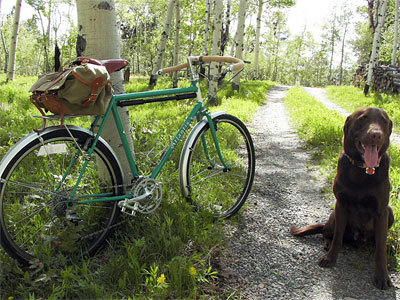
The Rivendell Atlantis
from the Rivendell website:

"Form follows function" works for nature, but too often with people, it's used as an excuse to rush to market something that's fully functional but still not so good looking.  (Have you noticed that old things usually look good? Manhole covers, typewriters, '50s station wagons, chairs, hand-saw handles, buildings, bells, letter openers, kitchen appliances, almost anything.  They were designed slowly, on a real drawing board, by people who were part industrial designer, part artist, part engineer.  When you mix those qualities with manual involvement and patience, what finally hatches usually looks good.)"

15 December 2005 | Permalink | Comments (0) | TrackBack (0)

| |

Studio 360

Here's something I hadn't heard before:  Studio 360 Design for the Real World

A nice bento box of audio insights.

12 December 2005 | Permalink | Comments (0) | TrackBack (0)

| |

metacool Thought of the Day

"My inspiration comes from my childhood. I have a theory: As a child, you do a lot of things, you soak in the most; 20 or 30 years later you are in a position where you can make these things that you dreamed of or thought of back when you were a kid. You can make them happen. The color turquoise became very fashionable when the iMac came out. The designer who designed it was 35, my age then.  I remember that turquoise was all over when I was 9 or 10. It was a color from my childhood. Orange was a color of my childhood. The minimalism from the 60s came back. The 80's are coming back in the work of the younger guys."

- Markus Diebel

08 December 2005 | Permalink | Comments (0) | TrackBack (0)

| |

Never Mind the Nano, Here's the Zepto

A while back I mused that "Nano is the new Turbo".

I was wrong:  Zepto is the new Nano.

My wish for 2006 is that some marketer, somewhere, brands something "Zepto", and that a competitor quickly ups the ante to "Yocto".  I really want to own something called "Yocto".  Yocto Yocto Yocto

07 December 2005 | Permalink | Comments (2) | TrackBack (0)

| |

India Times on the d.school

Here's an article about the Hasso Plattner Institute of Design at Stanford (a.k.a. "the d.school) from the India Times.

Though it quickly ventures off into a discussion about more traditional approaches to design education, I like the article because of what it represents:  it's very much an example of Thomas Friedman's belief that ever-increasing flatness will, and it's also about the emergence of Dan Pink's view that R-directed thinking will be what enables one makes a good living in the 21st century.

Most of all, it affirms my belief that the d.school isn't so much a place as a state of mind.

06 December 2005 | Permalink | Comments (0) | TrackBack (0)

| |

By any other word would smell as sweet?

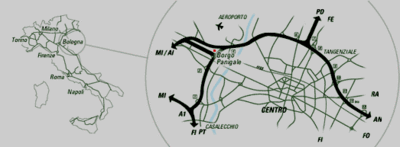
Mappa_air_1

Following my post last week about the meaning of Ducati, here's some breaking news on Ducati: a majority stake has been sold by Texas Pacific Group (an American firm) to Investindustrial Holdings (an Italian firm). 

What's interesting about this from a meaning point of view is that Ducati is now owned by an Italian corporate entity, rather than by an American corporate entity.  Does it matter that the firm is now in Italian hands?  On the one hand, Ducati has certainly thrived for the past decade under American ownership.  On the other, the Ducatisti seem to think so -- they're already saying something along the lines of "Finally, Ducati is Italian".

I'm not so sure the nationality of ownership really matters to the meaning of a very nationality-centric brand like Ducati, so long as its deep roots in Borgo Panigale continue to be celebrated.  Mini, the quintessential British car, is owned and produced by a very Bavarian company called BMW.  Nor do I think it's really important where the nationality-centric object gets made.  For example, the BMW M Coupe, perhaps the most radical expression of BMW brand values ever produced, was made in the United States.  But critically, it was designed in Germany, by German Engineers.

So what matters?  I think what matters is that the people designing the offering really "get" -- and have control over -- all the tacit cultural markers that end up embedded in any designed object.  To the extent that one needs to live in a culture to really understand it, designers should probably live there if they are engaged in creating offerings that are largely differentiated on the basis of meaning, rather than functionality.

What do you think?

04 December 2005 | Permalink | Comments (2) | TrackBack (0)

| |

The marketer as design thinker

As usual, Seth and I are in violent agreement.  Substitute "design thinker" for "architect", and you've got the blueprint for the stuff that creates good, generative marketing: Great Marketers are Architects

30 November 2005 | Permalink | Comments (0) | TrackBack (0)

| |

Ducati at the d.school

I_03_1024

Yesterday in the class I teach at the Hasso Plattner Institute of Design at Stanford (aka "the d.school") we had a fascinating discussion about how Ducati creates meaning in the marketplace.  The starting point for the discussion is a Harvard Business School case by Giovanni Gavetti which asks the question "to cruise, or not to cruise?"  In other words, should Ducati enter the lucrative market for cruiser motorcycles at the risk of diluting an intensely meaningful brand built up over 60 years?

For me, the best part of running this class is the support I get from the folks at Ducati North America and some local owner's clubs.  Not only did we have a wide variety of Ducati motorcycles on display for the class, we also had the pleasure of having Ducati North America CEO Michael Lock provide us with his thoughts and insights about the process of creating and celebrating meaning.  If the measure of a good teaching experience is the learning you glean from the process, then for me this session was a bumper crop.

And the roar of those Desmos wasn't half bad, either! 

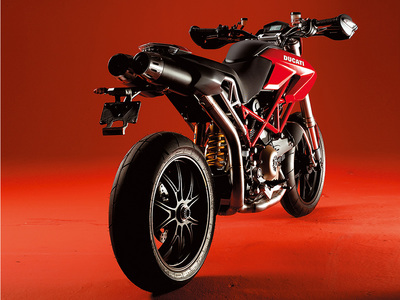
Here's hoping that the new Ducati Hypermotard concept (above) makes it to market.  It's a stunning, gutsy, and... wow!

29 November 2005 | Permalink | Comments (1) | TrackBack (0)

| |

Hackathoninnovation

Here's a cool idea:  hold an eight-hour hackathon for your offering or business.  Get a lot done.  Innovate.  Hackathoninnovation, in other words.

The people over at FeedBurner did this recently, and got a whole bunch of stuff done.  Sure, this is easier done if your offering is a piece of web software, but I'd argue that the spirit of a hackathon can be applied to everything from your corner Dairy Queen to the Pentagon.  It's the innovation equivalent of working an extra weekend shift on the manufacturing line to get it cleared of WIP.  It's all about turning off the WiFi, switching off Outlook, closing the meeting calendar, and getting stuff done.  It's about really focusing on the important stuff, rather than on the urgent or routine.

Racers get the idea of a hackathoninnovation -- they have to do it all the time.

What could you hack today?

17 November 2005 | Permalink | Comments (0) | TrackBack (0)

| |

Happiness & Innovative Behavior: Send Help!

I'm starting to write another column for BusinessWeek Online, this time on something around the subject of happiness and innovative behavior.

I need your help. 

What are your thoughts on this subject?  What stories do you have for or against?  Please comment below or drop me a line.

Many thanks.  Mahalo.

15 November 2005 | Permalink | Comments (11) | TrackBack (1)

| |

Complementary Products

It's always interesting to see the kinds of complementary products that spring up and form the ecosystem around successful offerings such as the iPod Shuffle. 

Here's one you probably didn't expect:  iBelieve

13 November 2005 | Permalink | Comments (0) | TrackBack (0)

| |

metacool Thought of the Day

"For the longest time ideation was about throwing out as many ideas as you can.  We've realized pretty quickly that it's really not about a bunch of ideas, it's about really good strategy, alignment and business, diagnostics, and deep customer understanding... the ideas are no longer just about the product, they're about new business models and how you go to market, and what's your supply chain like."

- Sam Lucente

11 November 2005 | Permalink | Comments (1) | TrackBack (0)

| |

You won't make that flight

A few weeks back I posited that the key to being a successful innovator is having the mindset of a racer, which is some mix of foolish optimism, self-confidence, humility, and above all, persistence. 

Here's a fun story of persistence and why you shouldn't believe the naysayers who say it can't be done.

10 November 2005 | Permalink | Comments (1) | TrackBack (0)

| |

Unabashed Gearhead Gnarlyness

1115822459

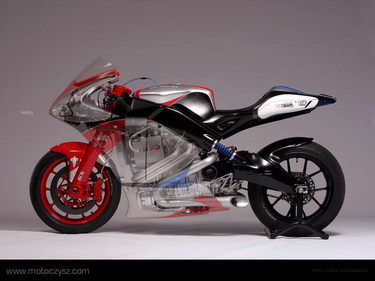
Any startup is hard.  Startups involving internal combustion engines are even more difficult to pull off than the usual venture.  Demanding distribution, sales, service, and support logistics, not to mention the sheer complexity of a modern vehicle, makes a vehicular startup an endeavor for the very brave of heart, the very wealthy, or (hopefully) both.

The Motoczysz company of Portland, Oregon, is working to market the innovative motorcycle shown above.  It's full of innovative mechancial design elements, and the aesthetics ain't bad, either.

Let's wish them luck.

07 November 2005 | Permalink | Comments (0) | TrackBack (0)

| |

VCitis

Now, some of my best friends are in the venture capital industry, but Dave Hornik's creative connection between Narcissistic Personality Disorder, your average VC, and the Diagnostic and Statistical Manual of Mental Disorders is just too funny to pass up:  VCitis

04 November 2005 | Permalink | Comments (3) | TrackBack (0)

| |

When Bad Things Happen to Good Brands

No matter how carefully you design a brand experience for customers, bad things will happen.  Some will simply be beyond your control.  Recent heart bypass surgery recipients will waltz into your store, try to use the restroom, and end up glued to the toilet seat in a lonely stall. 

No, this isn't something out of The Onion:  Man's glued ass spurs lawsuit

The only question is, how far would you be willing to go to rectify this?

03 November 2005 | Permalink | Comments (5) | TrackBack (0)

| |

On Tangible Brand Mantras

Bmw_2002tii_p0022510c

Consider these tidbits:

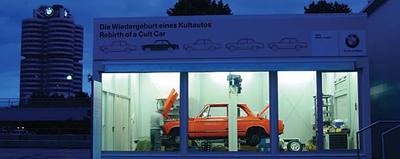
  • BMW is in the process of building a "new" 1972 BMW 2002tii.  It's coming together in a glass-walled area of the BMW museum.  The 2002 is the icon that defined every BMW since (except for those X cars, perhaps).  And it's orange, natch.
  • Audi recently commissioned a "new" 1939 Auto Union D-type Grand Prix racer.  Though the original Auto Union racers were funded by the Nazi propaganda machine, and sported swastikas, the design itself was a highwater mark for German automotive design which flowed from the brain of one Ferdinand Porsche.  All of Audi's design language is rooted in this car.

Why engage in these expensive endeavors?

Well, if a brand is an expression of everything you do in the world, then why not literally build the brand again in front of the world.  These are tangible brand mantras, intensely meaningful.  And probably better at saying "this is our brand" than a written positioning statement ever could be. 

As such, they're priceless.

18nov05 update:  here's a nice overview of the 2002 project, written by Matt Davis (superb as always)

02 November 2005 | Permalink | Comments (1) | TrackBack (2)

| |

More cool blogs

My Cool Stuff blogroll is a dynamic mix of favorites and others which reflect topical areas of interest.

Here are some highly recommended additions:

  • TEDBlog:  TED + Blog = cool
  • Presentation Zen:  Fantastic know-how about being a better presenter, but much more than that, too, such as this post on Wabi-Sabi.
  • english cut:  Everything you want to know about quality.  Period.

01 November 2005 | Permalink | Comments (0) | TrackBack (0)

| |

Venture Design, part 10

The airline Song is dead.  As Seth notes on his blog, Song was a superficial attempt to create a new airline with a new value proposition.  The superficial part was that it was more about the "brand is who we say we are" approach than the much more real "brand is what we do" approach.

The cool part of Seth's post is his insight that this event can be looked upon as a total failure, or as an opportunity to learn.  If you can do the latter, and treat everything as an experiment to be learned from, no matter if the outcome is "good" or "bad", then you're well on your way to a process of creating ventures that starts to look a lot like design thinking.

28 October 2005 | Permalink | Comments (3) | TrackBack (0)

| |

metacool Thought of the Day

"If you have any talent, or any occupation that delights you, do it, and do it to the hilt.  Don't ask why, or what difficulties you may get into."

- Richard Feynman

27 October 2005 | Permalink | Comments (0) | TrackBack (1)

| |

What was I thinking?

My recent column in BusinessWeek Online drove a bunch of feedback my way, most of it very positive. 

Thanks, Mom! 

(just kidding)

While I did get a lot of great feedback, some of it doubted my sincerity.  "Diego, you're the biggest car dude I know, " most of it goes.  "Surely you can't be serious about Saturn?  Don't they suck?  That was all facetious, right?"

My answer is a big, fat "no".  Everything I said in my column was heartfelt.  I really believe in Saturn the brand and in the Saturn Sky.  I think the Saturn Sky is stunning and will provide a wonderful driving experience.  In fact, if Cadillac and Saturn were the two brands of a standalone car company, I'd be first in line to buy stock.

26 October 2005 | Permalink | Comments (0) | TrackBack (0)

| |

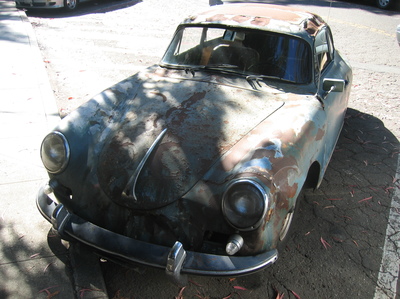
Beausage?

Img_6841
Is this beausage?

No.  Beausage is the confluence of beauty and usage.

This rusty Porsche 356 is just plain usage. 

What I can't believe is that there's a FastPass RFID beacon in the windshield.  Clearly the owner is an optimist.

25 October 2005 | Permalink | Comments (0) | TrackBack (0)

| |

If you're nano and you know it, Clap your...

Clap.  It’s a verb, but it’s also a noun highly correlated with another popular verb which I can’t use within the limits of metacool’s PG-13 language decency protocol.  And, as I’ve just learned, Clap is also the brand name of an automotive engine therapy product which supposedly features nanotechnology.

Just what were the Clap marketers thinking?  Now, over the years I’ve been known to apply scatological appellations to certain things I've run across in the product development funnel, but never have I ventured into the realm of social diseases as a source of naming inspiration.  But maybe -- and this is a bit of a stretch -- maybe there's a touch of genius at work here.  As a brand name, Clap is so bad it’s good, and – who knows? –  it just might be the magical message which really connects with the demographic/psychographic market segment of males who really believe engine treatments will work wonders on their clapped-out Chevy smallblocks.  Good marketing takes guts.

24 October 2005 | Permalink | Comments (2) | TrackBack (0)

| |

Rust-Proof Branding

I'm happy to say that I'm now writing a column for BusinessWeek Online

Here's my debut:  Saturn's Rust-Proof Brand

20 October 2005 | Permalink | Comments (3) | TrackBack (0)

| |

Unabashed Gearhead Gnarlyness

Brillluxus
The Brill Luxus 38 lawn mower

19 October 2005 | Permalink | Comments (0) | TrackBack (0)

| |

Tom Kelley Blogging about Innovation

My colleague Tom Kelley is writing about innovation this week over at Fast Company Now.   

You can hear a podcast of on interview Tom did on NPR about his new book titled The Ten Faces of Innovation.  If you're at all interested in becoming a better innovator, the podcast is 45 minutes very well spent.  The book is worth your while, too!

17 October 2005 | Permalink | Comments (1) | TrackBack (1)

| |

Innovators All: TED Prize Winners

The new TEDBLOG has a nice overview of each of the TED Prize winners.  They're as amazing as last year's group, and just as humbling, too:

Cameron Sinclair 

Larry Brilliant

Jehane Noujaim

14 October 2005 | Permalink | Comments (0) | TrackBack (0)

| |

Time and Design

Time and design -- what happens to your offering as it lives in the world?  How can you design with that in mind?  That might mean optimizing for beausage, or perhaps recognizing that the dynamic experience of your offering -- as exemplified by the Rivendell SpeedBlend bike tire -- can be so much more interesting than that provided by a static object.

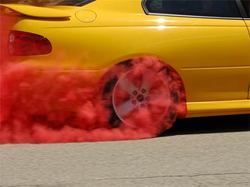
And then there's the Kumho Ecsta MX-C automobile tire, which puts an entirely new spin on tire smoke.   When spun faster than the corresponding groundspeed of the car they're attached to, tires burn.  Burning rubber emits lots of smoke, generally of a bluish-white variety. 

Kumho's innovation was to recognize that, as with SpeedBlend, the experience of a tire in motion could be designed.  In this case, that meant formulating the rubber compound such that it emits dense red smoke when burned.  Here's a photo and video of the tire in action from Automobile Magazine (I highly recommend the video -- if Pontiac made GTO ads like this, their sales would be oh so much higher):

0510_pontiac_gto_04_445

Please recognize that while I find the Kumho tire interesting from a "how in the world are we going to differentiate our product in this market?" point of view, I'm not an advocate of crazy driving.  In fact, I hate it when people speed in the wrong context, such as all the cell-phone-porting-latte-quafing-fast-driving jerks who drive down my suburban street at ten over the posted speed limit. 

But for the time and the place where a well-laid patch of rubber is just what the doctor ordered, why not make it a red one?


09 October 2005 | Permalink | Comments (2) | TrackBack (3)

| |

Introducing the Hasso Plattner Institute of Design at Stanford

        Img_6601

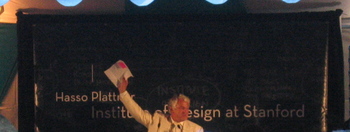
This past Monday was a Good Day for the Stanford "d.school".  Monday was the day it became the Hasso Plattner Institute of Design at Stanford.  Plattner's incredibly generous and visionary donation means that all of us at the Institute can now really focus on our primary mission of training leaders who use design thinking to solve big challenges.

The Plattner Institute was rung in with a big celebration at Stanford's Frost Amphiteater, attended by such luminaries as Plattner (shown above), Stanford President John Hennessy, Professor David Kelley, and Executive Director George Kembel.  As Kelley remarked to the assembled crowd, "Bravo, Hasso!"

05 October 2005 | Permalink | Comments (2) | TrackBack (0)

| |

metacool Thought of the Day

"The guitar for me is a translation device.  It's not a goal. And in some ways jazz isn't a destination for me. For me, jazz is a vehicle that takes you to the true destination - a musical one that describes all kinds of stuff about the human condition and the way music works." 
- Pat Metheny

(Metheny's take on jazz isn't so far from how Ettore Sottsass thinks about design.  If there's such a thing as "jazz thinking", I think it shares many elements with "design thinking".)


03 October 2005 | Permalink | Comments (0) | TrackBack (0)

| |

A Welcome Voice in the World of Design Thinking

Bruce Nussbaum is blogging:  NussbaumOnDesign

28 September 2005 | Permalink | Comments (1) | TrackBack (0)

| |

On Zanardi and Innovation

13025_1024

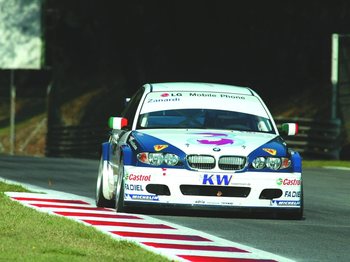
Earlier this month, Alex Zanardi won the Italian Touring Car Championship at the wheel of a BMW.

Even if you don't "get" auto racing, give me a chance to tell you why Zanardi is one of my personal heroes, and why he's an important role model for innovators.  Simply put, Zanardi, has the kind of singular genius that makes something very difficult look oh so easy.  He is an incredible driver, very talented.  During the 1990's, from his come from behind win at Long Beach, to his audacious Corkscrew maneuver at Laguna Seca (in racing circles simple referred to as The Pass), Zanardi was the guy you knew would always go for it, would never ever - ever! - give up.  In other word, Zanardi is a racer, a person intrinsically motivated to win.

He almost died in 2001.  Zanardi's recent Touring car crown is all the more remarkable because it was achieved by a man whose legs were amputated above the knee, by a man whose died several times in a helicopter on the way to the ER room after his horrible accident.  Made all the more remarkable by the fact that, after regaining his health, his intrinsic motivation led him to figure out a control system for his racing BMW which uses his hands and his hip so effectively that he could not just be competitive, but be the most competitive in what is a very competitive racing series.

At the risk of trivializing Zanardi's accomplishments, let me say this:  innovation is a difficult pastime.  Most of the time it's not glamorous, fun videos about shopping carts not withstanding.  You're going to lose a lot of the time.  Ideas get beat up mercilessly.  Hard work gets flushed down the toilet.  People don't believe you can do it.  And the real world has a way of providing harsh feedback on things that work very well in theory but not in practice.  If you're serious about changing the world, innovation is ultimately about doing, and ultimately, winning.  Winning, as it turns out, is tough.

I think great innovators - winners - share a lot in common with great racers.  I just want to be a great racer.  That's why Zanardi is my hero. 
27 September 2005 | Permalink | Comments (6) | TrackBack (0)

| |

Venture Design, part 9

Now that's a creative business model: Eternal Reefs

26 September 2005 | Permalink | Comments (0) | TrackBack (0)

| |

Making Things Make Things Beautiful

I had a casual, brief water-cooler-type conversation yesterday, which went something like this:

Me:  I noticed you're using Keynote instead of PowerPoint.  How do you like it?

Them:  It's great.

Me:  Did it take a lot of time to make your presentation look so designerly?

Them:  No.  I think Apple designed it so that you can't produce anything that's not beautiful.

That really blew my mind.  What a simple yet utterly audacious vision for any offering: help your customers make their lives more beautiful. 

What if your car made you drive with the smoothness of Fangio?  If your food processor helped you cook with the elegance of Batali?  As Virgina Postrel has been saying for a while, the desire for beauty in our lives is more basic than we think.  Perhaps those of us who create things for other people to use should be going beyond functionality, usability and visceral aesthetic concerns to deliver the realm of the poetic existence. 

24 September 2005 | Permalink | Comments (3) | TrackBack (0)

| |

metacool Thought of the Day

"I like to launch [products] early and often. That has become my mantra.  Nobody remembers [Madonna's] Sex Book or the Newton. Consumers remember your average over time. That philosophy frees you from fear."

- Marissa Mayer, Google

23 September 2005 | Permalink | Comments (1) | TrackBack (0)

| |

Unabashed Gearhead Gnarlyness

Large10
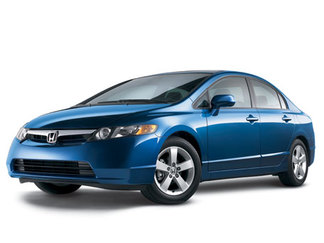
The 2006 Honda Civic Sedan

After seeing one pass me on the street, I have to admit I'm head-over-heels for the new Civic.  The shape and proportions represent a huge improvement over somewhat dowdy 2005 model, and there's more than a little Alfa Romeo Giulia Berlina in the trunk section, which is no bad thing.  This is the first Honda sedan since the famed pop-up headlight Accord of the late 80's to make you wonder why people bother with two-door coupes.  Sweet.

photo copyright Honda

22 September 2005 | Permalink | Comments (2) | TrackBack (0)

| |

More "How Far?"

I'm writing an extended essay on the subject of "How far?  How?".  I'm building off the Saturn story from my earlier blog post, but would love to hear about other remarkable ways that companies express their brands.

Please send me an email if you've got a good story.

Mahalo!

21 September 2005 | Permalink | Comments (0) | TrackBack (0)

| |

Thought Contagion

When I first began this blog my day job was marketing web software, and I was obsessed with figuring out how to make ideas more likely to spread across the web.  Though part of the reason for blogging was long tail self-expression, much of it was about building my professional chops.  I'm a big fan of knowing by doing.

I'm no longer making my dough as a web marketer, but I'm still fascinated by the mechanisms of thought contagion on the web and elsewhere.  I love sifting through web logs to see who is visiting and linking to metacool.

Imagine my delight earlier this week when PubSub indicated that metacool was the 14th strongest website out there (out of 16 million sites tracked!!) in terms of link strength and buzz.  Sure, I'm happy to be up in the quantitative ranking, but really turns me on is the prospect of figuring out what makes PubSub tick as a measure of contagion.  To that end, I need your help:

  1. If you have any sense of how PubSub derives its rankings, leave a comment or drop me a line.
  2. If you know of any other online measures of contagion (besides Google page rank), please tell me about them.

Thought contagion is so cool, eh?

17 September 2005 | Permalink | Comments (1) | TrackBack (0)

| |

The Return of Jolie-Laide

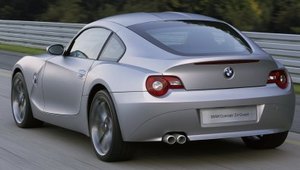
Bmw_z4_rear
The new BMW Z4 Coupe. 

This is fantastic.  It's the return of Jolie-Laide, and it's about design that takes guts.  Love it or leave it, you have to admire BMW's willingness to take a point of view and run with it.  In that sense, it's beautiful.

(via Jalopnik)

13 September 2005 | Permalink | Comments (1) | TrackBack (0)

| |

Nano is the new Turbo

Wa096a

The whole "nano-as-the-ultimate-modifier" marketing thing tipped last week with the release of the iPod nano.  While I don't (yet) own one of these iPods, I do own several shirts which supposedly feature a nanotechnology fabric treatment.  I believe we're now going to see "nano" applied to everything from cigars to Civics.  Which is fine, except that in few cases will the product actually contain, or be about, nanotechnology. 

Such is the case with the iPod nano, and that is why I believe that nano is the new turbo, another technical term appropriated by marketing people and applied in so many ways as to make it meaningless.

Nothing wrong with this, of course, for the truth is all marketers are liars.  But it really rankles the engineer in me.  And delights the marketer in me.

12 September 2005 | Permalink | Comments (15) | TrackBack (3)

| |

Design Manifestos: Eva Zeisel

"The designer must understand that form does not follow function, nor does form follow a production process. For every use and for every production process there are innumerable equally attractive possibilities."
- Eva Zeisel

Read more about Eva Zeisel's point of view on the design process in this wonderful profile written by Virginia Postrel.

08 September 2005 | Permalink | Comments (2) | TrackBack (0)

| |

Me and My Murse

Cam1_image

A few weeks ago I lamented the fact that I couldn't order a Freitag Murse online.  Of course, many of you are lamenting the fact that I want a murse, but for me the lamentation stems only from my continuing state of murselessness.  Each morning as I try and squeeze my gadget-stuffed pockets into the seat of my car, I remind myself to find a way to get out to the Freitag store in Davos.

Salvation came in the form of an email from a nice person at Freitag called Manuela, who told me that, while the object of my murse lust won't be available online until late September, it is possible to purchase one today without jetting off to Davos.  How?  Well, if you consider the designed-as-a-one-of-a-kind-object premise which forms the essence of the Freitag brand, then the solution is obvious:  log into a web cam in the Davos store and have a living Freitag salesperson show you each bag until you find one you like.

Seriously.  You must see it to believe it. 

It's kind of cool and brand-enhancing, eh?  But I still don't have my murse.  The tyranny of the wallet has yet to cease.

07 September 2005 | Permalink | Comments (1) | TrackBack (1)

| |

metacool Thought of the Day

"NetGens think of the computer as a door, not a box.  When they are on, they have 5-7 IM windows open and multiple tabs into different communities. Each community provides a way of being, to express facets of their identity while engaging in an activity. Most activities are centered around objects to spin stories and hold conversations. They don't go to places, it's more likely they augment plazes in the real world. With increasing mobility they tap groups for what they need to get done no matter where they are and make where they are matter... In other words, the web is increasingly less about places and other nouns, but verbs."

- Ross Mayfield

04 September 2005 | Permalink | Comments (0) | TrackBack (0)

| |

Knock Knock

The other day I was asked to name the person I'd most like to have evaluate the design of a website.  A few designer names swept through my head, but then I thought, "No, I'd want a marketer who thinks like a designer who thinks like a marketer.  Seth Godin." 

Over the past five years I've had a hand in architecting and building five major websites, and Seth's thoughts on permission marketing, sneezing, and remarkability played no small part in shaping their design.  This one was done on less than a shoestring budget but got nominated for a Webby.  This one is built around getting people to a permission asset, and as a bonus gives sneezers a handy little manifesto for cocktail parties, too. 

Seth just wrote a new guide to creating websites that work.  It's free, it's here, it's Knock Knock

01 September 2005 | Permalink | Comments (1) | TrackBack (0)

| |

Brand Doppelgangers

Last week, while strolling through the wilds of Silicon Valley on my way to "work" (I love my job too much to think of it as work; I refer to it instead as "flow central", but that's fodder for another post), I passed by a Muzak cargo truck.  Yes, that Muzak, of tunes and elevators.

The broad tall cargo wall of the truck was emblazoned with the Muzak logo:

Logomuzak_72dpi


And I couldn't help but think that the Muzak "m" felt a lot like the "m" logo found on the side of a bottle of Method soap:

Handwash_pomegranate

Yes, to a graphic designer they're quite different, but to everyone else they're pretty close.  They are, for all intents and purposes, doppelgangers.  I find this notion of brand doppelgangers quite intriguing.  Is this good?  Bad?  Irrelevant?  I'm not sure yet, but I'd like to think more about it. 

Can you think of other examples of brand doppelgangers?  Drop me a line or leave a comment.

Mahalo.

22 August 2005 | Permalink | Comments (10) | TrackBack (0)

| |

Unabashed Gearhead Gnarlyness

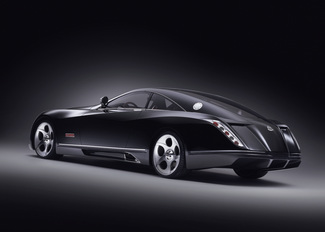
Mayexe006_tcm2304708
The Maybach Fulda Exelero

17 August 2005 | Permalink | Comments (0) | TrackBack (0)

| |

Design Thinking on Ice

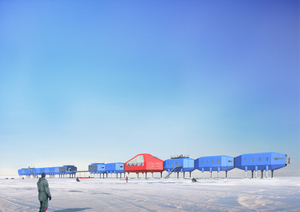
External_view_01
Could this be the oft-rumored winter under-ice exploration HQ of Team Zissou?  Or perhaps the Banzai Institute's secret computational genomics R&D lab?

Nothing so cool.  But on the other hand, something designed with surviving the cool as a key consideration.  Or in this case, being in Antarctica and not getting buried by it.

For this is Haley VI, the latest in a series of Antarctic research stations created by the British Antarctic Survey.  Haley VI is an extremely clever answer to the question, "How should humans live in the cold?".  Among other things, it features:

  • A modular architecture which allows multiple units to be combined and recombined
  • Renewable energy supplies
  • A thoughtful approach to dealing with doo-doo
  • Ski stilts which enable the module to avoid burial by layers of snow by being towed away

It's a good example of the holistic nature of design thinking at work.  A traditional, building-centric worldview would have responded to the challenge of snow burial with a "build it stronger and heavier" dictum, because buildings can't move, right?.  But Haley VI shows us that sliding modules gather no ice, and that's a breakthrough informed by a fundamentally optimistic view of the world: slide a building across the ground in the middle of nowhere, then snap it to another modular building?  Let's build it!

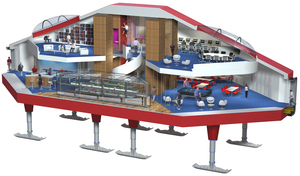
And you just gotta love the clubhouse module - it's enough to start an Antarctic housing bubble:

Central_module_iso_1


15 August 2005 | Permalink | Comments (0) | TrackBack (0)

| |

Sneezing The Big Moo

159184103801_sclzzzzzzz_

Are you a connected maven in a slice of the world that cares about remarkable ideas?

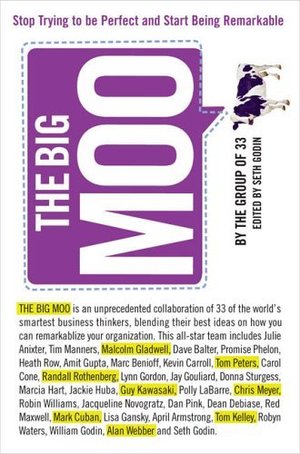
Then check out Seth Godin's influencer campaign for The Big Moo.  Very clever promotional thinking for the insights of the The Group of 33.

14 August 2005 | Permalink | Comments (0) | TrackBack (0)

| |

metacool Thought of the Day

2005_yzfr1_photo_07_tcm2650996

"To be successful in motorcycle product planning, you need to have enthusiasm and at the same time you need to have an enormous curiosity to dig deeper and see what's behind people's motivation, combined with an open mind for creativity. It is a difficult balance between logic & facts and creativity & vision. I believe you either have this ability or you don't. Just like a good painter, you either have the ability to make great paintings or you don't. This job requires a lot of intuition, which one cannot learn from schoolbooks."
- Masahiro Inumaru

11 August 2005 | Permalink | Comments (0) | TrackBack (0)

| |

How far? How?... continued

11048740ll

"Atelier De Cannes"  by Pablo Picasso, original crayon drawing, 1958

Yours for only $129,999.99 today at www.costco.com

Yes, at Costco.  I don't know about you, but this changes, at least a bit, the way I think about Costco.  Your brand is an expression of what you put out in the world, and this ain't no bulk pack of toilet paper.

Personally, I'd go for the Miro.

(thanks to Carlos for the link)

09 August 2005 | Permalink | Comments (6) | TrackBack (1)

| |

« Previous | Next »

Categories

  • designing
  • innovating
  • leading
  • marketing
  • meta metacool

search


About

Subscribe to this blog's feed

    follow me on Twitter

    Favorite Posts

    • A million reasons why...
    • Mo Cheeks and a fundamental question of leadership
    • Innovation Lessons from Garage Majal
    • From Obama to Pink to Oprah
    • Shinya Kimura and the primacy of doing
    • A tribute to friends and friendship
    • Strategy that makes your hands bleed
    • Quality in a switch
    • Travis Pastrana and the future of the world economy

    on the nightstand

    • : The Great Bridge

      The Great Bridge

    • : Porsche - Origin of the Species

      Porsche - Origin of the Species

    Principles for Innovating

    • 1: Experience the world instead of talking about experiencing the world
    • 2: See and hear with the mind of a child
    • 3: Always ask: "How do we want people to feel after they experience this?"
    • 4: Prototype as if you are right. Listen as if you are wrong.
    • 5: Anything can be prototyped. You can prototype with anything.
    • 6: Live life at the intersection
    • 7: Develop a taste for the many flavors of innovation
    • 8: Most new ideas aren't
    • 9: Killing good ideas is a good idea
    • 10: Baby steps often lead to big leaps
    • 11: Everyone needs time to innovate
    • 12: Instead of managing, try cultivating
    • 13: Do everything right, and you'll still fail
    • 14: Failure sucks, but instructs
    • 15: Celebrate errors of commission. Stamp out errors of omission.
    • 16: Grok the gestalt of teams
    • 17. It's not the years, it's the mileage
    • 18: Learn to orbit the hairball
    • 19: Have a point of view
    • 20: Be remarkable

    CC

    • Creative Commons License