metacool

thoughts on the art & science of bringing cool stuff to life, by Diego Rodriguez

Rethinking management education, organizing for routine innovation, Charles Eames, and the importance of holding the air gun trigger down

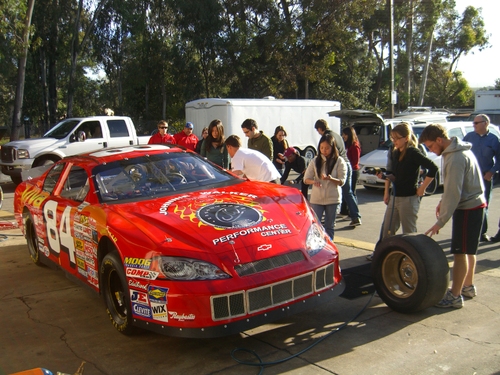
Cimg0016

Just the other week I had the pleasure of dropping in on one of Bob Sutton's graduate courses at Stanford.  I was supposed to be on paternity leave, but if you haven't noticed yet, I have this thing for racing and cars, and well, it's only a ten-minute walk to the Stanford campus from where I live, and my wife is a kind and charitable soul when it comes to indulging my passion for gearhead gnarlyness.  Call it a busman's holiday. This particular class (pictured above) deals with navigating innovations through complex organizations.  Yes, that's a real NASCAR racer.  Yes, those are real live Stanford graduate students.  And yes, that's what February in California looks like.

So what's going on in the photo?  A very interesting exercise in teamwork which exposes and illuminates all sorts of juicy issues in organizing for innovation.  In this class, Sutton, co-teacher Michael Dearing, and guest lecturer Andy Papathanassiou of Hendrick Motorsports get teams of students to go through the process of changing the tires on a NASCAR machine.  It is harder than it looks: the tires and rims are heavy, the car wants to fall of the jack (well, it is on jack stands, but it feels like it wants to fall off), and the lug nuts seem to be cross-bred with jumping beans.  You can read more about the class exercise here and here.

After 60 minutes of watching teams of students go from zero to hero in terms of their tire-changing acumen, my head was buzzing with lessons for those studying the art and science of bringing cool things to life:

  1. Mind your modalities:  How do you want to grow?  What are you trying to accomplish?  At first glance, changing a tire is easy, right?  Take it off, grab a new one, bolt it on.  But how might one reduce the cycle time by 10%?  50%?  90%?  How would you organize teams to reach those goals?  And on the other hand, how do you create teams that are able to change tires in a hurry in the heat of the Daytona 500 without missing a beat?  And how do you get one team or organization to be good at both innovating and executing?  I think it is all about minding your modalities, knowing what you are shooting for at any instant.  If we want to commit to taking 20% off of our tire changing times over the course of a racing season, perhaps we need to start an R&D department whose function is to create extreme variance, to find those weird solutions that will lead to paradigm shifts.  And perhaps we need to establish a test team whose job it is to sort through the revolutionary stuff coming out of R&D in the name of focusing and honing a few promising solutions.  And then we need to find a way to train our front-line team so rigorously that they can execute flawlessly on that killer idea birthed in R&D, and matured by the test team.  Minding modalities is about recognizing when it's about business by design versus business as usual, and structuring and leading things accordingly.  It's about embracing variance when it is needed, and driving it out when it is not.   The best racing teams, such as Hendrick, Penske, and Ferrari, know how to do both.  They are masters of innovation modalities.
  2. Seek out constraints:  when staring in to the abyss of a blank sheet of paper, constraints provide a vital toehold, a way forward.  Not necessarily the way forward, because rarely is innovating a linear process, but a way forward nonetheless.  NASCAR is an incredibly constrained environment when it comes to the design and operation of race cars.  Everything is templatized and mandated to the nth degree by a central organization.  And yet, creativity flourishes, the leading edge continually moves forward, and the garden blooms.  Sure, there are some a few "cheating" weeds here and there, but that's racers being racers.  Cheating is just a way of signaling that that a constraint is likely invalid.  Constraints = Progress.  Infinite possibilities lead to stasis.
  3. Organize for information flow:  How do you design an organization so that it can innovate where it needs to innovate and execute when it needs to execute?  Here's a clue: drawing org charts won't get you there.  Ideally, one thinks first about critical information flows which need to occur in order for certain outcomes to be realized.  Once those information flows are identified, the organizational structure emerges fairly organically, with an org chart as a by-product.  I was thrilled to meet Andy Papa at this class exercise, because Hendrick does a wicked job of organizing for creative information flow.  As a pioneer of the multi-car team in NASCAR, Hendrick has cracked the code on how to structure an organization such that variance-reducing, execution-minded focus (separate teams each competing to win the NASCAR cup) can coexist with a non-zero, variance-embracing, innovation-seeking worldview (everyone in the organization sharing information in order to identify patterns which lead to revolutionary and evolutionary innovations, and hopefully, victory for all).  Racing teams have no choice but to evolve or die, and to make tough choices or cease to be relevant, so I often look to them for inspiration when faced with organization design challenges in my own work.  You read it here first:  Hendrick is the New Apple.  Or the new GE.
  4. Learn by Doing: I'm entering broken-record mode here, but the teams that did the best in this class challenge were those that dove in and started changing tires.  Instead of arguing over who would be the CEO of rickybobbytirechangers.com, and who would be leading the war for talent, these teams got down on the ground and got their hands dirty.  By the wail of the air gun, thee too shall witness one's strategy emerge.  And so it happened -- the best way around a NASCAR wheelwell can't be thought through in one's head, but has to be iteratively solved with hand and heart and brain.  In other words, strategy that makes your hands bleed.

Note to self: if ever I find myself swapping out new rubber in a big hurry, keep the trigger down on the air gun.  WFO, baby!
19 February 2008 | Permalink | Comments (1) | TrackBack (0)

| |

Unabashed Gearhead Gnarlyness

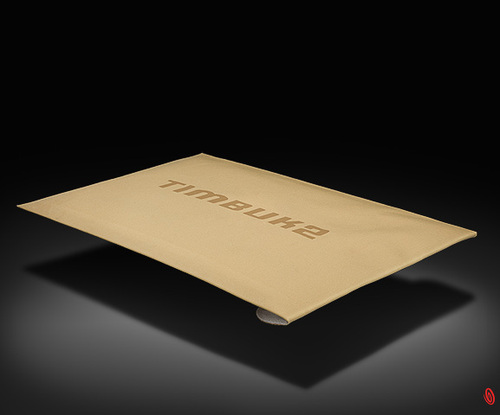
Timbuk2macbookairsleeve_back

Timbuk2macbookairsleeve_front

The Timbuk2 Steve Sleeve for the MacBook Air

12 February 2008 | Permalink | Comments (4) | TrackBack (0)

| |

It's Eccentric Clamp Day

Clamppatent

Did you forget? Join all of us at metacool in celebrating February 8 as Eccentric Clamp Day

Tell your friends!  Gearheads of the world, unite!

08 February 2008 | Permalink | Comments (0) | TrackBack (0)

| |

metacool Thought of the Day

David_e_davis_2

"I suddenly understood with great clarity that nothing in life—except death itself—was ever going to kill me. No meeting could ever go that badly. No client would ever be that angry. No business error would ever bring me as close to the brink as I had already been."

- David E. Davis, Jr., on the liberating effects of the automobile accident which almost claimed his life

07 February 2008 | Permalink | Comments (0) | TrackBack (0)

| |

The most interesting blog post I've read in 2008

Mr_rogers

Mr. Rogers, The US Senate, Mary Baker Eddy, A Sneaker Sanctum: Just Another Day in the Neighborhood

05 February 2008 | Permalink | Comments (0) | TrackBack (0)

| |

Matte is the New Black, continued

Porsche_carrera_gt_flat_black_fro_3

It seems I'm not the only one enamored of satin finishes. 

Rob Poltras of I Love Substance has been tracking this trend for the past year.  Check out his portfolio of mattness: Catching Up on Flat Black Hotness

04 February 2008 | Permalink | Comments (2) | TrackBack (0)

| |

Matte is the New Black

Last weekend, as I tended to my newest market offering's complex fluidic thermodynamic power systems in the wee hours of the morning, I flipped on the tube and watched more than a few laps of the 24 Hours of Daytona.

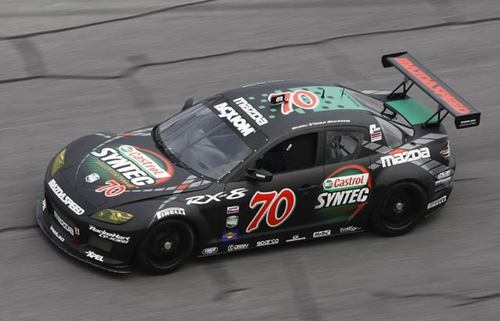
Speedsource_daytona_2008

A Mazda RX-8 (pictured above) won its class, beating out a gaggle of Porsche 911's for the honor.  In no sense a stock car (see the video at the end of this post for a walkaround this full tube-framed racer), this RX-8 nonetheless points to the future of car design for us civilians: look closely and you'll notice that the paint isn't glossy.  Instead, the luscious carbon fiber panels on this machine are matte black, or satin if you will.  Wax not needed or desired.

We've been raised to believe that gloss is good, that shiny equals quality.  Those days are over.  Hear this now: the cult of the waxed car body is melting, and this RX-8 represents the tipping point.  Sure, beating the 911's at Daytona is a win for the ages, but sporting a matte finish and finishing first -- that's a tipping point.  If manufacturing and repair (how do you buff out a matte finish?) issues can be solved, I think we'll start to see a lot of matte paint jobs rolling around.  And a lot of them will likely be dirt-shedding nano particle finishes.  Even cooler.  We've already see matte paint on show cars from BMW and Lamborghini. 

Matte is the New Black.

Here's a video of the Daytona-winning RX-8 from the driver's seat (oh, the wail of a rotary motor!):

And here's an extra treat in the form of a most gnarly walkaround the car in the presence of race Nick Ham.  Check out the paint (shown to best effect toward the end of the video):

02 February 2008 | Permalink | Comments (0) | TrackBack (0)

| |

Director's Commentary: 2007 Honda Odyssey One Lap racer

Here's  a fantastic Director's Commentary for gearheads.  Honda's Bradley Buchanan takes us through all the design work that went in to the creation of an Odyssey that hauls at both ends. 

What a sound this thing makes!  And how it hunkers!  It has all the gravitas of a hairy-armed first-generation Porsche 911 Turbo.

I've said it before, and I'll say it again: there's a market out there for vans that pack the punch and handling of a BMW 535i.  People in my demographic and psychographic could easily absorb 10,000 of these a year in North America alone.  I'd buy one in a second, especially if it were powered by a turbodiesel. 

Space is the ultimate luxury. 

Space coupled with warp-speed performance?  Well, that's nirvana.  Honda, are you listening?

31 January 2008 | Permalink | Comments (0) | TrackBack (0)

| |

The MacBook Air ain't got nothin' on this: metacool ships another one

Yeah, I dig the MacBook Air, too, but Apple's big announcement of January 15th pales in comparison with big news coming out of metacool today: I'm very proud to announce that today we shipped yet another fantastic offering to market.  It's much cooler than that other thing.

Coming from the same corporate gene pool, as it were, very little distinguishes this version from that of our last announcement in 2005 -- they share not only total cuteness but an amazing list of features and functionality.  And yet each one is uniquely individual.  Look at this feature list and eat your heart out, Apple Design Team:

  • a complex, powerful, yet low-power consumption bio-computer running a self-teaching, open-source operating system
  • a huge amount of information storage capacity -- won't run out for decades, hopefully even a century
  • completely cradle-to-cradle in terms of production materials
  • low mass -- all of this in a package only a few pounds heavier than the MacBook Air: a total of 8 pounds, 9 ounces, to be exact
  • timeless aesthetics; built for the ages

Branding is still TBD.  Am going to sleep on that (I really need to sleep, come to think of it). 

HonestIy, I can't say that this one is in any way better than the previous one -- I love 'em both.  But, I would say that metacool's software development process has certainly benefited from the real-world experience gained over the past 31 months of intense development activity.  To quote Indiana Jones, it's not the years, it's the mileage.

15 January 2008 | Permalink | Comments (5) | TrackBack (0)

| |

An inconvenient truth about blogging

Sure, blogging is an integral part of what transparent leadership looks like cira 2008, and bloggers do great things, but blogging has its downside.

Hear Yossi Vardi speak eloquently about some downside of having a G5 humming away in one's lap.  If nothing else, this is a great example of how to use PowerPoint.  It's not the crate, but the person who pilots it, as was once said.

And check out this great profile of Vardi in The Economist.

14 January 2008 | Permalink | Comments (0) | TrackBack (0)

| |

Nano is the new Turbo, part deux

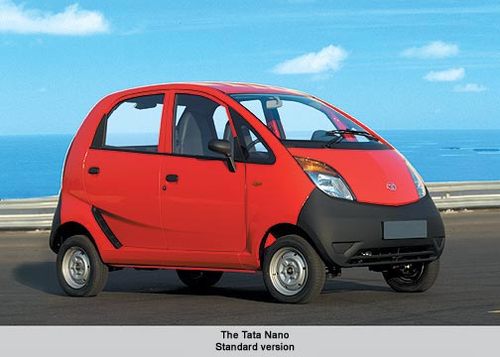
This week's unveiling of the Tata Nano is yet another piece of evidence that "nano" is the new "turbo".

Nano_standard_low_res02

In our world of bloated, inane Flabbigators and ANC SL2455's and RSQ77 urban land yachts, the Nano is a refreshing point of view.  Instead of car design being done from an elitist point of view whose aim is to find ever new and novel ways to heat, cool, and pamper our fat asses, the engineers at Tata have said "here's all you need" and nothing more.  It's a populist design approach visited before by such iconic designs as the Model T, the Beetle, the Mini, the Cinquecento, and -- my favorite -- the 2CV.  Unlike those designs, however, I don't believe the Nano is the rational enough.  That swoopy windshield is a hollow attempt at style over substance: who needs an expensive, complex, Le Mans-quality aerodynamic solution when one's top speed (let alone average speed) is so low?  Something more planar would be simpler, cheaper, and easier to fix and replace over the life of the car.  Of course, reflective design is the lord of the manor when it comes to automotive sales, and what people really want is swoopy, I suppose.

And, doffing my hypocrite's cap, I can't help but think that the last thing the world needs is another car, let alone a popular, high-volume one.  However, if we're going to have more, they might as well be nano-ish in mass and form.  Where's the true cradle-to-cradle personal transportation solution we all need?  Perhaps I should get on that...

12 January 2008 | Permalink | Comments (8) | TrackBack (0)

| |

A blogger done good

John Lilly, a long-time member of the metacool blog roll, was named CEO of Mozilla today.  I've been lucky enough to work with John at the Stanford d.school, spend many hours together swapping war stories about business and the nature of product development, and even toil for a few days as fellow Lobbyists. 

Not only am I happy for John, I'm really psyched for Mozilla, too.  Firefox is one of my favorite products.  It is incredibly reliable, very easy to use, and is the most personalized product in my possession.  I use it for play and for work; in any given day I spend four hours staring in to the Web as mediated by Firefox.  It's safe to say that Mozilla is one of my favorite brands, right up there with Apple, BMW, The Economist, Honda, The Cortiina, Subaru, McGuckin Hardware, and McMenamins Kennedy School.  I can't wait to see where the Mozilla goes with John, and vice versa.

That last vice versa is crucial.  As I wrote about in MIT's Innovation journal last year, John and the Mozilla community represent a new way of getting things done, one which requires a new paradigm of leadership and participation.  They live in a world that thrives on transparency and openness, a place where web thinking is freedom thinking.  We can all learn a lot about innovation and the art of getting stuff done from Mozilla.  One thing for sure: this is a story with many chapters left to go.

w00t!

(you didn't think I was going to write this without saying that, did you?)

07 January 2008 | Permalink | Comments (1) | TrackBack (0)

| |

metacool Thought of the Day

Dsc03277_2

"There is a common belief that all designers are artists.  I am not.  I studied engineering at Stanford and although I took some drawing courses for fun, I am sure that a good many high-school students can top me in free-hand sketching."

- Harley Earl

05 January 2008 | Permalink | Comments (2) | TrackBack (0)

| |

Unabashed Gearhead Gnarlyness

Robotfly

The Harvard Robotic Fly

(click thru to witness an amazing video)

Here's an excerpt from the accompanying article:

Designing an automated fly implied having the ability to make lightweight, miniature working parts, a process that Wood says took up the bulk of his doctoral study, because of the lack of any previous research on which to draw. “For years, the thrust of our work was ‘How do we do this?’” says Wood. “There was no existing fabrication paradigm, given the scale we were operating on, the speed we wanted to operate with, and things like cost, turnaround, and robustness.” His research group developed and fabricated a laser carving system that could meticulously cut, shape, and bend sheets of carbon fiber and polymer—both strong but lightweight materials—into the necessary microparts.

And how to power those wings to beat 120 times per second? To keep this 60-milligram robot (the weight of a few grains of rice) with a 3-centimeter wingspan to a minimal size and weight, Wood says, you can’t simply use a shrunken version of the heavy DC (direct current) motors used in most robots. So he and his team settled on a simple actuator: in this case, a layered composite that bends when electricity is applied, thereby powering a micro-scale gearbox hooked up to the wings. Wood says the actuator works even better than its biological inspiration. The power density—a measure of power output as a function of mass—of a fly’s wing muscles is around 80 watts per kilogram; Wood’s wing design produces more than 400 watts per kilogram.

That's some kick-ass engineering at work.  Professor Wood, you are one gnarly dude.

Many thanks to the folks at Telstar Logistics, a key member of the metacool horizontal keiretsu, for bringing this innovation to the attention of our R&D group.

04 January 2008 | Permalink | Comments (1) | TrackBack (0)

| |

Another stab at defining marketing

A few weeks ago I asked for some help in whipping up a definition of marketing.  What ensued was a good online brainstorm.  That discussion helped me formulate this working definition of marketing, which I used for my MSI talk (a copy of which will be posted here soon):

identifying desirable experiences, then delivering them

It's not a bad definition, but not as good as the one I found recently at the HBS Marketing Unit department page:

Marketers concern themselves with acquiring and retaining customers, who are the lifeblood of an organization. They attract customers by learning about potential needs, helping to develop products that customers want, creating awareness, and communicating benefits; they retain them by ensuring that they get good value, appropriate service, and a stream of future products. The marketing function not only communicates to the customer, but also communicates the needs of the customer to the company. In addition, it arranges and monitors the distribution of products and/or services from company to customer.

I think that's it.  Should have started there.

03 January 2008 | Permalink | Comments (3) | TrackBack (0)

| |

Why modern racing sucks compared to LeMons

What appears to be footage from the taxi ride in from Logan is actually racing action from a recent round of The 24 Hours of LeMons.

Seriously folks, the racing featured in this not-so-serious contest for under-$500 racing "machines" beats the pants off of anything I've seen in my last two decades of 4am Formula 1 gazing.  The 24 Hours of LeMons works because it is designed to be fun for drivers, teams, and spectators.  Simple.  I imagine the design principles behind the series look something like this:

  1. Make it fun for drivers
  2. Make it wild and outrageous for spectators
  3. Keep the cars simple and brutally cheap so that teams can have a good time at the race, too

What an indictment of the state of modern motorsports that, when it comes to creating an arena where the simple joys of competition can flourish, a hipster-doofus series administered by ace scribe Jay Lamm puts almost any professionally-managed racing series to shame.  Modern race series are deep-yawn, drool-running-down-your chin boring.  Boring boring boring.  I don't know about you, but the only in-car footage that compares to the stuff above would be something out of a WRC car.  Modern racing series can learn a lot from Lemons.

As a case in point, look what happens to cheaters at The 24 Hours of Lemons:

There are three main points to take away from this video:

  1. That backhoe operator is an artist
  2. The structural integrity of a BMW is not to be underestimated (how about those door hinges?!!!)
  3. Any experience, be it a call to an airline reservation center or an ER admitting line or a trip to the DMV, can be and should be designed to be meaningful.  Look at the creativity that went in to making the act of disqualifying an entrant something worth talking about.  If you wanted a customer to feel good about interacting with your brand, you could do worse than to digest what Jay Lamm has done with Lemons and then reassess every point of interaction in the customer journey through your organization's presence in the world.

For example, consider the hum-drum treatment of cheaters in modern sports.  When McLaren was caught cheating in Formula 1 earlier this year, they were forced to pay a $100,000,000 fine.  Yes, 100 million dollars.  That's a steep fine, but the boys at McLaren were allowed to keep racing for the entire season.  It was all about the lawyers, not the fans.  If we learning from LeMons, a much more appropriate penalty would have been a hydraulic-clawed machine of some sort munching dainty MP4-22 carbon monocoques by the harbor at Monaco.  And then no more racing.  That would be a truly priceless penalty, and a crowd-pleaser at that.

The next running of The 24 Hours of LeMons will be next week on the 28th and 29th of December. 
 

22 December 2007 | Permalink | Comments (1) | TrackBack (0)

| |

Director's Commentary: Philippe Starck

My favorite talk from TED2007.  As one might expect, this is a meta level talk, a Director's Commentary about being a director dreaming big things.  A meditation on designing life. 

Here's a transcript of Starck's talk.  Let's just say that this is a very provocative and intriguing twenty minutes.

20 December 2007 | Permalink | Comments (0) | TrackBack (0)

| |

metacool Thought of the Day

"Most new ideas are bad; and the good ones are mostly not new."

- James G. March

17 December 2007 | Permalink | Comments (1) | TrackBack (0)

| |

Halloween and the weird and wonderful workplace

Moonwalking designers in a Halloween parade featured prominently in my earlier post about the weird and wonderful culture of my own innovative workplace.  I recently learned about a similar Halloween parade at Zappos, a significant sponging agent for my disposable income, and a remarkably innovative retailer in its own right.

Might there be a causal link between putting on killer Halloween parties and forging corporate cultures capable of innovation on a routine basis?  Or does the causality flow in the other direction?  Or both ways?  Or is this merely correlation, and not causation?

No matter.  I really dig the Poltergeist reference at the end of the Zappos video.  Very nice.

14 December 2007 | Permalink | Comments (1) | TrackBack (0)

| |

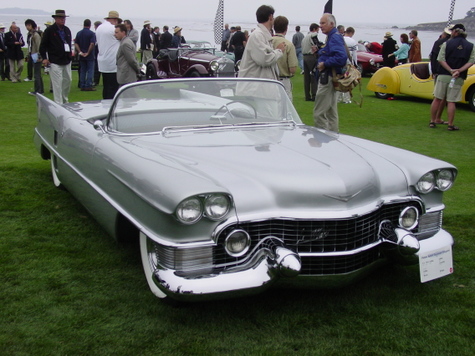
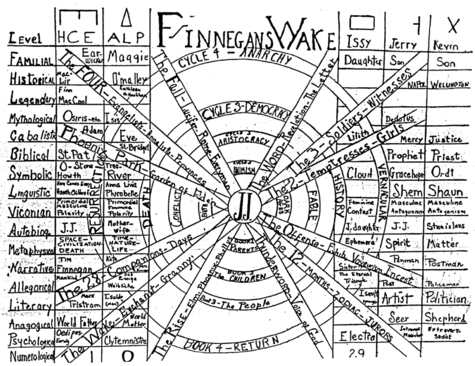
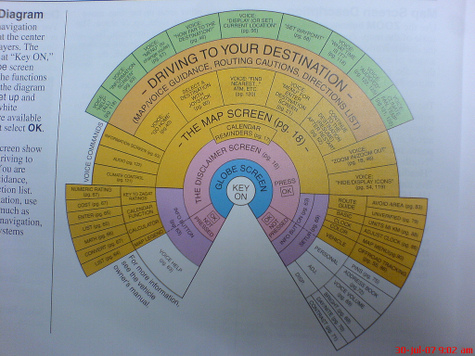
Random aesthetic connections, part 2

Moholy_lg

"Vision in Motion", Laszlo Moholy-Nagy's representation of Finnegan's Wake.

985549591_942393539a_b

Satellite navigation system instructional diagram from the Honda Ridgeline owner's manual.

08 December 2007 | Permalink | Comments (1) | TrackBack (0)

| |

Creativity, Entrepreneurship, and Organizations of the Future

Tomorrow I'll be part of a panel discussion at Creativity, Entrepreneurship, and Organizations of the Future, a conference presented by Harvard Business School.

Professor Jim Heskett will be moderating our panel.  He's written a provocative post on the HBS Working Knowledge website about tomorrow's discussion.  There's on open invitation there to leave your comments, ideas, and thoughts on the subject.  Please do so, as we'll be tackling at least some of them in the time we have tomorrow together, and the discussion will continue online through December 18.

The agenda of speakers at the conference is simply mind-blowing.  I expect to walk away with more than a few new ideas and insights, all of which will no doubt make their way in to metacool.  The entire conference is being held in honor of Professor Thomas K. McCraw, author of my favorite book of the year, Prophet of Innovation: Joseph Schumpeter and Creative Destruction.

My time at Harvard Business School changed my view of the world in many ways, and as a result fundamentally changed my life.  It is very meaningful to me to be back on campus exploring design, innovation, technology, business, and life.

06 December 2007 | Permalink | Comments (1) | TrackBack (0)

| |

Unabashed Gearhead Gnarlyness

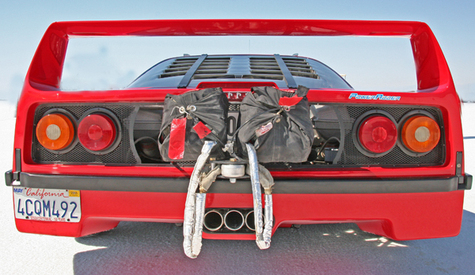
Spectre_f40_parachute

The salt-spitting machines of Speed Week, as seen through the eyes of BW Jones. 

Here, here, and here.

05 December 2007 | Permalink | Comments (1) | TrackBack (0)

| |

Yet another reason why I venerate, respect, and love Alex Zanardi, part II

I wrote the other week about Alex Zanardi's amazing achievement at the New York Marathon.

I'm not a good enough writer to capture the charm of a live interview with Zanardi.  So to show yet again why he's my hero, here's a five minute segment from WindTunnel.  Enjoy.

29 November 2007 | Permalink | Comments (0) | TrackBack (0)

| |

Jolie-Laide

L8

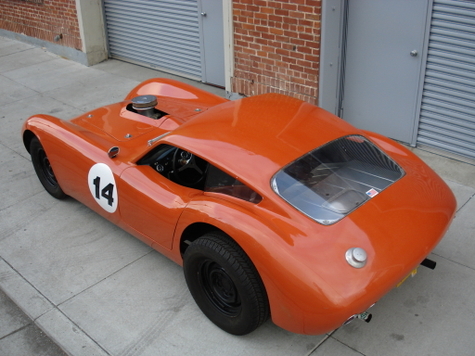
The Kellison J-4R

Beautiful can be so... boring.  The great thing about race cars is that, since style is not a primary design objective, they tend to fall at either end of an aesthetic bell curve: either they're so gorgeous that no styled object can match their state of perfection (think Ferrari GTO or SR-71), or their ugliness is so extreme that from it rises another kind of beauty, one characterized by exceptions to all norms of classical beautiful (think Panoz Esperante or the first-gen BMW M Coupe).  In other words, they are jolie-laide, ugly-beautiful.

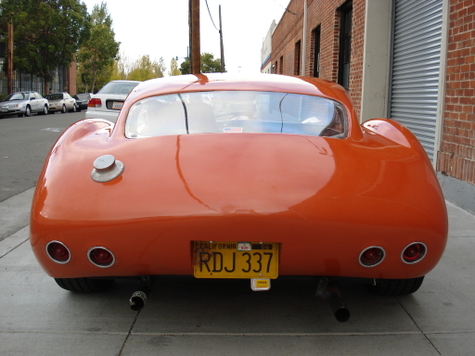
There's so much going on with this Kellison.  It's the Gerard Depardieu of automobiles.  For example, check out the squashed roof and the bulbous behind below it.  Driving this car would be like living in a flat with low ceilings and one too many overstuffed leather couches from American Furniture Warehouse.  Or like walking around the set of Being John Malkovich:

L6

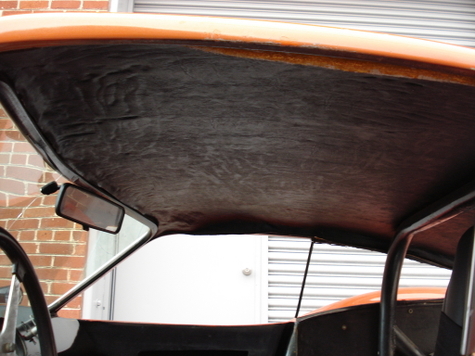
Looking inside, the lack of workmanship is compelling.  Lexus?  Flawless fit and finish?  What is that?  Forget about tight panel fits or unbroken surfaces, this thing is all about undulations and unresolved lines and sharp corners that might make you go "ouch":

L35

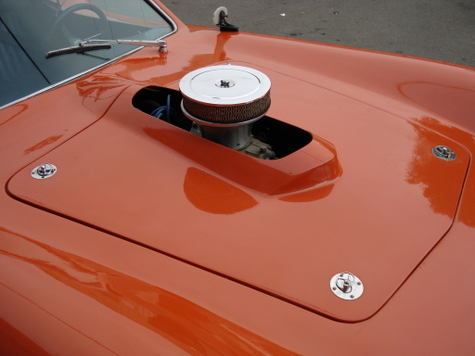
And that aircleaner, standing proud of the hood like the conning tower on a WWII sub floating somewhere in the Pacific.  It's just there.  Standing free and proud, utterly oblivious to all the streamlining floating around it:

L12

Why be beautiful when you could be interesting?

For the adventurous (and masochistic) among you, this particular J-4R is for sale at Fantasy Junction (where these photos were sourced).  Props to the upstanding lads at Bring a Trailer for pointing it out.

26 November 2007 | Permalink | Comments (0) | TrackBack (0)

| |

Collaborative Innovation and Collective Intelligence

Innovationscover

I recently had the great pleasure of writing this article with Doug Solomon.  Titled "Leadership and Innovation in a Networked World", and published by the MIT Press's innovations journal,  this essay takes a look at what's happening to the state of the art of getting stuff done in a world where having meaningful interactions with people via things like Google Docs, iSight video cameras, and yes, even World of Warcraft, has become an everyday reality.  Here's the heart of the article:

Unfortunately, by seeking the rare brilliance of a limited few instead of the statistically likely success of the connected many, the “lone genius” worldview has limited our ability to make meaningful progress in everything from technology, to organizations, to education, and all the way to society. We’ve done very little to systematically develop technology to support the innovation process. Overall, we are still in the “horseless carriage” days of living in a truly networked world. We can do better, but how do we begin to engage this new way of being? We believe a path to the future can be found by paying conscious attention to evidence of what works in the world today, and by asking the following questions as we work:

  • What are some of the enabling collaborative tools available today?
  • What lessons can be learned from organizations doing networked innovation?
  • How do things get done in a networked world?

Writing this essay was a chance to learn by doing.  Though Doug is a colleague of mine at IDEO, and we sit in the same building, we almost never see each other because we're always off cranking on some interesting, but separate, project.  That, plus the fact that we're both crazy busy, led us to use Google Docs to help us write the article in a collaborate way.  We began the essay at 11pm in the lobby of a hotel after the first day of the Fortune iMeme conference, and then proceeded to write it whenever we each had time.  For me, that meant waking up at 5am on a Sunday for some quiet working hours, or writing a few lines while sitting, delayed, on the tarmac at DFW.  Over 744 (!) revisions later, Doug and I had what I hope passes for a coherent essay, and during all those days of writing, we only worked face-to-face two or three times.  There's something to this technology-enabled collaboration stuff.

23 November 2007 | Permalink | Comments (0) | TrackBack (0)

| |

Where's your place for failing?

I heard this statement expressed the other week while walking around the campus of a thriving business:

                "This is the building where we do failure"

A very simple statement, but very deep.  It referred to a building dedicated to the support of prototyping behavior.  In other words, a place where people are encouraged to craft probes in to the future, each designed to bring back a bit of evidence meant to guide decision making.

What I also found significant about this place is that it is open to anyone.  It's not a special lab or skunkworks for a select group of people.  Anyone can walk in and do failure.  I think this is an important kind of resource to have available if your organization is serious about engaging in innovation on a routine basis, whether that innovation be incremental or evolutionary in nature.

There's a Field of Dreams aspect to having a place designed for failure.  You have to believe.  In particular, three points of belief are key to sustaining a place for failure, otherwise it won't get used in the right way or even understood:

  1. You can prototype anything
  2. You can prototype with anything
  3. Failure sucks, but instructs

At the end of the day, having a place responsible for the creation of variance, fueled by intuition and experimentation and optimism, is key to making failure instructive and productive.


21 November 2007 | Permalink | Comments (2) | TrackBack (0)

| |

Director's Commentary: John Maeda

A wonderful Director's Commentary by by the ever delightful Professor John Maeda on the topics of design, technology, business, and life through the lens of simplicity.  See how understanding why we want to finish a big cookie, but not a big pile of laundry, is key to using the principles of simplicity in your work and life.

His book on simplicity, by the way, continues to be one of my all-time favorite points of inspiration.

16 November 2007 | Permalink | Comments (0) | TrackBack (0)

| |

metacool Thought of the Day

Millikencar

"There are those who do the real work of the world, and those who hound them."

- William F. Milliken

14 November 2007 | Permalink | Comments (0) | TrackBack (0)

| |

Unabashed Gearhead Gnarlyness

Technology

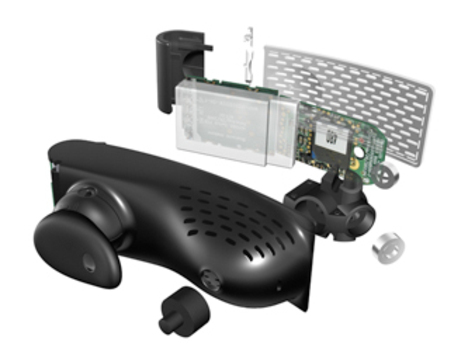
The Jawbone Noise Shield Bluetooth Headset.

I really like mine.  The design of the component parts is very well done and everything fits together very nicely -- snick snick, snick snick.  I do feel like a dork wearing it, and vaguely antisocial at that, but I suppose that may change over time as more people wear these things. 

What's absolutely stunning  -- and what makes this device worthy of gnarly status -- is its amazing noise reduction technology.  Check out the following demo video:

12 November 2007 | Permalink | Comments (1) | TrackBack (0)

| |

My workplace is a weird and wonderful place

As a rule, I don't write much of anything here about my job at IDEO, but in this case, I have to make an exception.

Here's what life looks like in place that likes to build stuff, do stuff, and generally kick ass.  We have a yearly Halloween party where various IDEO'ers put together costumes, scarf some pizza, and generally have a good time.  This year, however, the ante got upped, and things were, well... thrilling.

In what kind of organizational culture do people dedicate multiple lunch hours to practice dance moves?  This one.  Creative genius at work.  And look at the all the obvious love and support they get from assembled coworkers.  Cool.

11 November 2007 | Permalink | Comments (2) | TrackBack (0)

| |

DigitAll magazine

Here's a link to an interview I did with Samsung's DigitAll magazine.  Also interviewed are Dave Lawrence of Shimano, Pandora's Tim Westergren, and Chris Beard from Mozilla.  There's some interesting stuff in there.

07 November 2007 | Permalink | Comments (0) | TrackBack (0)

| |

Yet another reason why I venerate, respect, and love Alex Zanardi

Z_1

Today Alex Zanardi placed 4th out of 53 competitors in the hand cycle class of today's New York Marathon.  Not bad for a guy who not only didn't train for the marathon, but who died several times on the way to the hospital after losing his legs six years ago.

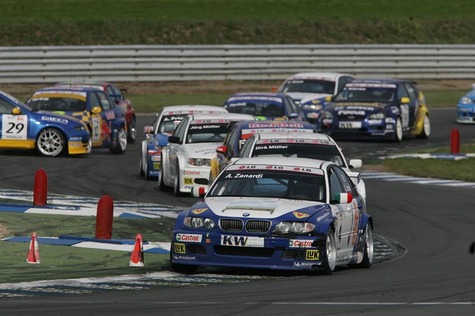
I love and respect Zanardi because he's such a racer.  Run a marathon?  No problem, let's do it.  Get back in the saddle and race the bejeezus out of touring cars (in a BMW, natch!)?  No problem, let's do it.  Write some inspiring books about your life and times?  No problem, let's do it.

In a world where negative whining often poses as concrete action, it's great to see someone who just gets on with it.  I have the distinct pleasure of hanging out with some people who make a living carving amazing things out of aluminum, wood, steel, and plastic.  Their job is really hard, because there is no bullshit factor due to the inherent tangibility of their medium; unlike a glossy PowerPoint deck, a milled piece of aluminum is either it, or is not.  They have a saying they roll out when someone is paralyzed by the prospect of  something new, something that might lead to failure, loss of status, or pain: Just F****** Do It.  JFDI.

Zanardi is a JFDI kind of guy.  In other words, a racer.  Racers are innovators.

04 November 2007 | Permalink | Comments (1) | TrackBack (0)

| |

metacool Thought of the Day

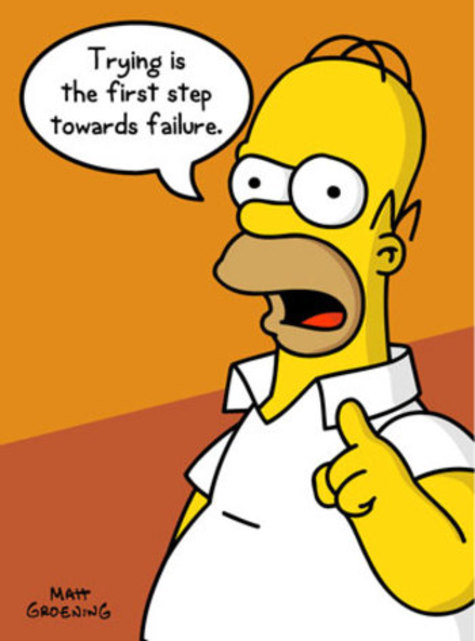
24825bpthesimpsonshomertryingispost

failure sucks, but instructs

29 October 2007 | Permalink | Comments (1) | TrackBack (0)

| |

Unabashed Gearhead Gnarlyness

The Nissan GT-R

GT-R.  Probably my favorite performance car brand ever.  Capable of spanking a Porsche 911 Turbo around the famed Nurburgring.  The new version of the GT-R is here, which means it is time to start saving up my quarters.  Yowsa.

28 October 2007 | Permalink | Comments (2) | TrackBack (0)

| |

All quiet at metacool

Sorry for the recent radio silence here at metacool. Everything is a-okay.  Been busy at conferences, endurance car races, taking care of the family, and work.  The good news is, I'm now swamped with interesting ideas.  It'll all brew up in to some good blog fodder, I reckon.

Now, it's time to crack open a tasty new book about Porsche 550 Spyders... a wonderful form of structured procrastination if there ever was one.

23 October 2007 | Permalink | Comments (0) | TrackBack (0)

| |

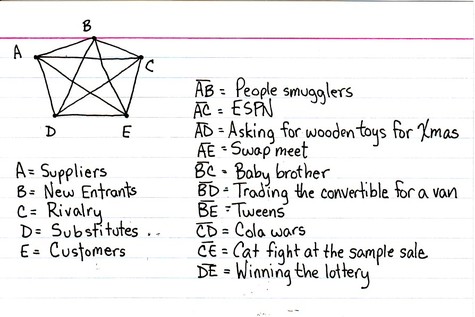
Another golden insight from Indexed

Card1062

For my MBA friends (apologies to Dr. Porter)

14 October 2007 | Permalink | Comments (1) | TrackBack (0)

| |

metacool Thought of the Day

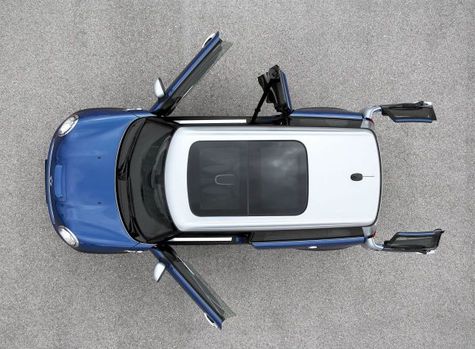
Mini_clubman_of18_2

"It was design by dictatorship.  All else, this marketing, these focus groups, what have you, is bullshit."

- Mini Clubman chief designer, Gerd Hildebrand.


(I love this quote because it acknowledges the unique role which talents plays in the realm of visceral design.  If you have talented, highly-trained and educated designers, why would you second-guess their aesthetic judgment based on the input of folks off the street?  Yes, test the hell out of the behavioral elements of your offerings -- fit, function, ergonomics -- but leave the visceral, and to some extent the reflective meaning, up to the people who get it)

12 October 2007 | Permalink | Comments (2) | TrackBack (0)

| |

Is a tendency toward unabashed gearhead gnarlyness genetic?

Yes.

My brother Carlos is quoted in today's New York Times in an article about making quiet computers:

Some customers are paying attention. When Carlos Rodriguez, a community manager for a Web start-up, built out the PC for his home theater, he turned to a Zalman CNPS9500, a $49 cooler for the C.P.U. that comes with hundreds of thin copper fins and weighs almost a quarter of a pound.

“It’s got huge heat-sink fins,” Mr. Rodriguez said. “It’s got a 92-millimeter fan. I just can’t hear it at all. It’s big, but it’s also kind of beautiful.”

Right on, bro! 

Having designed the thermal system for the original Intel Xeon processor, I'm really in to cooling fins.  They are beautiful.

11 October 2007 | Permalink | Comments (3) | TrackBack (0)

| |

Oh what a WoW feeling

You may not like this ad, but I do.  Not just because I'm a fan (and owner) of Toyota cars, but because it's a great example of designing a message to spread. 

In this case, it is about tapping in to the seven million plus folks who play the online game World of Warcraft.  That's a lot of potential truck buyers.  If you don't play World of Warcraft, the ad is entertaining, but if you do play, the ad is just amazing.  And, it seems perfectly designed to spread around the place where World of Warcraft players hang out the most, that thing called the internet.  This is about designing for YouTube.

My only question is, I'm level 66, so can I get a Tundra instead?

Thanks to Carlos for showing me the video.

10 October 2007 | Permalink | Comments (1) | TrackBack (0)

| |

Random aesthetic connections

A 1966 Alfa Romeo Giulia Ti:

Rf_2

A 2007 BMW M5:

15726_1024

A 1972 Chevrolet Suburban:

Jeff_72_b_rf

It's quite late.  Perhaps I should go to sleep.

08 October 2007 | Permalink | Comments (1) | TrackBack (0)

| |

Worth paying attention to

Design everything

06 October 2007 | Permalink | Comments (1) | TrackBack (0)

| |

Help me out, please

Help me out here.  Last night I was putting together my argument for an upcoming speech about marketing when I realized that I don't know what marketing is about.  Or, to be precise, I do know what marketing is about (I have a very strong point of view on it, actually), but I don't have a good definition.

What is marketing?

Can you help me?  If you have a definition you'd like to share, please shoot me an email.  Or, better yet, please leave a comment below.  That way we can all riff off each other. 

Thanks in advance.

01 October 2007 | Permalink | Comments (28) | TrackBack (0)

| |

Designing by influence

The current issue of Fast Company has a great article about the way HP's corporate design group influences the rest of the organization.  I found the article fascinating -- it's a great example of designing for business.

It's also a good example of why there's no silver bullet when it comes to getting an organization to integrate the design process in to the way it goes to market.  I love most of Apple's products, but I also realize that the way it goes about innovating -- a centralized, low-variance, top-down approach -- isn't the answer for every organization.  With HP, for example, you have a decentralized company where the leaders of individual business units are very powerful.  A centralized innovation model based on power wouldn't work well there.  As the article shows, what does seem to be working at HP is an approach based on influence, as well as on showing the distributed decision makers what could happen.  It's all about looking hard at the constituent parts that make up a culture -- people, resources, processes and values -- and then structuring a congruent approach.  Good stuff.

30 September 2007 | Permalink | Comments (0) | TrackBack (0)

| |

Always in beta

In the spirit of always being in beta, never leaving well enough alone, and continuing to use this blog as an intellectual sandbox, the staff of metacool have made a few small changes to this blog.

First, a shift from nouns to verbs.  Sharp-eyed web surfers will notice that the topical categories on metacool are no longer nouns.  Instead of “design”, there’s “designing”.  Innovation is now innovating, leading has replaced leadership, and marketing is, well... marketing. Doing seems more important to me than ever, and so the verbs have it.

Second, we’ve rounded up a group of books and placed them under the heading of — hold on to your seat, folks
—
COOL BOOKS.  I find myself going back to these again and again for clarity, insight, and inspiration.  This list is partly for me, so that I can remember what I've read that worked for me.  Hopefully you'll find it useful, too.

27 September 2007 | Permalink | Comments (2) | TrackBack (0)

| |

Strategy that makes your hands bleed

I'm mildly addicted to cable TV.  I simply can't get enough of two shows on Discovery Channel: Dirty Jobs and Build it Bigger.  Both of these shows revolve around a witty, game, and willing host who puts himself in to the middle of projects where things are being built, renovated, restored, maintained, or torn down.  These aren't shows about stuff, they're shows about the reality of making stuff and keeping stuff viable.  I call them "build" shows because they deal with atoms, not just ideas, and atoms tend to have a mind of their own... building things is a tough past time.  Talking about doing things is one thing; doing them is quite another.

I'm a big believer in knowing how to build things before you begin to decide what to build.  In other words, at an individual, team, group, and organizational level, deeply understand execution before you engage in strategy.  If innovation is about using ideas to make a change in the world, then the ability to execute is vital, and the ability to know what can be executed is even more important.  Building informs one's ability to know what will work the next time you go to the strategy board.

Building is not only important as a way to shape one's ability to formulate strategy.  Especially important is the notion that building is strategy, or that building as you go is a key way to coax an emergent strategy in to being.  The other day I was shooting the breeze with a colleague who made the observation that the way we (him, me, and design thinkers in general) formulate strategy is by making our hands bleed.  We in other words, we take our notions of strategy and build them, whether they be of bricks or bytes, and we let the results kick the crap our of precious notions of what should have worked.  Sometimes building a prototype will literally cut your fingers  -- or, heaven forbid, take them off -- but even a HTML protoype can deal a nasty sting to one's ego.  But that's the way to go. Know by doing, do because you know.

Perhaps strategy should make your hands bleed.

25 September 2007 | Permalink | Comments (3) | TrackBack (0)

| |

Unabashed Gearhead Gnarlyness

1176286473379_pam00279_profilo

Were I an atom of titanium, I'd try and pull every string I could (bear in mind that I would be Italian titanium) in order to be packed in to this amazing Luminar Marina Automatic by Panerai.  I'd lobby hard to land some choice real estate near that tasty winding mechanism.

Oh man.  Hubba hubba.   Titanium.

24 September 2007 | Permalink | Comments (0) | TrackBack (0)

| |

2007 David H. Liu Memorial Lecture Series in Design at Stanford

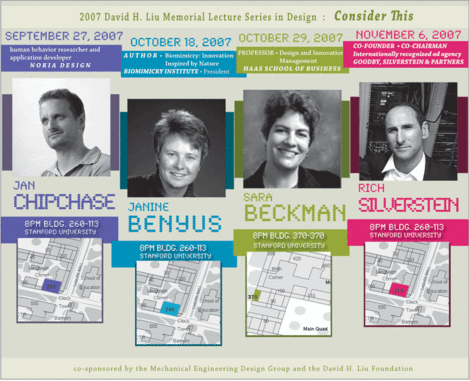
Fallposter

Consider This: the 2007 David H. Liu Memorial Lecture Series in Design is about to kick off at Stanford!

As usual, it is a pretty amazing roster of speakers, including Jan Chipchase, whose Future Perfect blog has been a mainstay of the metacool Cool Destinations blog roll for quite some time.  I had the great fortune to hang out with Jan at a beach party at TED earlier this year, and we had a (no surprise!) really interesting conversation.  Can't wait to hear him again.

I'd also like to issue a challenge for all of you with blogs or other means of spreading the word.  Over the years, attendance at the Liu Lectures has been less than one would expect given the quality of the speakers.  Which is a real pity, not just because the speakers are always amazing, but also because the series is a celebration of David Liu's love of designing things, and by showing up we pay respect. 

We can change that.  Let's embark on an experiment in creating infectious action.  Here's how:

  1. If you have a blog or a website, please post something about the Liu lectures.  Even if you aren't located near Stanford, please do this, as the web knows no boundaries.
  2. Then please send a trackback to this blog post so that I can keep a count of how this spreads
  3. Ask your friends and readers of your blog post to do the same

Cool.  See you there!

20 September 2007 | Permalink | Comments (4) | TrackBack (3)

| |

metacool Thought of the Day

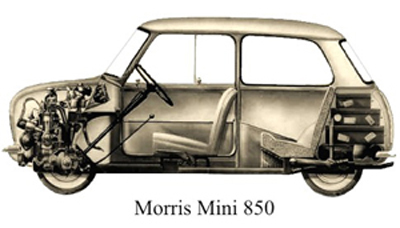
Minimorris

”One thing that I learnt the hard way – well not the hard way, the easy way – when you’re designing a new car for production, never, never copy the opposition.”

- Sir Alec Issigonis

18 September 2007 | Permalink | Comments (0) | TrackBack (0)

| |

Colin McRae, RIP


Colin McRae, a racer's racer.  RIP

15 September 2007 | Permalink | Comments (0) | TrackBack (0)

| |

More fractal experiences... how everything matters

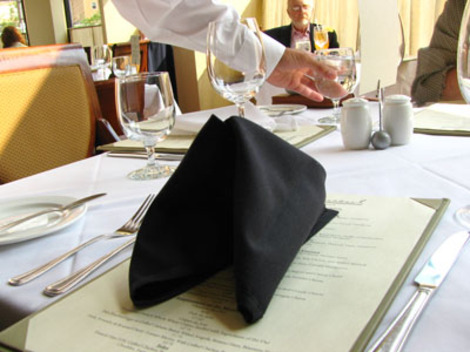
John Maeda recently had a remarkable experience in a restaurant in Minneapolis.  Here's a photo of what happened, followed by this commentary:

07_napkinsm

When sitting down at a restaurant in Minneapolis, I noticed the waiter replaced my white napkin with a black one. Apparently the tradition here is that if you are wearing black trousers or a dark skirt, the reasoning is that a white linen napkin might leave visible lint on your clothing so they immediately swap it for a black one. Such careful attention to detail surely develops trust.

A black napkin for black-robed laps feels just right, and is a world away from a crummy-looking nacelle on a passenger jet.  It makes an empathic (and emphatic) statement; we care about the way you'll look when you leave our restaurant.  And by making that statement, we say everything that needs to be said about the level of care poured in to the meal itself. 

Good experiences -- the drivers of good brands -- are fractal, and everything matters.

15 September 2007 | Permalink | Comments (1) | TrackBack (0)

| |

« Previous | Next »

Categories

  • designing
  • innovating
  • leading
  • marketing
  • meta metacool

search


About

Subscribe to this blog's feed

    follow me on Twitter

    Favorite Posts

    • A million reasons why...
    • Mo Cheeks and a fundamental question of leadership
    • Innovation Lessons from Garage Majal
    • From Obama to Pink to Oprah
    • Shinya Kimura and the primacy of doing
    • A tribute to friends and friendship
    • Strategy that makes your hands bleed
    • Quality in a switch
    • Travis Pastrana and the future of the world economy

    on the nightstand

    • : The Great Bridge

      The Great Bridge

    • : Porsche - Origin of the Species

      Porsche - Origin of the Species

    Principles for Innovating

    • 1: Experience the world instead of talking about experiencing the world
    • 2: See and hear with the mind of a child
    • 3: Always ask: "How do we want people to feel after they experience this?"
    • 4: Prototype as if you are right. Listen as if you are wrong.
    • 5: Anything can be prototyped. You can prototype with anything.
    • 6: Live life at the intersection
    • 7: Develop a taste for the many flavors of innovation
    • 8: Most new ideas aren't
    • 9: Killing good ideas is a good idea
    • 10: Baby steps often lead to big leaps
    • 11: Everyone needs time to innovate
    • 12: Instead of managing, try cultivating
    • 13: Do everything right, and you'll still fail
    • 14: Failure sucks, but instructs
    • 15: Celebrate errors of commission. Stamp out errors of omission.
    • 16: Grok the gestalt of teams
    • 17. It's not the years, it's the mileage
    • 18: Learn to orbit the hairball
    • 19: Have a point of view
    • 20: Be remarkable

    CC

    • Creative Commons License