metacool

thoughts on the art & science of bringing cool stuff to life, by Diego Rodriguez

metacool Thought of the Day

3

14 August 2008 | Permalink | Comments (0) | TrackBack (0)

| |

Forget strategy

An innocuous typo I saw today got me thinking:  what if we used a word called "startegy" instead of "strategy"? 

When faced with a blank sheet of paper, we tend to spend too much time engaged in discussions about strategy, otherwise known as "strategery", and too little time learning by doing.  In this context, talking a lot about what to do and why is inappropriate because we don't know enough about context and contraints. When you're getting out in to the world and starting things, guiding evidence has a way of surfacing in a way which doesn't happen within the cloistered confines of meeting rooms. 

Revolutions don't just happen, they get started.  Startegy. JFCI!

12 August 2008 | Permalink | Comments (2) | TrackBack (0)

| |

What's on Dieter Rams' iPod?

Check out Gary Hustwitt's cool new blog Objectified.  The blog is about his upcoming movie by the same name.  Here is what it is all about, in Gary's words:

One reason that I’m delving into the world of objects in this film is that I, admittedly, am obsessed by them. Why do I salivate over a shiny new piece of technology, or obsess over a 50-year-old plywood chair? What does all the stuff I accumulate say about me, and do I really need any of it in the first place?

Those of you who followed the making of my first film, Helvetica, know that the reason I make these films is not that I have a comprehensive knowledge of the subject matter. I wasn’t an expert on graphic design, and I’m certainly not an expert on industrial design. But they’re both fields that fascinate me, and that I want to learn more about. I’m interested in industrial designers because their work influences so many aspects of our world yet most of the time it’s taken for granted. And I think that, especially today, it’s crucial for us to re-examine how we make and use consumer products at every level.

And if you could get all of these designers and design experts together at a dinner party, what would they talk about? This film will hopefully represent that conversation. I’ve been lucky to be able to include an amazing group of participants in the film so far, and I sincerely thank them all for their time and knowledge.

The term objectified has two meanings. One is ‘to be treated with the status of a mere object.’ But the other is ‘something abstract expressed in a concrete form,’ as in the way a sculpture objectifies an artist’s thoughts. It’s the act of transforming creative thought into a tangible object, which is what designers in this film do every day. But maybe there’s a third meaning to this title, regarding the ways these objects are affecting us and our environment. Have we all become objectified?

About Dieter Rams: nothing.  What's cool is what is on his reel-to-reel.  Man, that thing is awesome.  If Apple sold one, I'd buy it in a second.
 

06 August 2008 | Permalink | Comments (1) | TrackBack (0)

| |

My new car is a...

... bike.  In fact it's this tasty number made by Breezer:
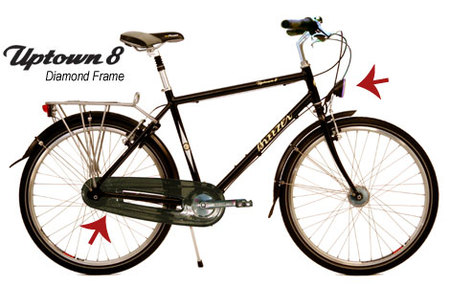
Uptownd_2


I've had the bike for about three months now, and have grown to love it on several levels:

  • It's an integrated experience:  I could have spent a bit less money by cobbling together an equivalent bike from bits and pieces, but the Breezer works really well as a unified whole.  Its designer, Joe Breeze, has a strong point of view on what makes a good bike, and I can feel that as I ride it.
  • It's fun:  I spent a significant percentage of my childhood free time messing around with bikes.  I lived for my BMX bike.  I was either jumping it off of tall things, riding it through deep pits of mud, fixing it and cleaning it due to the previous two activites, or finding a way to get moneoy tobuy upgrade parts.  Over the course of about six years I took it from being a $80 Huffy to being a mean, lean, nickle-plated jumping machine.  A Mongoose that flew through the air and even landed safely more often than not. By the time I was done modifying it, the only original parts left were the wheels (the original ones ran strong and true), and the chain.  I'm looking forward to hacking on this bike (because as Facebook has taught us, it's all about user-hackable platforms), and I just love the feel of the wind through what is left of my hair.  Fun fun fun.
  • It looks killer:  Amsterdam is the New LA.  Or Paris.  In other words, the cool look these days is fenders plus bells plus black paint.  Forget spandex and your aero tuck on that carbon fiber frame; sitting upright and maximizing your coefficient of drag is the way to go.  Admittedly, I've been unduly influenced by the editors of Monocle on this dimension, but I see the general rise in popularity of the Dutch bike aesthetic as a search for consumptive sobriety for sombre times; the Prius is statement about remorse for over exuberant car-ness, and I think black bikes with fenders are like wearing Timberland boots in a world of Blahniks -- the durable, practical,sensible choice.  That happens to also look killer in its own way.

Is the commuter bike the new Prius?

Yes.

31 July 2008 | Permalink | Comments (2) | TrackBack (0)

| |

What's old is new again

1

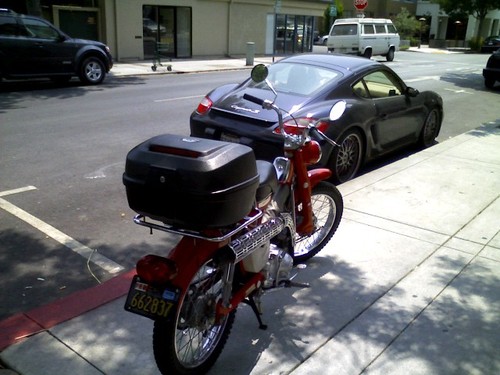
I spied this vintage Honda Cub on the street today in Palo Alto.  And yes, that is a tasty Cayman S just behind it, looking quite gnarly crouched down on a lowered suspension and some expensive three-piece wheels.  But I digress.  Let's focus on the Cub for now.

As our societal context changes, value propositions that were of no value can suddenly gain back their value, and vice versa.  In a world of cheap gas, a Honda Cub is an inferior mode of transportation in many ways to a Flabigator XL SUV.  But expensive gas is enough to bring one out of mothballs and use it to carry quite a bit of stuff, as witnessed by the large trunk strapped to the back of this one.

Innovation is about finding ways to grow that are right for you.  Do the ideas need to be new to the world?  Not likely, especially since there are few new things under the sun.  It may be as simple as looking back to times past in search of analogous situations.  People are still people.  What worked then that could work now?

25 July 2008 | Permalink | Comments (0) | TrackBack (0)

| |

More simplicity from the Glass House

Here's a video overview of the Simplicity Conversation I had the pleasure to be a part of earlier this year. 

Enjoy!

20 July 2008 | Permalink | Comments (1) | TrackBack (0)

| |

metacool Thought of the Day

"There is a very thing line between being dismissed and becoming a field-marshal."
- Sam Manekshaw

18 July 2008 | Permalink | Comments (0) | TrackBack (0)

| |

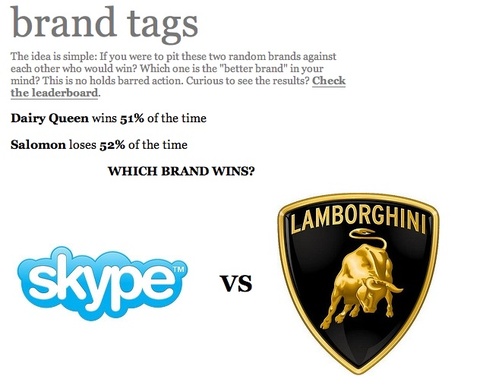
Brands are what we say they are: Brand Tags

Brand Tags is a website about something very near the absolute truth when it comes to the essence of brands.  It is truthful because it is not about positioning statements or a theories of meaning emanating from self-proclaimed branding gurus sitting deep inside corporate campuses.  Instead, it uses crowdsourcing to let all of us know what all of us really think brands stand for.

It is instructive and illuminating to peruse the catalog of brands.  For instance, this site helped me understand the gap I feel between my fondness for cars made by BMW and some aspects of the brand that surrounds them.  Here's what the crowd thinks of BMW:
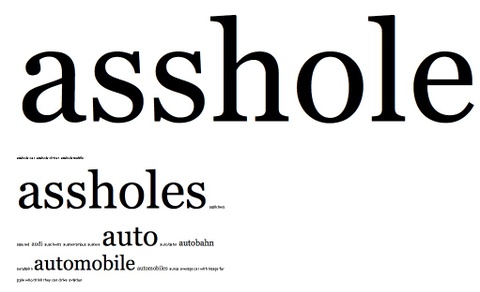
Metacool_no_bmw_rule

I admire this site because it flips the fundamental equation of formal market research on its head.  Instead of a few asking the many to provide isolated points of data which are aggregated in private for the exclusive use of the few, this is about the many publicly commenting on the work of a few.  It's brand equity made transparent.  The internet changes the equation of one-to-many communications such as market research so radically that we have to question many of the market research methodologies that worked well for the past fifty years.

Enough sermonizing.  The battle mode is a fun time sink -- watch out!
Metacool_brand_tags


17 July 2008 | Permalink | Comments (1) | TrackBack (0)

| |

There's something about GINA.

I've received a large number of emails from folks asking my opinion of the BMW GINA concept car.

Here's what I think:

  • GINA is about being remarkable.  And being remarkable, whether it be in the domains of design, engineering or marketing, takes guts.  BMW excels across all three of these domains, and does so in no small part due to having the courage of its convictions.  Sometimes these convictions are too strongly held, witness iDrive in all of its befuddling infamy.  But from iDrives to flame surfaces to Bangle Butts, BMW seems to be a place where errors of commission are forgiven.  It's about guts, in other words, and GINA is an tangible expression of those held by the brave folks from Munich.
  • GINA is about a return to a paradigm of flexible, articulating structures.  GINA's anthropomorhpic nature is quite sticky from an emotional point of view, but I find it most interesting in terms of a return to a structural paradigm used by early aviation pioneer such as Louis Bleriot.  Being covered with a fabric is not a new idea -- many cars used to have leather bodywork (and we still have lingering fabric convertible tops out there) -- but combining that fabric with an articulating structure is new for automobiles.  The wing of a Bleriot monoplane flexed in response to pilot control inputs.  To see that wing in motion is to see organic motion very different to the mechanistic slides and pivots that characterize modern airplanes.  When the light hits it just right, there are few mechanical structures more beautiful than a semi-translucent Bleriot wing.
  • GINA is a platform for a new age of open innovation and co-creation.  As Chris Bangle states in the video, attaching the fabric covering to the space frame does not require a great deal of time.  Imagine the cool stuff that could happen if BMW enabled "civilians" to riff on their own fabric covering patterns.  Or perhaps non-structural elements of the space frame could be easily modified within specified parameters to allow for surface improvisations.  And even the parameters controlling the wink of GINA's eyes could be made available for public hacking, so that you could upload new software routines and choose to have a sleepy car or a caffeinated autobahn stormer.  Most BMW's, I'd wager, would be the latter.

I'll take mine in a matte finish.

15 July 2008 | Permalink | Comments (0) | TrackBack (0)

| |

Have you...

... had a serving of Unabashed Gearhead Gnarlyness lately?

11 July 2008 | Permalink | Comments (0) | TrackBack (0)

| |

Everything matters: great marketing from Virgin America

I received this email last month the night before taking a Virgin America flight:

Dear Diego Rodriguez             
            
Due to delays in the modification of our new planes, the inflight entertainment and select other in-seat services will not be available on your upcoming Virgin America flight. This includes the Red Inflight Entertainment system, which normally features satellite TV, movies, games, Google Maps and a food ordering system. In addition, the plugs at every seat for electronic gear will not be operational for the flight. Why are we sending you this message? We want you to be prepared to have your laptop or iPod fully charged, and ensure you have the latest magazines or newspapers to read while onboard your flight. We’ll do our best to provide some reading material onboard in case you forget.

We make millions of dollars in high-tech modifications to each one of Virgin America’s brand new planes and we appreciate your patience with us as we finalize this modification process across our brand new fleet. Thank you again for your patience and we look forward to welcoming you on Virgin America.          

The Guest Services Team

As it turned out, when I boarded the inflight entertainment system was working (they had fixed it, I suppose) so my low expectations were greatly exceeded.  I was a happy guy: happy to be on a clean airplane with an enthusiastic crew, happy to get something I didn't think was going to happen, and happy that Virgin knew how to reach me with the right message at the right time. 

This message feels like it was written by someone who had flown on a plane at some point in their life, and understood the importance of having something to do during the flight.  Like having reading material.  It is a far cry from the disjointed jingle-driven marketing drivel spewed by most other airlines.  No tag-lines or positioning statements here; this is marketing at its best: all about making my experience the best it can be, and showing a concern for all the small elements of the flying experience which signal that the big stuff are being taken care of, too.  Great marketing is an exercise in fractal experience design.

09 July 2008 | Permalink | Comments (1) | TrackBack (0)

| |

My favorite new blogs: technohumanism & Our RISD

I really like technohumanism and Our RISD, John Maeda's latest new blogs.  For such as busy guy, Professor Maeda sure has a lot of blogs -- I count four on the metacool roster of cool destinations.  And maybe that's the point: if you're using a blog as a place to fool around with ideas, it helps open your eyes to the world, which then makes it easier to see the world, which then makes it easy to have things you'd like to blog about, and so forth.  Of course, it helps a lot if you start out with John Maeda's curiosity and energy!

If you have access to Monocle magazine, check out their recent profile of Professor Maeda's new role as the President of RISD.  Here's a quote where he is talking about where students of the future may come from:

"I want all these under-served areas that are massively creative and unique. How do you get to where the missing talent is? How do you find raw talent? Maybe it's ageless, maybe it's people who are 60-plus. I think all these stigmas can maybe go away."

If you're a reader of metacool, you know that greatly admire John's philosophy of doing both.  If I were 17 again and looking at places to pursue an undergraduate education, I would look quite seriously at RISD, for it is a place  all about exploration across boundaries.  When I was 19, after a harrowing freshman and sophomore years that felt like I was leaving my soul at the entrance to campus, I figured out a way to do both, and ever sense I've been happiest in life when I'm trying to do both.  Now, it's tough to do both at times (and I've been caught doing too much of both in the last six months), but life gets better and richer this way.  Why choose?  Do both.  One blog?  Why not two blogs?  One job?  Why not two?  How about three?  The only sell out is selling yourself short with false tradeoffs. 

03 July 2008 | Permalink | Comments (0) | TrackBack (0)

| |

Q: what does our brand stand for?

A: what does our space feel like?

The office of Lamborghini's marketing chief, Manfred Fitzgerald, is covered in a nice profile in Fortune magazine.  You can see a glimpse of it here, but unfortunately the best photographs of his office are only in the print magazine. 

Configured in raw aluminum, polished steel, black stone tile, and white leather, Fitzgerald's office does in fact look and feel like the embodiment of the current Lambo brand - which is something about German technical know-how and integrity draped in Italian mojo.  Audi-owned Lamborghini is the type of Italian car company whose marketing chief would most appropriately be named Manfred, in other words.  As is argued in the article, the aesthetic of the space informs the thinking done there which informs the greater brand of the company as embodied by its products.  Aside from the use of Eames chairs, the product of folks whose design sensibility sits in a place a world away from that of Lamborghini, it works for me. 

It also leads me to believe that imagining what one's brand-delivery knowledge working space should look like could be a great exercise for getting to the essence of a brand.  And perhaps a more effective exercise than coming up with keywords or images borrowed from stock imagery or from other brands.  For example, the workspace of the pre-Audi Lamborghini -- a chaotic, passion-filled brand -- would have been an old Emilian barn with a gas-welding setup in the middle of the room, spanners on a table, sheets of aluminum in a messy pile, and a pyramid of empty lambrusco bottles over in the corner.  And some loud opera playing off of vinyl.

Let's try some more to see if this works.  Close your eyes and imagine Apple's place.  You can see it, right?  It's not so different from Lamborghini's palace, except that people are wearing jeans instead of multi-thousand Euro suits, the floors are white instead of black, and there's a CNC machine in there carving something interesting out of a block of stainless steel.  Puma.  What would Puma be like?  I see it as an outdoor cafe in a hipster place like Miami, with multiple open-participation shoe creation stations where civilians (filtered by a hipster bouncer, natch) could help design future shoes.  Subaru's brand development place would be a heli-vac capable modular building transported around the world on a seasonal basis, always positioned out in the boonies where there's a good supply of muck, gravel, snow, and sheep filth.  Petter Solberg would have a permanent bunk bed there, always ready to roll, so long as he slept in his nomex coveralls.

These are the types of spaces where brand-creating folks should be sitting, not in some corporate cubicle-ville where the closest cultural wellsprings are a TGI-McFunster's, a parking lot, and the nearest highway.  Living in the brand in order to create the brand.  Virtually or literally, it makes sense.

02 July 2008 | Permalink | Comments (0) | TrackBack (0)

| |

Benjamin Zander on Leadership

This is the second of my three favorite talks from TED2008 (Jill Bolte Taylor's being the first).

Here Benjamin Zander delivers a nice insight in to what makes well-performed classical music a sublime aesthetic experience.  But what impressed me so much about Zander's talk was his message of leadership being about making eyes bright.  This is a truly moving TED talk, and an informative one as well.

26 June 2008 | Permalink | Comments (0) | TrackBack (0)

| |

Man, how are we ever going to get disruptive?

Two of my favorite books on innovation are The Innovator's Dilemma and -- you guessed it -- The Innovator's Solution.  However, not all is well and good in the world when it comes to my relationship with these books: my dilemma is that I am lacking a good solution in terms of influencing people around me to actually read them.  Short of actually taking a class with Clay Christensen and reading the books because you're so afraid he's going to cold call you on the day when you've forgotten to memorize the killer chart on when to spin a venture out versus leaving it inside, I can't imagine a motivational technique for encouraging each and every page to be read (me, I've read each ten plus times... but I'm a geek that way). 

But maybe it's more about getting people to a disruptive state of mind?  Maybe it's about getting them on the bus?  If convincing folks to read either edition of Innovators is tantamount to dragging old wild horses to water and teaching them a new trick, then I can't help but admire this alternative solution from the Boulder office of CP+B:

L1020006_7

A Disruptive Thinker Transport!  Why didn't I think of this? I find this fantastic piece of graphic design particularly funny, but then I grew up in Boulder and suffer from a bit of that locale's typical twisted (or is that disruptive?) sense of humor.  When this thing makes its way up to Gunbarrel, massive seas of Legacy Outbacks part and make way.  Make way for disruption!  Yield to the low end, Volvo 240 wagons of the world!

Read more about it at John Winsor's fine blog.

23 June 2008 | Permalink | Comments (1) | TrackBack (0)

| |

metacool Thought of the Day

"If we have a strong sense of purpose, good friends, loving relationships, meaningful work, and good health it’s very likely that we will also quite frequently experience happiness in our lives. Yet, happiness is a by-product of pursuing those other goals and I think that analogy applies to business as well. In my business experience, profits are best achieved by not making them the primary goal of the business. Rather, long-term profits are the result of having a deeper business purpose, great products, customer satisfaction, employee happiness, excellent suppliers, community and environmental responsibility—these are the keys to maximizing long-term profits. The paradox of profits is that, like happiness, they are best achieved by not aiming directly for them."

- John Mackey

18 June 2008 | Permalink | Comments (0) | TrackBack (0)

| |

Cybergenic is the New Telegenic

Cybergenic is the New Telegenic. 

Check out this awesome essay by Paul Saffo -- he really nails it:  Obama's 'Cybergenic' Edge

So many structural shifts are happening right now.  Most of the assumptions we have about how the world of power and influence works are based on paradigms dating back to the 50's and 60's.  New platforms and mindsets open up great value to those willing to work with them. This is an exciting time to be playing with the art and science of bringing cool stuff to life.

11 June 2008 | Permalink | Comments (0) | TrackBack (0)

| |

The new iPhone 3G is cool, but...

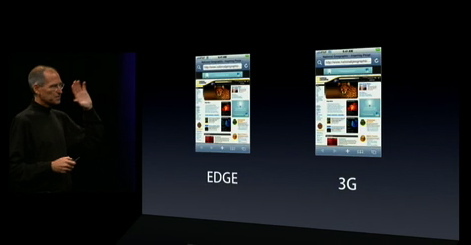
... a particular 59 seconds of the introductory demo was sheer brilliance.  At the Stanford d.school where I teach, I'm all over students like a broken record, repeating a mantra of "show, don't tell.  show, don't tell.  show, don't tell".  A great demo is one where you show how all your hours of process brilliance have created something truly remarkable, but the point of proof lies in only showing that which is remarkable, rather than telling us how you got there.  In other words, show, don't tell.
59secondsofbrilliance

Take a look at the rhetorical brilliance of Steve Jobs in his iPhone 3G introduction here.  Forward the video to the 1:27:21 mark, and watch through 1:28:50 to see an awesome 59 seconds of demo magic.  Show, don't tell.

09 June 2008 | Permalink | Comments (0) | TrackBack (0)

| |

Great Marketing 101: Download Day 2008

Download Day

Here's a cool example of creating infectious action being done by the folks at Mozilla: Download Day 2008

I found about it via Facebook.  Based on the pledge ticker at the Download website, it appears to be working quite well.

Infectious Action = Remarkable Offering + a Sticky, Compelling Message + a System Designed to Spread


06 June 2008 | Permalink | Comments (1) | TrackBack (0)

| |

metacool Thought of the Day

"The iPhone is merely a triumph of guts. It's a triumph of someone forcing   people to do things they were scared of, and thus completely changing the paradigm of a multibillion-dollar industry."

- Seth Godin

04 June 2008 | Permalink | Comments (0) | TrackBack (0)

| |

Amazing design thinking @ D6

I attended All Things Digital last week, and -- much to my surprise -- walked away with more than just a more informed view of where the digital ecosystem is headed.

As cool a conference as it is, I didn't expect to have an emotional experience.  But there you go, my hat got knocked in to the creek by the amazing work being done by Dean Kamen's group at DEKA. Take a look at this video and tell me that you aren't blown away by the wicked combination of elegant engineering, high-minded problem solving, and a darn-it-we'll-solve-this-challenge-no-matter-what sensibility:

For the impatient among you (and who isn't in this Web 2.0 world), fast forward to about the 2:30 mark.   You can read more about these arms here.

Each time I see this stuff I get tears in my eyes, and to see innovative engineering like this makes me feel optimistic about the future of the profession.  As organizations age, I believe there's a tendency for established disciplines to cease to be creative, to become more critical than generative.  Success naturally leads to conservatism and a desire to preserve the status quo.  Engineering, more so than other disciplines, is prone to this dynamic.  Great engineers push hard to find elegant solutions to seemingly impossible problems.  Mediocre ones don't.  Innovation is really about being innovative.  In other words, it is a way of being, and it is a personal choice.  Let's keep thinking of these arms from DEKA in all that we do. 

02 June 2008 | Permalink | Comments (0) | TrackBack (0)

| |

More on leadership matters

Look at an organization which is doing great stuff in the world, and you'll very likely see leadership which knows whereof it speaks.  Not leadership who got there by doing something unrelated.  I've written recently about leaders who know what they are doing because they've done it before they were leaders.  Let's call them "do it - know it - do it" leaders.  These are folks such as Takeo Fukui (Honda) and John Heinricy (GM) as exemplars of this.  My friend John Lilly of Mozilla is another good example, and the list goes on and on: Steve Jobs, Wendelin Wiedeking, A.G. Lafley -- you get the picture. 

Roger Penske is another exemplar of this ethos, as illustrated by this New York Times article from a few years ago.  Here is a telling example of "do it- know it - do it" leadership at work, describing the scene around the Penske garages as Team Penske prepares to race at the Indy 500:

Early Friday, as crews prepared for the final practice before the race, a Penske employee, wearing a crisp white shirt, black pants and black shoes, stood outside the garage, using a paper towel to wipe down barricades printed with Penske's logo.

Most teams do not have such barricades. Penske's employees wear uniforms with embroidered logos, not stitched-on patches. They share one big toolbox, but each crew member has a drawer. Parts that can be polished are polished — every day.

"The real success is in the details," Penske said as he sat behind the desk in his motor home Friday. "I've tried to be a leader by getting my own hands dirty."

Then he washes them. Penske cannot say for sure that being fastidious off the racetrack results in being fast on it. What he can say, though, is that he has created a culture that has fostered loyalty. And loyal employees produce results.

Executional excellence is one part of the story.  Knowing which details to focus on is something that comes from experience in working in operational settings.  Dirty trucks don't show up on a P&L statement, at least not directly, but as a statement of brand integrity, they most certainly do over time.  To have a sense for this, you'd have to get out of the boardroom and take a look around.  But just looking isn't enough.  When you look, you need pattern recognition to see what is important, and that ability to see deeply can only be informed by relevant personal experience.

Morale and motivation and alignment are the other big wins of "do it - know it - do it" leadership environments.   Al Unser Jr. is quoted in the article as saying ""He is the one car owner of all the car owners I drove for who truly understands what a driver is going through out there."  Racing drivers put their existence on the line when they go out on the track, so it's easy to understand the importance to them of having someone who understand what they're going through, who will demand perfection in mechanical preparation as Penske does.  But why shouldn't that be the standard for any organization?  If I'm going to ask you to do something, especially something really tough and hard such as creating something meaningful from a blank sheet of paper, shouldn't I understand your task deeply enough to be able to do things that increase the odds that you will come out of it victorious and healthy and happy?  Otherwise why would you take the plunge with me instead of with an organization with better odds of success. 

If not for that, why are we all here?

23 May 2008 | Permalink | Comments (2) | TrackBack (0)

| |

A picture is worth...

If you haven't yet made Presentation Zen a part of your blog diet, I encourage you to do so.  PowerPoint presentations trying to do what should be better done with prose are destined to fail.  Getting an audience to believe in what you're saying, to go somewhere with you, is better done with spoken words over images.

For example, what better way to sum up the state of the Yahoo!/Microsoft transaction than this wonderful image, brought to us by Brad Feld? 

Touché, my friend.  Touché.

20 May 2008 | Permalink | Comments (0) | TrackBack (0)

| |

Why management matters

Ctsv_greenhell1280

When it comes to being innovative and the art and science of bringing cool stuff to life, does the kind and quality of management matter?

Yes.

I've written before about the importance of having management who knows what good looks like.  I think we'd all agree that a computer company should have people who know the best computer when they see it, and that a restaurant's menu should be the result of a passionate chef.   

Part of the reason behind the emergence of cars like the amazing new CTS-V out of General Motors is the presence of product development executives like John Heinricy, who is the one who pedaled the CTS-V to a record time around the famed Nurburgring.  It may be the most obvious statement of the year, but a simple strategy for creating winning offerings is to put power in the hands of people who know what good is, and know how to bring good to market.  That's what GM is doing these days.  As you watch Heinricy at work in this video of the record lap (via a camera strapped to his head), ask yourself if your management team could take their own products to the limit in their own way.

15 May 2008 | Permalink | Comments (1) | TrackBack (0)

| |

Glass Houses

A pretty good Billy Joel album, and a simply great day of design thinking I experienced just the other week at the Philip Johnson Glass House.  I was fortunate to take part in a Glass House Conversation hosted by John Maeda on the subject of Simplicity.  Keen readers of metacool will no doubt recall that Professor Maeda's book The Laws of Simplicity is one of my all-time favorites (be sure to watch his brilliant TED talk here).  His thinking has had an enormous influence on my work.

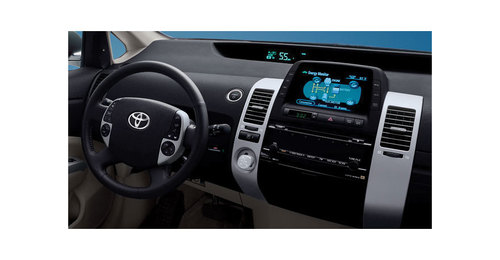
Each of the attendees were asked to be the guru for one of the ten laws of simplicity.  I chose the 5th law, Differences, which states that simplicity and complexity need each other.  I spend a lot of my time designing and implementing organizational systems which enable people to do things they otherwise couldn't.  I find time and time again that solutions that aspire only to simplicity tend toward the simplistic, and those that embrace only complexity veer off toward a morass of complexity.  Balancing the two, and figuring out where to place the complexity so that it creates value, and how to position the simplicity to extract that value, is the art.  Here's the illustrative example I brought with me to the Glass House, a snapshot of the dashboard from a Toyota Prius (you were expecting something other than a car from me?):
2454820208_f91cda8d46_o

The cockpit of the Prius is one of the simplest on the market.  A digital readout replaces traditional gauges, buttons are few in number and highly considered in placement, and even the gearshift is just about going foward or backward or not.  And yet the Prius is arguably the most complex car you can buy.  Its gas-sipping nature stems from having not one but two motors, connected to the driving wheels by a fiendishly clever transmission orchestrated by a suite of chips of immense processing power.  All of that complexity without a mediating layer wouldn't be the car that non-car people love to own and operate.  The Prius is a great example of the 5th law.

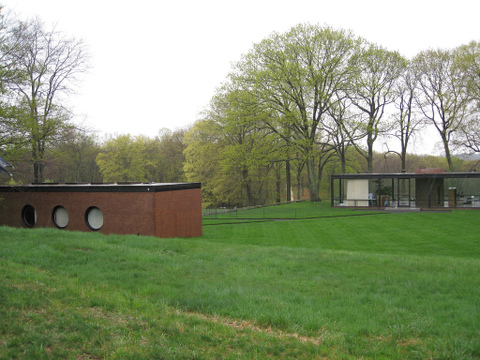
I saw the law of Differences in action at the Glass House.  Having only ever seen the Glass House in history books, I didn't have a feel for the complexity of the campus on which it stands.  Over time, Philip Johnson built a family of structures which work together in quite interesting ways.  For example, did you know that the Glass House has a sister structure in the Brick House?  Here's a view of the two of them:
2454783848_82f7063568_b

All of the mechanical needs of the Glass House are met by the Brick House.  An underground umbilical shaft connects the Glass House to a feed of heat from the Brick House.  The Brick House also contains a bedroom for those times when one might like to engage in... er, some more complex acts of human nature than would be appropriate in a public setting.  A Glass House without a Brick House to power and feed it would be untenable.  Even from a purely formal aesthetic sense, the two houses work better together than apart.  Simplicity and complexity need each other.

I really enjoyed the afternoon of conversation on design, business, technology and life.  I've had a fortunate life of exposure to some pretty amazing people and experiences, and this was right up there.  I'd like to show you some photos, not to gloat, but to share some fun stuff from the day in the name of creativity and openness. 

An amazing group of chefs prepared a meal for us in the Glass House.  It centered on themes of simplicty.  Wine was served.
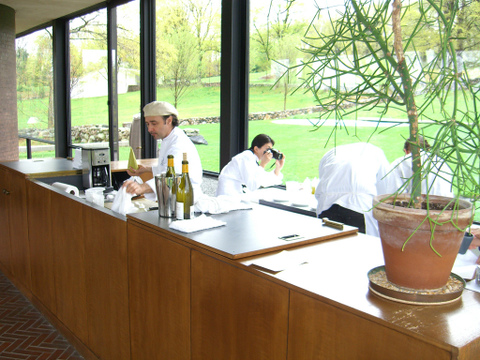
2469207531_66b46aac00_b_2

We sat at table together and talked and ate and watched the weather go from stormy to sunny and back again.  You can't help but be immersed in the weather in this architecture.
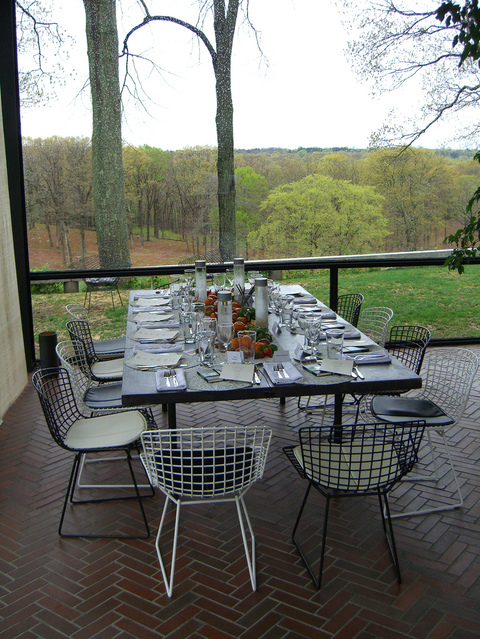
2469253551_53d9387023_b

We had assigned seats.  I sat in a white chair and ate more than my fair share of the edible centerpiece, which was quite tasty in its own right.  This is my favorite photo from the day:
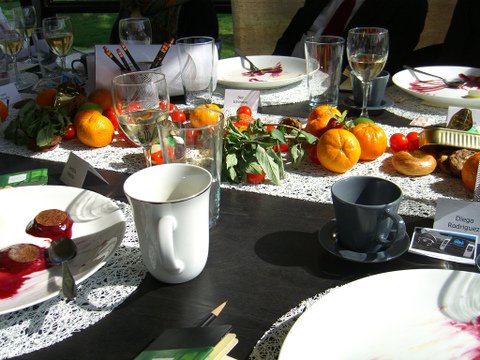
2470064212_d01ed83026_b


13 May 2008 | Permalink | Comments (1) | TrackBack (0)

| |

What is this all about?

Designing is the process of linking need with desire. 

It's easier (and better) to sell something which is desirable, rather than (un)desirable.

Desirability is value by another name.  A more insiring and emotive name. 

Would you rather be valuable or desirable?

We're in the business of creating desirability via innovation.

08 May 2008 | Permalink | Comments (1) | TrackBack (0)

| |

Words of wisdom from Jeff Bezos

BusinessWeek recently ran a wonderful interview with Jeff Bezos on the subject of managing and leading innovation.  Thoughtful and illuminating, he had me nodding my head and saying "yes", "yes" and "yes" again.  Some highlights:

On the liberating nature of constraints:

"I think frugality drives innovation, just like other constraints do. One of the only ways to get out of a tight box is to invent your way out. When we were [first] trying to acquire customers, we didn't have money to spend on ad budgets. So we created the associates program, [which lets] any Web site link to us, and we give them a revenue share. We invented one-click shopping so we could make check-out faster. Those things didn't require big budgets. They required thoughtfulness and focus on the customer."

On cultivating a purposeful portfolio of innovation:

"With large-scale innovation, you have to set a very high bar. You don't get to do too many of those [initiatives] per unit of time. You have to be really selective."

On the right timing for innovation:

"My view is there's no bad time to innovate. You should be doing it when times are good and when times are tough—and you want to be doing it around things that your customers care about."

02 May 2008 | Permalink | Comments (1) | TrackBack (0)

| |

metacool Thought of the Day

Wangyangming

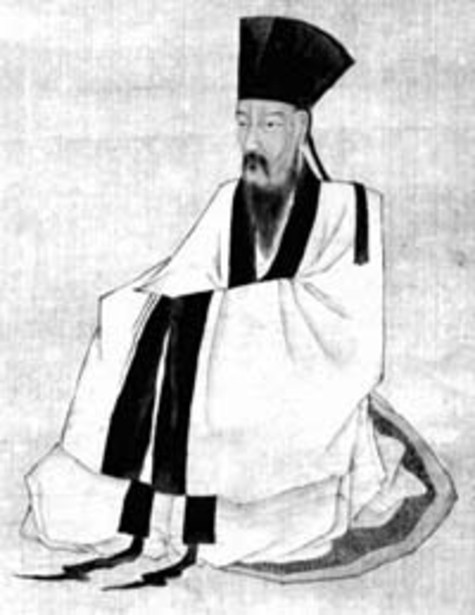
"I have said that knowledge is the purpose to act, and that practice implies carrying out knowledge.  Knowledge is the beginning of practice; doing is the completion of knowing."

- Wang Yangming

30 April 2008 | Permalink | Comments (0) | TrackBack (0)

| |

Location Change: d.school Conference Now at Hewlett 201 on the Stanford Campus

ALERT!  ALERT!

We have had a BUNCH of folks sign-up for our conference on Creating Infectious Action so we are moving to a bigger room. It is now in Hewlett 201.

Here is the link to the new location.  The event still goes from 3:30 to 6 with a reception to follow.  See you there!

30 April 2008 | Permalink | Comments (0) | TrackBack (0)

| |

May 1st Innovation Conference @ Stanford d.school

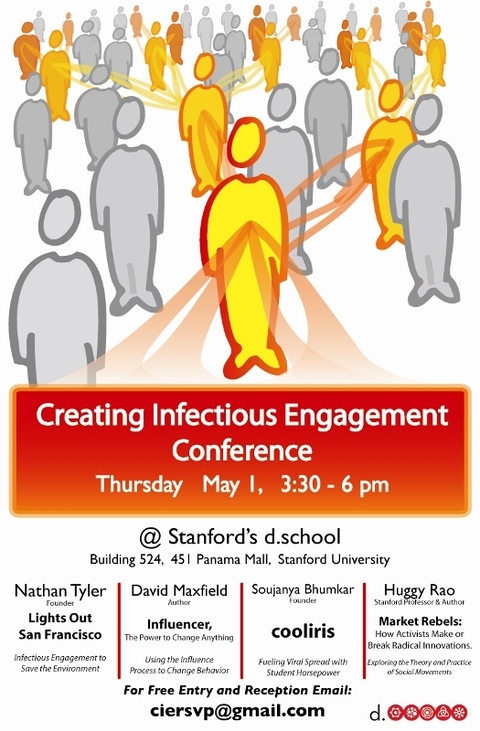
The Stanford d.school class I'm co-teaching on Creating Infectious Engagement is holding a conference next Thursday May 1st from 3:30 pm to 6:00 pm.  Will you please come if you are in the area? 

We've held a conference the previous two years of teaching the class, and each one has been a highlight of the quarter.  Previous speakers have included luminaries such as Steve Jurvetson, Perry Klebahn, Dennis Whittle, Mari Kuraishi, and Jessica Flannery.  Folks that knock your hat in the creek.

This year is no exception.  I can't wait to hear all of them speak, and Ruggy Rao in particular is one of my favorites. Please RSVP to Joe Mellin at ciersvp@gmail.com if you will be joining us so that we can arrange for the right quantity of tasty vittles and libations.

Where?  Our KILLER new d.school space at Stanford Building 524.  This building is right across from Old Union, near the Design Loft.

Since this is all about creating infectious action, please tell your friends all about it!
Wholeposter_3


23 April 2008 | Permalink | Comments (0) | TrackBack (0)

| |

Unabashed Gearhead Gnarlyness

It's all about a brand that is based on a truth rooted in getting real stuff done in the world.  It's not about selling the sizzle, it's about selling a steak that sizzlers.  Hot!  And a juicy one at that.

What makes it all authentic is the relatively close tie between the WRX's you see pogoing around in this video and what you or I could buy down at the corner Subaru dealer.  They're a lot closer to the civilian models than anything you'd find in NASCAR, let alone Le Mans racing or even touring cars.  Effective marketing is about brands that are real, not fake.  Truth, not myth.

16 April 2008 | Permalink | Comments (2) | TrackBack (0)

| |

The ultimate long tail business model?

Here's the most radical version of a long-tail business model yet:

Icon Group International

Here's the video summary:

14 April 2008 | Permalink | Comments (1) | TrackBack (0)

| |

It's in the mail...

Usps08sta023c1

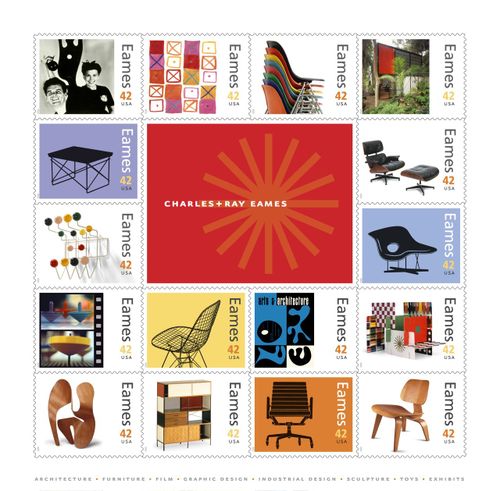
I feel blessed to live with four Eames-authored items in my household.  Especially my book-laden nightstand,  which means a vision of Eames is the last thing I see before shutting my eyes.  That little Eames wire table is the first thing I bought after getting a real job out of college.

Simple pleasures.

Speaking of which, these lovely stamps, to be issued this summer, will be a nice way to send a friend a little kiss of design thinking at its best.

10 April 2008 | Permalink | Comments (1) | TrackBack (0)

| |

New York Times, meet Alltop. Your disruptor.

Featured in Alltop

Personally, I haven't had much luck with RSS readers.  I suffer from the "weekend barrier" -- I'd rather not spend the time to curate my own collection of RSS feeds, and I often wonder what I'm missing out there that I simply don't know about.

Enter Alltop, a new experiment from Guy Kawasaki and friends.  I like it as brain food: it feels like the New York Times in terms of breadth, but deeper in passion due to the laser focus of each of the "contributors".  It's curated RSS, or perhaps even an edited newspaper, but with a radically streamlined business model, with each of the "contributors" having an individual revenue stream of their own design.  As such, Alltop represents a disruptive business model relative to the New York Times.  Let's see where it goes.

And yes, metacool is part of Alltop!  Definitely take a few minutes to wander through the various sections -- lots of cool stuff!

Alltop_170x30b_2

08 April 2008 | Permalink | Comments (1) | TrackBack (0)

| |

metacool Thought of the Day

"When I am no longer controversial I will no longer be important.'
- Gustave Courbet

Are people upset with you?  It is because what you've done is so bad it is shameful, or because it is so polarizing, so rooted in a strong point of view that all but the most progressive or forward-thinking people don't understand and "get it"?  Do you want to design for the mass market of today or tomorrow?  Are you designing under the old paradigm or for a new one?

Having a strong point of view, informed by real human needs, is at the core of how design thinkerdoers behave.  They make choices, and thus end up with strategies grounded in the needs of real human beings, real organisms, and the planet, and end up with something whose value proposition is intelligible, which creates real value for a real soul somewhere in the world, and is designed to spread and reach the right people, whether that be a bushel or a billion.

Making choices, taking the route which may be controversial or even painful, is about being willing to live with innovative outcomes. 

03 April 2008 | Permalink | Comments (2) | TrackBack (0)

| |

Quattro!

Audi_quattro_pikes03

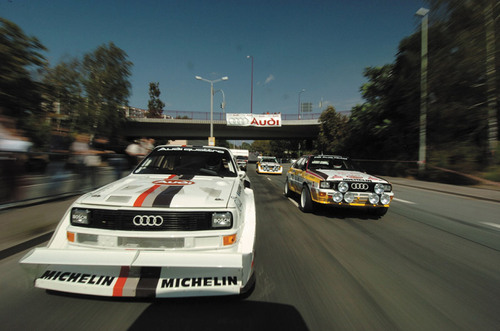
I'm happy to say that metacool turns four today.  Huzzah!

Four years ago my wife vacationed attended a yoga camp or something in Hawaii and I stayed behind in California because of work commitments.  Me, at home by my lonesome and wondering how I might learn a bit about how ideas diffuse across the web, decided to indulge my 3rd-grade ambition to be a writer, and cranked up this blog by writing a one-liner about the merits of ugly cars.  Thus was born metacool.*

Some 838 posts later, I'm still at it, and I thank you for your patronage and for the great conversations.  The great thing about taking risks in life and just doing something is that unexpected things emerge, stuff you never anticipated would happen.  I can honestly say that this little blog landed me two great new jobs, a new hobby that routinely transports me to a state of flow, and an incredible group of new friends.  Via metacool I've been able to befriend people everywhere from the Middle East to Japan, and just about everywhere in-between.  I've quite literally met some of my heroes, too.  I am very grateful for all of these human experiences.

My wife has been my biggest supporter.  I can be a bit obsessive about my passion for the art and science of bringing cool stuff to life.  For example, she came with me the day I visited the Ducati factory, the Pagani atelier, Fiorano raceway, and the Ferrari museum, all without even a pitstop for a coffee, let alone lunch.  That's  love.  Please join me in thanking my wife for her patience and support over the past four years as I've dribbled out these posts.  I'd likely be a little fitter, our household a bit more together, and more rested than I am now if it weren't for the time I spend writing stuff here.  But it is so fun, and I've learned so much.  My wife is just great, and words fail me.

Thanks for quattro, let's go for otto.  And flow.

* actually, I already had a mailing list going on Yahoo Groups called metacool.  Blogging on TypePad, as it turned out, is much cooler than spamming your friends.

02 April 2008 | Permalink | Comments (3) | TrackBack (0)

| |

Introducing a new blog: Unabashed Gearhead Gnarlyness
Picture12_3

Never leave well enough alone.

Spring is in the air, and the team here at metacool world headquarters just returned from a week-long management retreat where, among other things, we decided to revamp the way we go to market.  It's time for some market segmentation.  Instead of delivering metacool goodness through just one tube called metacool, we'll now be delivering metacool goodness through two of these tube structures which we're told make up this internet thing.  More than double the fun, and a new way for me, I mean us, to investigate some passion areas without boring the majority of you all to tears.

If you dig my coverage of the more visceral aspects of our designed environment, please tune your radios to my new blog called Unabashed Gearhead Gnarlyness.  Where metacool is all about the art and science of bringing cool stuff to life, Unabashed Gearhead Gnarlyness is focused on the visceral side of things.  If I were to imagine a Venn diagram of sorts, then this new one would overlap 90% of its area with the older one.  One can't understand the art and science of bringing cool stuff to life without understand the visceral sides of things, but many folks interested in the art and science of bringing cool stuff to life bore easily when fed gearhead gnarlyness more than once a month.  Hence the segmentation. 

If it helps, allow me to sketch out a prototypical target audience member for each blog:

  • metacool:  early forties, with 2.3 years of graduate school; enjoys a fine red wine and dines on gourmet Vietnamese cuisine at least 2x per week; can name the drummer on every Coltrane album; also reads the NYT, Winding Road, the Economist, and Monocle (but is unsure where the last publication is going); recently augmented the 1964 Aston Martin with a Breezer Uptown 8 bike.
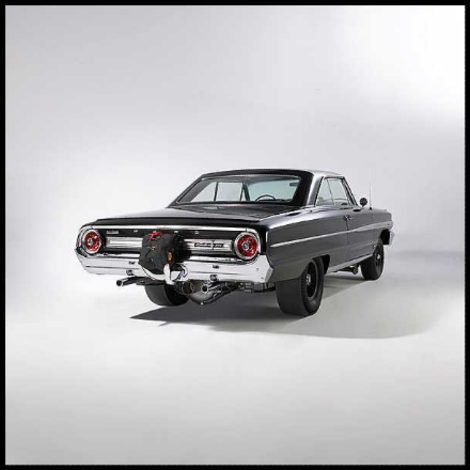
  • Unabashed Gearhead Gnarlyness:  mental age of 14 regardless of true physical age; likes music a whole lot but suffers from hearing loss from standing too near to too many aluminum-block Can-Am V8's;  likes any number of fine cuisines but is equally comfortable with cheese doodles and a fine light beer from Golden, Colorado;  used to read Road & Track, Automobile, Car & Driver, Autoweek, Autosport, Racer, Motor Trend, Car, Air & Space, and Bicycling, but dumped all of those subscriptions for Winding Road alone; recently modified the 1964 Aston Martin with a supercharged Chevy small-block conversion, and added a Boeing Stearman to the internal combustion corral because of the sound it makes.  Secretly prays each night to receive a Ford rocket Galaxie from the Easter Bunny or Tooth Fairy.  Or both.

Does that help?  In other words, I am both of these blogs, and they are both me.  I want to have a way to explore visceral stuff more deeply without turning off the rest of you.  I am mildly dismayed when metacool is called a "car blog" (it isn't -- I merely use cars as a lingua franca to talk about innovation), but I would love it if Unabashed Gearhead Gnarlyness were labled as such.  One of my favorite public intellectuals is Russell Davies, and all I'm really doing here is aping him or Kevin Kelly, each of whom maintain a nice collection of inter-related blogs.  Looking at what Russell does, hopefully Unabashed Gearhead Gnarlyness is to metacool as eggsbaconchipsandbeans is to we're as disappointed as you are.

This new blog is a working prototype.  The graphic design is rough, and some of you loyal readers will recognize some older content.  Thank you for patience and feedback as it moves forward.

Let me know what you think by dropping me a line or leaving me a comment.

AFAQS*:

  • Why are you wasting your life blogging about cars?  Well, I don't really blog about cars that much.  But I believe it is vitally important to understand the visceral side of things if we're going to make much progress on planet Earth.  Why doesn't everyone drive a fuel-efficient car?  Why doesn't everyone ride a bike instead of driving a fuel-efficient car?  Why don't we ride public transportation?  All of these have to do with what I call the challenge of making green red, and unless you dive deep in to our reptilian psyches as I plan to do here, I think you lose the big picture.
  • Will there be less Unabashed Gearhead Gnarlyness on metacool?  No.  But there will be more at Unabashed Gearhead Gnarlyness.
  • Will the character of metacool change?  I think so, but only gradually.  When I started writing metacool, I was but a lad in my early thirties without a care in the world and a hot 240-horsepower car in the garage.  Now I'm an old man with two kids, a mortgage, and a real job, and my hot car now gets out-dragged by a Camry from Hertz.  As I move through the world, I'm actually less interested overall in aesthetics and product-related stuff, and more interested by macro economics, psychology, and organizational dynamics.  I hope metacool continues to be interesting across those domains.

Oh my goodness, this has to be the most boring post I've ever written.  Let's get back to business!

Ship it!  JFCI!

Unabashed Gearhead Gnarlyness


* Anticipated to be Frequently Asked Questions


31 March 2008 | Permalink | Comments (1) | TrackBack (0)

| |

metacool Thought of the Day

"I've always thought that being early is a bit like being lucky. If you're early good things happen."

- Russell Davies

27 March 2008 | Permalink | Comments (0) | TrackBack (0)

| |

Presenting the Lutzinator

Pontiac

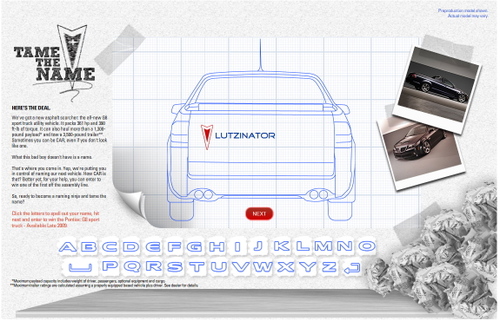
A while back I wrote about the crazies at Ducati tapping in to the power of co-creation.  By promising to use a  name submitted over the web for its new G8-based car/pickup, Pontiac is pushing that idea harder.  If you go to Tame the Name, you too can submit a name for this new product.  How cool is that?  Go ahead, submit a few. 

I've said it before, and I'll say it again: when it comes to using the web to push the frontiers of marketing, the people at GM know what they are doing.  I love this initiative: good marketing takes guts, and Pontiac is about to enjoy a true brand renaissance.  They finally have fantastic product (but perhaps poorly timed, given $4 gas...) and it appears as though their marketing folks are working hard to shed any remnant of their screaming-chicken past.  Another decade of this kind of execution and Pontiac will be the new BMW.  I kid you not.

25 March 2008 | Permalink | Comments (0) | TrackBack (0)

| |

Messing around with virality in Facebook

I'm a big believer in knowing by doing.  So in preparation for my upcoming Stanford class on Creating Infectious Engagement, which will involve a viral marketing project for Facebook, I've been messing about a bit over in their part of the world.

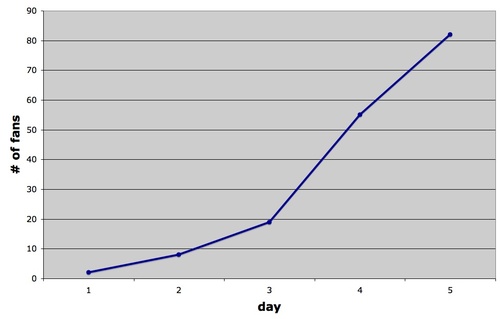
This past weekend I set up a "I'm a fan of" page on Facebook for the Stanford d.school.  Using some tools built in to Facebook, I sent notice of this fan page to four key connected mavens, and have been tracking the membership stats over the subsequent days.  Here's what the curve looks like, tracking the total number of fans at the end of each day (or at my 10pm bedtime, to be more precise):
Dschool_fan_diffusion

I'm not sure what to think about these results.  Any comments or ideas from Facebook and/or marketing gurus would be great. 


21 March 2008 | Permalink | Comments (5) | TrackBack (0)

| |

Jill Bolte Taylor at TED2008

This is the first of my three favorite talks from TED2008.  Not only does Jill Bolte Taylor use the best stage prop I've ever witnessed in a live speech, but she manages to talk about left brain and right brain in a way that helps us understand the power of living with a truly whole mind. 

Her presentation blew me away the first time I heard it, and my second and third viewings have been just as powerful.  I've already made some changes in my life as a result of her words.

12 March 2008 | Permalink | Comments (6) | TrackBack (0)

| |

Want an innovative culture? Status differences blow

Hondajetexterior2

When it comes to bringing cool stuff in to the world, I'm a big fan of Honda.  If you've been around metacool for any period of time, then you know that I admire Honda a great deal.  I've written about Honda's ability to innovate on a routine basis, about the fact that it is led by someone who really -- really! -- knows the business, about its ability to advertise truth rather than myth, about the pickup they make which I dearly want and am only waiting for the diesel model to arrive to purchase, and about kick-ass minivan race cars made by Honda's own employees on their own time because, well, kick-ass minivans are a kick in the ass if you're a racer.  Just about everyone at Honda, it would seem, is a racer, as explained in this great article in Fortune:

Unlike Toyota (TM), which is stodgy and bureaucratic, Honda's culture is more entrepreneurial, even quirky. Employees are paid less than at the competition, and advancement is limited, given Honda's flat organization. Their satisfaction and fierce loyalty to the company come from being around people like themselves - tinkerers who are obsessed with making things work.

At the risk of making a broad generalization, I would say that innovative startups and more mature organizations capable of innovating on a routine basis (like Honda) share two key elements in common:  first, a remarkable lack of status differences among employees, and second, a low-friction environment when it comes to the meritocracy of ideas.  I actually believe the latter is a function of the former.  Why? 

We all have 24 hours a day to live our lives.  We have finite time and energy at our disposal.  If we all start with the same account balance, some of us choose to spend it worrying about what our boss's boss thinks about us, or on over-preparing for that internal review meeting, or on wondering what our growth path is.  Others say "this is this" and get on with being generative, pushing ideas as far as they can go, and helping others see what works by gathering real evidence from the world and letting opinions fall by the wayside.  Status differences are energy sinks.  Do you want to spend your life worrying or producing?  Dramatic status differences lead to dramatic wastes of energy. 

Show me a group of people who worry less about where others think they stand, and more about how things are really going and how they might do things better and cooler, and mark my word, that's the group of innovators.

11 March 2008 | Permalink | Comments (0) | TrackBack (0)

| |

A wonderful example of a disruptive business model

Here's a great example of a low-end disruptive business model: Psychotherapy for All

The more I work on the creation of disruptive business models, the more I'm convinced that there's almost always room for a disruptive model.  One just needs to start with human needs and look hard, work hard for it.  The design process needs constraints.  A lack of viable solution spaces is more a reflection of poor innovation process than a statement of fact; it is a lack of generative contraints which leads to dead ends. 

I can think of no better design constraint for the genesis of disruptive business models than trying to serve the needs of people living on a few dollars a day.  What, for example, might happen to pace of innovation in our US healthcare system if we were to take notes on disruptions such as this one, or from the Aravind Eye Care System? 

10 March 2008 | Permalink | Comments (0) | TrackBack (0)

| |

Stanford d.school viral marketing course rides again!

If you are a Stanford graduate student and want to get some sticky experience in designing stuff to be viral, please sign up for Creating Infectious Engagement.  This course is the third iteration of a vein of intellectual inquiry which began with Creating Infectious Action (CIA) two years ago, and became Creating Infectious Action, Kindling Gregarious Behavior (CIA-KGB) last year.  Is there a government agency named CIE anywhere on the planet?  Let me know about that one.

As usual, the d.school experience is all about team teaching, because it increases variance.  I have the pleasure of joining an illustrious, experienced, and fun teaching team for the class:  Debra Dunn, Perry Klebahn, Kerry O'Connor, and Bob Sutton.  We'll be doing projects for Facebook and the Climate Savers  Computing Project.

You can find out more about the class at Bob's blog.  The class is for registered Stanford graduate students and will likely be the most work of any class you've ever taken at Stanford.  If you are interested in applying to the class, please send a resume and statement to CIEapplication@lists.stanford.edu (no more than 500 words) about why you are interested in taking the class and will be a constructive part of it.  Additionally, please list your experiences, if any, with d.school classes.  Applications are due March 15 and admissions to the class will be announced on March 19.    Also, if you have any questions, please write Debra, Kerry, or Bob.

07 March 2008 | Permalink | Comments (0) | TrackBack (0)

| |

Director's Commentary: Amia Chair

Here's a marvellous Director's Commentary about the Amia chair.  Thomas Overthun, a colleague of mine from IDEO, and Bruce Smith of Steelcase take us through its genesis.

Watch the video, and find out why an integral part of innovating is being willing to cut everything in half.  It's all about strategy that makes your hands bleed: I challenge you to find something in your work life that you should cut in half on the bandsaw, if only metaphorically.

Why not?

05 March 2008 | Permalink | Comments (0) | TrackBack (0)

| |

Adios, WoW!

Diegogyrocopter

Like my fellow blogger John, I recently quit World of Warcraft.  It wasn't just about saving the $15/month I was blowing on a game I wasn't playing anymore; many issues played a role in my decision, to wit:

  1. WoW just isn't as cool anymore.  Ah, you say, it was never cool!  Oh, but it was.  WoW is the most amazing piece of "flow design" -- the art of matching challenge to skill -- that I've ever had the pleasure to use.  Pair its ability to put one in a state of flow with some beautiful graphics and an easy to use platform for social networking, and you've got one sticky game.  Cool, even.  But what is hip today soon becomes passe, and I fear that WoW has become a victim of its own success, becoming too familiar and too big.  And, to paraphrase a statement I heard over the weekend, advertising is the penalty companies pay for being uninteresting: I knew I had to quit WoW when I saw the commercial featuring Mr. T.  In its heyday, WoW didn't need mass advertising.  (cash cow)*(milking it) = uninteresting
  2. Per the wisdom of Bob Sutton, I decided I had enough power, fame, glory, and material wealth.  In WoW, that is.  When you're a level 70 Hunter and your equipment is good enough to not get killed every five minutes, and you've got a pet bear named Yogi who you love like a... dog, and your outfit couldn't be more Darth Vader, and you finally built that gyrocopter to validate all those hours spent getting your engineering up to 350, there just isn't much more left to life.  With all of this achieved, I quickly fell off the challenge/skill matching curve and the flow stopped flowing.
  3. Opportunity costs.  I'm all about learning by doing, and I learned a lot from tooting around the world of WoW.  I learned about designing for flow, and got a glimpse of what the future of truly social software may hold.  Enough, even, to get a journal article out of it.  Now that the learning is under my belt, I'm ready for the next thing.  What should I do?  Let me know if you have any ideas.

But I'm more than a little bummed.  I miss Diegoman a bunch already.  Sniff sniff, sniff sniff.

03 March 2008 | Permalink | Comments (3) | TrackBack (1)

| |

metacool Thought of the Day

"Human progress depends on unreasonable people. Reasonable people accept the world as they meet it; unreasonable people persist in trying to change it."

- Bob Geldof

(via G.B. Shaw)

02 March 2008 | Permalink | Comments (1) | TrackBack (0)

| |

TEDding...

I'm blogging a bit from TED this week over at the TEDBlog.  I'm not trying to blog about big stuff said on stage, as there's lots of "small" interesting stuff scattered around the conference.  I just wrote one post, more to come if I can tear myself away from the Google coffee bar.

29 February 2008 | Permalink | Comments (1) | TrackBack (0)

| |

RIP, Paul Frère

Paul Frère, a singular driver, engineer, and journalist.  A big hero of mine.

25 February 2008 | Permalink | Comments (1) | TrackBack (0)

| |

Brand evolutions

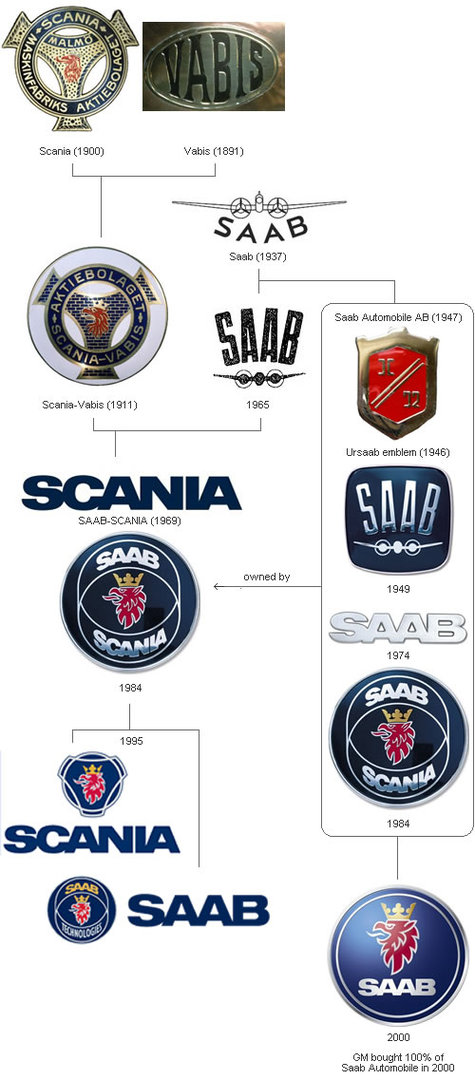
Here's some brain fodder to play with the next time you're stuck in traffic: Evolution of Car Logos

Just look at the evolution of the SAAB badge.  Amazing how much churn there is on the automotive branch of the tree for a brand which only emerged after WWII:
Carlogosaab_2


Myself, I like the 1949 badge the best.  Don't like the screaming chicken so much.  How does one say "Burt Reynolds" in Swedish?

As I look through this site, I have to admit that many of the older badge renditions are at least as compelling as their replacements, and often more so.  Having been a brand manager at one point in my peripatetic career, I sense that the rationale for many brand revisions or logo redesigns are rooted more in internal politics and the need to do something tangible for one's yearly performance review than in market needs.  In other words, most customers probably don't care if your new logo is slightly better than your old one, especially if they just finally got used to the old one, because it has only been the old for the three years that have passed since the last redesign.  As with management, sometimes the best marketing may be no marketing at all...

Anyway, it's fun stuff.  Thanks to Tim for pointing me to this link!

20 February 2008 | Permalink | Comments (0) | TrackBack (0)

| |

« Previous | Next »

Categories

  • designing
  • innovating
  • leading
  • marketing
  • meta metacool

search


About

Subscribe to this blog's feed

    follow me on Twitter

    Favorite Posts

    • A million reasons why...
    • Mo Cheeks and a fundamental question of leadership
    • Innovation Lessons from Garage Majal
    • From Obama to Pink to Oprah
    • Shinya Kimura and the primacy of doing
    • A tribute to friends and friendship
    • Strategy that makes your hands bleed
    • Quality in a switch
    • Travis Pastrana and the future of the world economy

    on the nightstand

    • : The Great Bridge

      The Great Bridge

    • : Porsche - Origin of the Species

      Porsche - Origin of the Species

    Principles for Innovating

    • 1: Experience the world instead of talking about experiencing the world
    • 2: See and hear with the mind of a child
    • 3: Always ask: "How do we want people to feel after they experience this?"
    • 4: Prototype as if you are right. Listen as if you are wrong.
    • 5: Anything can be prototyped. You can prototype with anything.
    • 6: Live life at the intersection
    • 7: Develop a taste for the many flavors of innovation
    • 8: Most new ideas aren't
    • 9: Killing good ideas is a good idea
    • 10: Baby steps often lead to big leaps
    • 11: Everyone needs time to innovate
    • 12: Instead of managing, try cultivating
    • 13: Do everything right, and you'll still fail
    • 14: Failure sucks, but instructs
    • 15: Celebrate errors of commission. Stamp out errors of omission.
    • 16: Grok the gestalt of teams
    • 17. It's not the years, it's the mileage
    • 18: Learn to orbit the hairball
    • 19: Have a point of view
    • 20: Be remarkable

    CC

    • Creative Commons License