metacool

thoughts on the art & science of bringing cool stuff to life, by Diego Rodriguez

Toot toot

Img_0322

I'm always one to endeavor to only toot my horn if I can do so without blowing it.  So this is meant as a quiet toot:  In case you haven't read the August 21 issue of BusinessWeek, check out this tasty blurb on metacool from the front of the magazine. 

Design geek, indeed!

13 August 2006 | Permalink | Comments (1) | TrackBack (0)

| |

Bandits on the roads

Bruce Nussbaum and Seth Godin have got me thinking about some ways to "fix" air travel.  As a boy reading about medieval history, I used to wonder what it was like to have bandits on the roads.  Now we know.  The ultimate solution would be to "fix" the root causes of the hatred which drive people to blow each other up, but short of that, how might we improve the current situation?

I agree with Seth that we can do -- and will have to do -- a lot without getting on airplanes.  The state of world affairs is going to sell a lot of Halo systems and iSight cameras alike.  My friend Anthony Pigliacampo runs his cool startup company on Skype.  The tools are already there, and they're going to get pushed hard.  Expect lots of innovation in this space.

But what about the airplanes?  What happens when we have to move atoms and not bits?  I just brainstormed with my buddies Ryan and Omar for three (3!) minutes and it's clear that opportunities abound (just to be clear, and to preserve the reputations of the two gentlemen, some of these ideas (the stupid ones) are mine and mine alone) :

  1. Brand Differentiation:  can an American airline step up and provide a substantially higher level of security than what government agencies can provide?  How much would you (or your company or your insurance agency) pay to reduce your flight risk?  What a great way to differentiate a brand.
  2. Process Improvement: there's a human threat on a plane, and there's a threat from the stuff we haul on board.  Why not separate the two?  Fly bags on a second airliner.  What if FedEx picked up your bag the day of your flight and delivered it to your final destination?  Lease a laptop from Apple and automatically have one available at your final destination with all your data synched up?  I've had bags transported for me between hotels in Japan and it's cool. 
  3. Asset Improvement: what's the civilian airliner equivalent of an A-10 Warthog?  Could a catastrophic incident be contained to merely dangerous?
  4. Business Model Innovation:  what's the low-end disruptive business model which utilizes small jets to ferry smaller groups of business travelers to all the places they currently go?  Reduce the size of the target.

And so on and so forth.  The current situation is unacceptable, some good thinking and some guts could make it better.

11 August 2006 | Permalink | Comments (8) | TrackBack (2)

| |

Learning from Burt Munro, Part I

Indian_rocker_cover1

Mr. Jalopy of Hooptyrides showed me this beautiful design detail he shot of Burt Munro's famous Indian motorcycle record breaker.  The same motorcycle featured in Roger Donaldson's wonderful movie The World's Fastest Indian.  I quite liked that flick, especially the opening sequence, which is a  perfect balance of deep technical unabashed gearhead gnarlyness and man-on-the-street, just-tell-me-a-simple-story plot exposition.

Just look at it.  Those two "seahorse" details in the metal plate are there to provide mechanical clearance for the furiously revolving rocker arms on the little terror of a motor found beneath.  You can just see the intake trumpet in the background, poking its snout out like a shy little elephant.  Burt Munro was an incredible innovator.  This is stunning design work.  I can't help but agree with Mr. Jalopy when he says that "...I am not even particularly interested in motorcycles, but I spent half an hour looking at this amazing machine and kept finding trick shit like this. I don't know that I have seen a greater accomplisment by a single person."

The more I look at it, the more I feel there's a wealth of insight to be found in this photo about the process, philosophy, and value of design thinking.  I'm going to keep writing about Burt Munro's rocker divots for a while, just to see what's there.  I'd like to hear what you see, too.

09 August 2006 | Permalink | Comments (3) | TrackBack (0)

| |

Unabashed Gearhead Gnarlyness

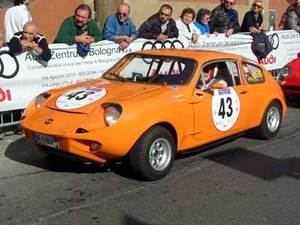
0043_vet

The Marcos GT Mini

As driven by Paolo Arbizzani of Scuderia Bologna at the Gran Premio Bologna-San Luca.  I've got to figure out a way to be hanging around (or driving?) in Bologna -- a rabid center of gearhead gnaryless if there ever was one -- come June 2007.

08 August 2006 | Permalink | Comments (1) | TrackBack (0)

| |

metacool Thought of the Day

"[W]e must consider the possibility that if Design Thinking is critical, maybe restricting it to designers and protecting them from business people is not actually the most productive avenue to pursue. Perhaps eliminating the need for protection by turning business people into Design Thinkers would be more effective.

... Rather than supplementing modern analytical management with design sensibilities, it is time to integrate design into management practice. The job of executives isn't to protect designers from line management, but to help line management become Design Thinkers. It is time for the management discipline of Design Thinking.

To create a Design Thinking organization, a company must create a corporate environment in which it is the job of all managers to understand customer needs at a deep and sophisticated level and to understand what the firm's product means to the customer at not only a functional level, but also an emotional and psychological level... It must create an operating environment by which line managers experiment with new ways of delighting the customer, realizing fully that some new ideas will fail, but that in failing these efforts have valuable benefits. Even failed experiments help convince customers that the company is aiming high, and the feedback will help them come up with newer, better approaches.

...The great firms of the 21st century will be those that recognize the goal isn't to supplement analytics with design; it is all about integrating design and management."

- Roger Martin

Continue reading "metacool Thought of the Day" »

04 August 2006 | Permalink | TrackBack (0)

| |

More thoughts on innovating routinely

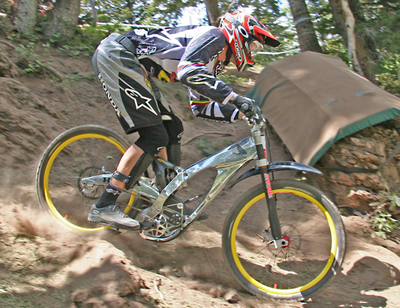
Honda_mountain_bike

BWJones, who is a card-carrying member of the Union of Unabashed Appreciators of Gearhead Gnarlyness, snapped this tasty photo above of a downhill mountain biker at work in his bike.  In addition to writing a very cool, extremely gnarly blog, Dr Jones focuses on something called metabolomics.  Fan that I am of all things meta, here's what that means:

Metabolomics is the analysis of micromolecular networks that form the currencies and currents of life.  Every cell exists in a metabolic N-space where mixtures of intra- and pericellular micromolecules are shaped by cell-autonomous and non-cell-autonomous factors. No theory predicts these mixtures, partly due to the paucity of micromolecular profile data from which a coherent model could be crafted. Profiling with single-cell resolution in complex tissues is essential to decoding the interactions between gene expression and environmental signaling.

Sweet.  Now back to that bike.  Look closely at the pedal area.  Interesting, eh?  It's missing the normal chainring and gear set.  The story gets even more interesting when you learn that bike is a Honda.  For a few years now, Honda has been evolving a fundamental re-think of the bicycle power transfer mechanism.  As is typical of their "just build it" culture, they're using racing as the laboratory to push forward the process of iterative information creation, which is a powerful way to innovate whenever you're at the edge of what's known.

Honda is a master when it comes to innovating on a routine basis.  Yeah, so I'm a pro-Honda cheerleader -- hey, I call 'em like I see 'em.  But from the standpoint of routine innovation, Honda is a soul mate to Google, Apple, and other great innovators.  What Honda shares with Google is the ability to routinely go back to first principles on everything it chooses to work on, no matter the market.  From a philosophical perspective, for example, I see very little difference between GMail and a Honda Ridgeline -- both took a product category bereft of innovation and redefined the offering from a blank sheet of paper.  Each was a fairly radicial rethink.  For an example of a milder form of ongoing innovation, look at the parallel between a Honda Odyssey and Google Search.  Both are in the business of doing a mainstream activity -- carrying people and search -- but the each just do it better thant he competition, and they do so transparently and with great simplicity and elegance, so the big middle of the market loves them.

Oh, and by the way, they're about to apply the same penchant for first principle innovation to the small jet market.  Honda, that is.  Not Google.  Yet.

03 August 2006 | Permalink | Comments (0) | TrackBack (1)

| |

Food, authenticity, and brand halos

Warning: this is a relatively long, rambling post because I'm thinking out loud.

What makes something authentic?  When are things not fake?  Can something be designed to be authentic, or does the act of considering authenticity at a conscious level doom something to the land of the artificial?  I've been swishing these questions around for a while.  I'm not sure yet.  I'm sounding out things here in the sandbox of this blog. Help me out if you care to.

When I write about the visceral aspects of stuff, I like to focus on cars, because the experience we all share in common of them which makes the conversation easier.  For similar reasons, when it comes to discussing authenticity and design, I find that food makes for the best subject.  Think about it: when was the last time you heard the word "authentic" being used to describe anything other than food?  I'm sure you have but food seems to live near the center of the authenticity universe.  As an example, Russell Davies just wrote a great book all about authentic eggs-and-bacon dining experiences.  If  car-based sensations of speed and acceleration inform our understanding of the design of visceral experiences, then concepts like terroir and appellation from the world of food should be a way to gain a deeper understanding of authenticity.

Enough philosophizing.  Let's eat.

I recently had a pizza at a restaurant by the name of Two Amys.  It was very, very good:

Pizzacloseup_1

I've never been to Naples.  But when I look at the picture above, I can taste the lactic whisper of the mozzarella and I'm reminded that this bubbly dish was one of the best pizzas I've ever eaten.  Tasty?  For sure.  Authentic?  I believe so -- but can I really know without having been to the source? 

Peruse the menu between bites.  Ho ho ho, what's this?
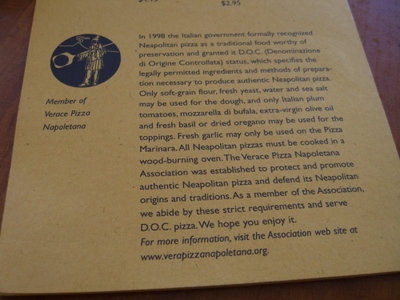
Neopolitan

The Two Amys chooses to spend some very precious menu space to explain how their fare meets the standards set out by an independent pizza standards group called Verace Pizza Napoletana.  The standards are precise and fairly strict.  From the Verace Pizza Napoletana website:

Basic  Requirements

1. A wood-burning oven: The pizza must be cooked by wood.  Gas, coal or electric ovens, while they may produce delicious pizza, do not conform to the tradition.

2. Proper ingredients: 00 flour, San Marzano (plum) tomatoes, all natural fior-di-latte or bufala mozzarella, fresh basil, salt and yeast. Only fresh, all-natural, non-processed ingredients are acceptable.

3. Proper technique: Hand-worked or low speed mixed dough, proper work surface (usually a marble slab), oven temp (800°F), pizza preparation, etc.

4. Review by the designated representative of the association assuring that the ingredients, technique and final product conform to the tradition.

5. Each individual restaurant is bound to uphold the standards of the association. Moreover, each individual restaurant is bound to pay a membership and membership renewal fee. Hence, membership fees do not apply to any new units opened subsequent to joining VPN, nor is membership transferable from one location to another. Rather,    each individual location is evaluated and billed separately. In the event of non-compliance by one or more of my restaurants, the VPN association maintains the right to suspend or rescind membership on an individual or collective basis.

This is a clever device, this appeal to an external maven of authenticity.  Putting it on the menu validates what my taste buds were telling me, and it's a powerful story which places a halo of authenticity around the entire Two Amys brand.  It tells me that this pizza is the Real Deal.  It's authentic so long as a believe that the VPN is authentic and real.  Is it?  I hope so.

Halos of authenticity are, I think, a useful way to help meaning and value become associated with a brand.  For example, when Subaru rallies its cars, it's hoping that success there will put a halo of racing toughness and speed over their brand.   And so on and so forth.  What do you think?
01 August 2006 | Permalink | Comments (2) | TrackBack (0)

| |

Live webcast of my AlwaysOn keynote

You can find a live broadcast of my AlwaysOn keynote here live at 8 AM PST, Wednesday July 26.

Bob Sutton and I are going to talk about Tales from a Double-Wide Trailer, which is a story about the lessons we learned from teaching our Creating Infectious Action class at the Stanford d.school.  Then we'll have a group discussion about stoking contagious behavior with:

  • Mitchell Baker, CEO of Mozilla.org
  • Perry Klebahn, founder of Atlas Snow Shoes
  • Gil Penchino, CEO of Wikia

If you're online while we're onstage, please please submit a question for the panel discussion, and we'll try to make it part of the discussion.

The organizers of the conference have put in place two interesting innovations.  First, the bloggers are sitting in the front row at a table reminiscent of something out of a McMenamin's brew pub movie theater, instead of in their customary back-of-the-auditorium position.  Second, there's a rolling screen of comments from people online.  So far some have been funny, some rude, some trenchant, some insightful.  Interesting stuff.

25 July 2006 | Permalink | Comments (0) | TrackBack (0)

| |

Pink on Returns on Design Thinking

Dan Pink's latest column talks about tracking the market performance of design-thinking companies: Who's your DADI?

20 July 2006 | Permalink | Comments (0) | TrackBack (0)

| |

TEDBlogging

Cover101_1

I'm still whipping up the occasional post over at TEDBlog.

Some recent entries:

Lego my Audi

An Electric Car is Born

While you're there, check out the TEDTalks Joshua Prince-Ramus video.  Great storytelling, great design thinking.

19 July 2006 | Permalink | Comments (0) | TrackBack (0)

| |

IDEO Prototypes the Future

190897613_0394381898_o

My second IDEO-centric post in as many weeks!  My, how I'm violating the self-imposed house rules here at metacool!

If you're going to be in or near Palo Alto before September 10, and if you're at all interested in innovation, design, and business, I encourage you to check out a nice new exhibition at the Palo Alto Art Center called IDEO Prototypes the Future.  It's a great retrospective of IDEO's work over the years, and more importantly, I think the exhibition does a marvelous job of showing our design process in action.  Innovation need not be a mysterious thing; it's mostly the result of hard work and persistence and optimism coupled with a deep-rooted sense of optimism.  And it doesn't hurt to have a happy group of people who love working together, either.

If I were to attend, I'd download this podcast by IDEO CEO Tim Brown to my iPod, and listen to his personal gallery walkthrough while I meandered through all the stuff on display.  The coolest part of the exhibit for me was seeing the shopping cart we did for Nightline (shown above) with the Nightline show playing behind it.  There's a (slightly) younger Diego there building prototypes and uttering something about a "SUV shopping cart", among other things... I used to think my biggest impact on modern culture would be the bazillions of parts made off of my designs for HP inkjet printers over the years, but now I think it's probably going to be the Nightline video, which has taught lots of people about the human-centric design process in the years since its debut.

So please check it out.  And don't just trust my word for it (I love IDEO, so I am biased, after all) -- see my friend (and fellow We Know member) Ross Mayfield's blog for another review of the show.

July 18 update:  Robert Scoble attended the opening night on behalf of his new company PodTech (which is why I'm on this podcast) and says that the exhibit "... is freaking awesome.  If you're a design nut, you need to see this."


17 July 2006 | Permalink | TrackBack (0)

| |

Unabashed Gearhead Gnarlyness

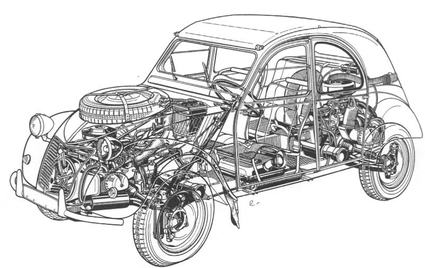
4car6

The Citroen 2CV Sahara

Need four-wheel-drive off-road capabilities?  Stick a second engine and transmission in the rear.  Panoramic sunroof?  A roll-back canvas roof will do. 

Audacious.  French.  A way of thinking beyond the obvious that's gone missing from Citroen in the decades that passed since a gnarly old Sahara last roamed the rocky roads of southern Spain, but whose iconoclastic sensibilitly can still be found in the work of the crazies at Honda.

13 July 2006 | Permalink | TrackBack (0)

| |

Making Petty Parking Problems Go Away

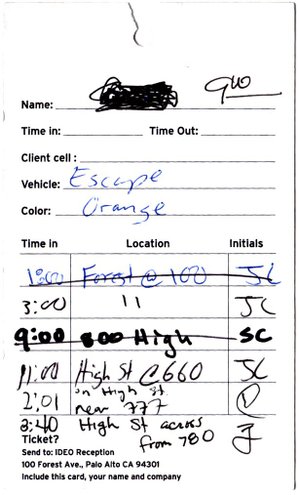
Ideo_tag

As a rule, I don't write much on metacool about my work at IDEO.  It's less that 120% of my IDEO stuff is swarming-ninjas-will-be-sent-out-to-slay-me-in-the-silence-of-the-moon confidential (which it is), and more that this blog is my personal sandbox.  It's about everything I do at work, but it's not about my work.  But today I make an exception, because I reckon the story is pretty cool.

Context: Parking in Palo Alto, where I work, is tough.  Not as tough as, say, downtown Tokyo, but certainly on that end of the bell curve.  The Palo Alto Police ticket mercilessly.  Even though I'm extremely careful, I've been known a ticket or two.  Come to think of it, given the taxes I kindly fork over each year, I should be gifted a diamond-encrusted personal parking spot by my local elected officials.  As well as a gold-leaf wrapped box of Macanudos.  Monthly, via FedEx.  But I digress.

Blogger and IDEO client Robert Davis tells a delightful story about the frustrating experience of parking solo near our Palo Alto headquarters, and then about the delightful experience of parking with the aid of the IDEO Experience Team.  Listen to my favorite bit of his post:

Here’s what: service is sometimes about giving the user the tools to manage the situation themselves; sometimes it’s about making the problem just go away. IDEO has figured out that when you’re bringing people in to do creative thinking about a business problem, you’re better off making their petty problems, like parking, just go away.

I won't even pretend to be able to say it better.  Thanks, Robert!

11 July 2006 | Permalink | TrackBack (0)

| |

AlwaysOn Innovation Summit Keynote

Stanfordsummit_summitbanner200_1

I'll be giving a keynote speech and moderating a panel on July 26 at the AlwaysOn Innovation Summit @ Stanford.  My partner in crime at the event will be Bob Sutton. 

Bob and I will be discussing the topic "What is the Secret Behind Creating Infectious Behavior?"  We just finished teaching a related class called Creating Infectious Acton.

So, if you plan on being there, drop me a line beforehand or just say hello once we're there.  I look forward to meeting you.

10 July 2006 | Permalink | TrackBack (0)

| |

metacool Thought of the Day

"Ultimately, it is not so much the goal that we should be concerned about as much as the process through which we attempt to achieve it. A return trip to Mars will require that we invent many new technologies and systems, all of which will have to perform seamlessly to ensure a safe and successful mission. Given the amount of uncertainty involved in such an endeavor, it is naïve to think we can sit here today and identify the date of our first touchdown and the means by which we will get there. Instead, we need to adopt a modular, experiment-driven approach, gradually building and verifying the set of technologies that will be needed for such a mission, while adapting our plans as we learn more about what approaches have merit, and which are likely to be dead ends."
-- Alan MacCormack

10 July 2006 | Permalink | TrackBack (0)

| |

Yes, Nano is still the New Turbo

I said it once, I'll say it again: Nano is the New Turbo

Wired, in a weirdly recursive way, agrees.

You heard it here first.

That's marketing.

Thank you.

05 July 2006 | Permalink | TrackBack (0)

| |

A Pitiful Design Observation

1364356689

Have you been watching the World Cup?

During today's Italy-Germany match I have to admit I was a bit distracted by a recurring thought popping in to my head:  Why did the Italians seem to be sweating so much more than the Germans? 

Of course, after a while, I realized that the ubiquitous underarm sweat blotches I was seeing where actually part of the graphic design of the Italian jersey.  Now, I'm a proponent of thinking through what a design will look like in use, and after it is used, but I find the point of view which led to this design somewhat odd.  Purposeful proactive pit stainage as a premediated graphic design element?  Weird.  Not beausage.

04 July 2006 | Permalink | TrackBack (1)

| |

Jeffersonian Simplicity

For me, the highlight of the 2006 Brainstorm Conference was the opportunity to hear Associate Justice Sandra Day O'Connor speak about the intricacies of the Constitution of the United States. 

In response to an audience question about the staying power of the Constitution (it's the oldest in existence), she paused, picked up her purse, and took out a copy of the Constitution in pamphlet form -- maybe 5 x 2.5 inches.  Just imagine: the document which shaped this country, and continues to guide it and many others around the world hundreds of years later, fits on just a few small sheets of paper.  Marvellously extensible and modular, it is also written in plain language.  Isn't that something?  For all its enormous generative power, the Constitution is likely more concise and more intelligible than many software license use agreements.

Thank you, Justice O'Connor, for giving us a dramatic lesson in the power of simplicity.  Simple design, but not ever simplistic.

Of course, perhaps that simplicity shouldn't be surprising.  Why?  Well, because said constitution was penned by a design thinker.

30 June 2006 | Permalink | Comments (0) | TrackBack (0)

| |

Brainstorm Bloggers

Here is a list of people blogging from Brainstorm.

29 June 2006 | Permalink | TrackBack (0)

| |

Jurvetson on #4

Steve Jurvetson, who is also attending the Brainstorm conference, provided what is easily my favorite answer to Question #4, "Your most cherished value?"

I'm so happy Steve took the opportunity to talk about the Stanford d.school.  As I like to say when I'm leading classes at the d.school, what we endeavor to teach is the ability to look at the world through the eyes of a child, but matched up with an attitude of wisdom informed by a deep belief in building to think.  That's the path to innovation.

29 June 2006 | Permalink | TrackBack (0)

| |

Four Questions

Here are four big questions to ponder:

  1. What is the most pressing problem to solve?  Why?
  2. Your biggest fear?
  3. Three global leaders who will set next decade's course?
  4. Your most cherished value?

All four questions were asked of people attending Brainstorm 2006, including yours truly.  Here are my answers:

  1. Reversing the trend of environmental degradation and moving to a new paradigm of consumption.  Efforts to slow the decline only delay the inevitable and fail to acknowledge the growth of prosperity-driven consumption -- not necessarily a bad thing -- across the globe.  e need to establish new ways of creating and supporting prosperity that enable growth without destruction.
  2. Our seeming inability to prevent genocidal behavior.
  3. John McCain, Hugo Chavez, Linus Torvalds
  4. Optimism

See more answers from other bloggers at the conference, including Ross Mayfield, Dan Gillmor, and Rebecca MacKinnon

28 June 2006 | Permalink | Comments (2) | TrackBack (0)

| |

Sir Ken Robinson on TEDTalks

Tedtalks_170x170_2 Ideas Worth Spreading. 

That's a topic near and dear to my heart.  And one for which I'm more than happy to play a willing accomplice.

In this particular case, it's both a pleasure and a duty.


At the TED2006 conference earlier this year I had a peak life experience in the form of a talk by Sir Ken Robinson.  He stirred my soul and reminded me why I was here on the planet. 

Kenrobinson_5_1

I encourage you to take 20 minutes to listen to Sir Robinson.  If you're engaged in any kind of creative endeavors in your life (and we all are), you must see this.  And if you're responsible for the care, feeding, and education of another human being, you must see this.  See his video (and many more) on TEDTalks.

(plus, it's all sponsored by one of my favorite producers of cool products, BMW)

27 June 2006 | Permalink | TrackBack (0)

| |

Meaning is Made, A Brand Comes Alive

Lmpodiumlr

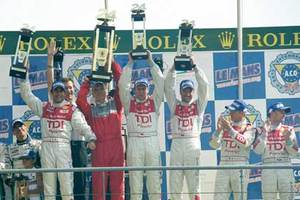
This past weekend a brand came alive.  The brand had already existed, and oodles of money had been spent to build it, but it wasn't a living, breathing thing yet.  In other words, it was still a brand built by marketers, not a brand felt and understood by people out in the world.

The brand I'm talking about in particular is Audi's TDI, which represents the state of the art in diesel-based internal conbustion.  In the guise of Audi's wicked new R10 race car, TDI not only won the 24 Hours of Le Mans (possibly the toughest race in the world), but also broke all the records, going farther than any car had gone before, while getting better gas mileage to boot.

Last week TDI was something which a person with a technical background like me would have explained to you in terms of technology (high-pressure fuel injection, clever turbos) and/or performance metrics, such as torque and consumption.  And I might have convinced you.  But could you have told a friend?  Would you have remembered the critical bits?  Would it all have meant something?

Now all I have to say is "TDI won Le Mans".  TDI is now a real story, and a romantic one at that, and from now on diesel isn't the smelly, smokey old Mercedes station wagon blocking the left lane but a speeding silver arrow whispering down the Mulsanne.  TDI.  Your brand is what you do in the world, not what you say you do.

21 June 2006 | Permalink | TrackBack (0)

| |

Unabashed Gearhead Gnarlyness

Laffite

Ah, the scream of a Ferrari motor at full boogie

In this case a twin-turbo V8 from a F40LM expertly pedaled by none other than French F1 hotshoe Jacques Lafitte.  How about that recalcitrant shifter trying to move gears around in a cold box?  At about the 60 second mark you can hear Lafitte really get into the turbos, and I just can't get enough of the exhaust spitting, burping and rip snorting as he heels and toes down the gearbox around the 90 second mark.

Sacrebleu!  Forza Italia!  It's like, visceral, dude.

thanks to the crazies at Winding Road blog for the link

20 June 2006 | Permalink | TrackBack (0)

| |

Why brainstorming does work, and a cool new blog

The WSJ ran an article the other week about the flaws of brainstorming as a way to generate new ideas.  As someone who has been formally trained in the art and science of brainstorming, and who has been a passionate practitioner of the process for over 15 years, I found the article disappointing.  I'm not a brainstorming fanatic -- I only use it when it's appropriate to the task at hand, just as I wouldn't use a baseball bat to whisk egg whites -- but it rankles me when reporters don't do their homework and write about something when they're clueless.

And what should that homework have been?  For a comprehensive and wildly entertaining rebuttal to WSJ's argument, I must turn to my Stanford d.school colleague Bob Sutton.  He points out the flaws of the WSJ article on many levels.  Here's my favorite part of his critique:

Not one one of these experimental studies on "brainstorming performance" has ever been done in an organization where it is work practice that is used as a routine part of the work.  Paulus wrote me some years back that he tried to recruit some "real" organizations that did real creative work, but had no luck. To put it another way, if these were studies of sexual performance, it would be like drawing inferences about what happens with experienced couples on the basis of research done only with virgins during the first time they had sex.

I'm really happy that Bob has started blogging.  He brings a wise yet fresh voice to the dialog on innovation, organizations, and design thinking:  www.bobsutton.net

19 June 2006 | Permalink | TrackBack (0)

| |

metacool Thought of the Day

"Strange but true: The more specific a film is, the more universal, because the more it understands individual characters, the more it applies to everyone."
- Roger Ebert

19 June 2006 | Permalink | TrackBack (0)

| |

Sculpting with Lego

Like building with plastic bricks?  Then check this out:  Lego my Audi

16 June 2006 | Permalink | TrackBack (0)

| |

Tales from Design 2.0

Qanda

I spoke at Design 2.0 last week, and had a lot of fun doing it.  I actually enjoy public speaking, so I had a great time talking about ecosystems and design and business.  Unfortunately, I can't post my slides... more on that in a bit.

Here are two really good summaries of what I talked about, done by two guys who I wish I had known in college -- they would have been great people to supply me with engineering lecture notes for all those fluid mechanics lectures I skipped:

  • Nick Baum  (he has great coverage of the entire conference)
  • Luke Wroblewski

The reason I can't give you my slides is that they were on my trusty PowerBook, which took a big, freakish fall during the conference.  It stayed alive for 48 hours, only to die a quiet death later in the week.  I think it may still be saved...

But my favorite review of the conference is this one, which points out that the conference highlight was  "... a really nice Ducati desktop background on Diego Rodriguez's Mac."  Gotta love those audiences full of designers.  Got their priorities straight.

15 June 2006 | Permalink | TrackBack (0)

| |

Back to first principles

In this insightful column, my colleague Paul Bennett says some "mean things" about branding but then goes on to make some really important (and honest) points about how the creation of meaning can and should be done within the world of marketing. 

As Paul says, "Marketing and branding need to get back to first principles -- people, feelings, stories, and things. Tangible things. Not weird words."

Please read it all here:  Time for some Buzz-Kill

12 June 2006 | Permalink | TrackBack (0)

| |

Creating Infectious Action Podcast

A podcast of the Creating Infectious Action Miniconference is now available here.

It's listed under the 5/11 class date.

05 June 2006 | Permalink | TrackBack (0)

| |

Fiat 500: Open Source Marketing

Fiat500

Just over two years ago I wrote a post about the Fiat Trepiùno concept car and mused a bit about cultural influences on design.  Design thinkers are particularly adept at reaching a point of empathy for users, but I do think that one's own sense of culture and surroundings does -- and in most cases should -- end up embedded in the offerings one design.

In other words, designers of small cars should live in cities.  Hummer designers should hang out in shopping malls.  And suburban pickup designers should hang out at Home Depot.

The good news is that Fiat is shipping the Trepiùno as the new Fiat 500.  It is to the great Dante Giacosa's Fiat Nuova 500 what the  New Beetle is to Professor Porsche's original Beetle -- a retro reskin of a modern front-wheel drive platform; an exercise in style more than in the extreme engineering packaging and rational beauty that characterized the originals.  But hey, I'll take it -- the iconic 500 look (inspired by the Isetta, a descendant of refrigerators, by the way), is just such a winner.

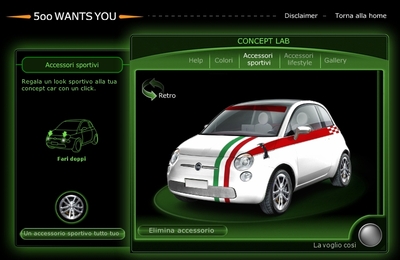
On to the marketing bit: lifting a page from Ducati and Virgin, but on a much grander scale, Fiat has set up www.fiat500.com, where you can go "design" your new Fiat 500 as I did above.  Of course, you're not really designing it -- you're just optioning it out with lifestyle and go-fast-boy-racer accessories, a la Mini.  But it's fun, it's good for getting some buzz out, and if Fiat is clever, they'll be data mining the results to guide their manufacturing production mix.  Clever.

04 June 2006 | Permalink | TrackBack (0)

| |

Knowing by Doing and Playing

I'm a big fan of knowing by doing.  I'm an even bigger fan of CEO's who know of what they speak because they know by doing.  If you haven't read it yet, Bruce Nussbaum has written a great post about how a CEO who doesn't "get" technology might not be able to command a towering compensation package in the future. 

True Story: in the process of coming up with the Firefox design project for my Creating Infectious Action class at Stanford, Mozilla VP John Lilly and I held many of our working meetings using virtual networking tools -- call it Web 2.0 if you want.  Our killer app?  World of Warcraft.  Beyond just being The New Golf, the private chat feature in World of Warcraft was a great way for the two us -- busy people with young families -- to find some time to talk on a Friday night without the overhead of conference calls, mobile phones, etc...

Plus, it's more fun than being in a conference room.  Don't ever underestimate the fun factor.  (or my ability to rationalize my subscription to World of Warcraft)

Where are you learning by doing today?

02 June 2006 | Permalink | TrackBack (0)

| |

Design Thinking meets Mozilla

Firefoxies

Asa Dotzler from Mozilla has written a nice post celebrating the achievements of student teams from the Creating Infectious Action (CIA) class I've been co-teaching this quarter at the Stanford d.school.  Here's a nice excerpt:

After some initial brainstorming with Diego in March and an afternoon in April talking to the CIA class, we saw the first round of work the student teams put together. At that time, there were about six projects and each one had something really cool going on. I especially liked the Faith Browser project because they took the challenge of reaching a niche audience with Firefox extensions -- something I think we should do a lot more of.

The class has moved to other CIA assignments but many of the student teams continue to iterate on their approaches to creating infectious action around Firefox -- and some have even launched entirely new efforts.

What's really exciting to me about all of this is how these small teams (just a few people each) were able to come up with novel ways to create attention and action around Firefox quickly put those plans into action. That a dozen projects were designed and put into the wild -- generating thousands of Firefox downloads, in just a couple of weeks time should be a huge motivator to all of us.

Mind you, this Firefox work was done in just two weeks by six teams with four students each.  And these are Stanford graduate students from the schools of business, engineering, education, and humantities, so they each have three or four other classes assigning work.  And the teams had to start with scratch -- all they were given was the goal of "find a way to spread Firefox to audiences not currently consuming it".  They had to start with ethnographic research to understand why people don't use things like Firefox even though they're better and cheaper (read: free) than any alternatives.  Then they formulated ideas of what could spread and how to spread and then and went, as we like to say in CIA, and "prototyped 'til they puked".

I'm so proud to be associated with this group of people! 

What I love about this class is that it isn't school, if school is a state of mind where everything is theoretical and abstract, up to and including the "real world".  If anything, being in class felt like being the front lines of any "work" project I've ever been associated with.  The downside of that classroom environment is that, as I heard loud and clear from students last week, it's difficult to provide crisp and clear performance feedback.   The upside is that CIA is a weekly reminder that none of us are really able to "know it when we see it".  While we did spend time in class discussing formal theories of how memes diffuse through populations, those formal theories couldn't tell us which, if any, of the Spread Firefox projects would hit it big.  As it turns out, Firefoxies has been generating an order of magnitude more downloads than any of the other solutions.  FaithBrowser, a very, very clever solution which I would have said was going to blow everything else out of the water, hasn't hit volume yet.  But it could well do so -- all of these projects, I believe, are following different S-curves. 

The point is, you've got to build it before you see if they'll come.  And if they don't, you can keep on building...

31 May 2006 | Permalink | TrackBack (0)

| |

Speaking at Design 2.0

I'll be speaking at Design 2.0 next week on the topic of "Products and their Ecosystems: Understanding the power of context in product innovation"

30 May 2006 | Permalink | TrackBack (0)

| |

Unabashed Gearhead Gnarlyness


Bashing a Lotus Elise around Bathurst?  Why yes -- I do think I'll take one!

Authentic, elemental design for drivers, by drivers.  Simplicity of specification. 

In many ways, Lotus is the new Porsche.

22 May 2006 | Permalink | TrackBack (2)

| |

On Authenticity

Dsc01034_1

I've been thinking a lot about authenticity lately.  It comes up in just about every conversation I'm in around the subject of designing things to spread, or creating infectious action.

As is the case with quality (the visceral, emotive kind, not the six-sigma variant), I believe authenticity is best understood via immersive experiences.  I'm not so interested in articulating what authenticity is or isn't, but I do appreciate it as an experience, and I think knowing what that experience feels like is the key creating things that are authentic as well as being authentic in one's own trek across this planet.

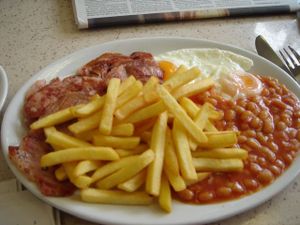
So what does it look like?  Here's a stab:  eggbaconchipsandbeans , by Russell Davies

19 May 2006 | Permalink | TrackBack (0)

| |

metacool Thought of the Day

"The only real enemy of design is indifference."
- Matt Kahn

17 May 2006 | Permalink | TrackBack (0)

| |

Stories from the CIA Mini Conference

Cia1_1

The mini-conference we held as part of the Creating Infectious Action course I'm teaching went really well.  I learned a ton from both the speakers and the audience -- we had quite a crowd show up!

Part of that audience was Nick Baum, who works as a project manager at Google.  Nick is one of those cool people you meet at conferences like this -- someone who's lived all over the place, done loads of neato things, and writes one helluva interesting blog.  In fact, he's done an enormous amount of work to document the conference on his blog, writing great summaries of the talks given by:

  • Paul Saffo, IFTF
  • Peter Ebert, SAP
  • Dr. Jamie Shandro, Stanford ER
  • Michael Dearing, eBay
  • Steve Jurvetson, DFJ
  • Paul Moore, Yahoo!
  • Perry Klebahn, Atlas Snowshoes

Read it all at Nick Baum's  Creating Infectious Action mini-conference summary

16 May 2006 | Permalink | TrackBack (0)

| |

Customized markets of one

Require

freddy&ma is a great example of how the web can be used to bring manufacturers and customers back together again, so that mass marketed offerings for many can become tailored -- even bespoke -- objects for one. 

While I'm not one to jump on the "in the future we'll all print out products at home" bandwagon, I do believe that we'll see the freddy&ma approach of "let me choose and then build it for me" take hold in other industries.  In a way, what Mini has done with the process of tailoring a car is a first, web-enabled step toward this world.  I hope to see the day when I can use the web to order custom bodywork for a Ferrari coupe from an authentic carrozzeria panel beater working with a hammer and tree stump, sipping lambrusco while he pounds out the web-enabled fenders of my dreams...  of course, the car will probably be made of carbon fiber and constructed in a clean room, but the other reality is just so romantic.

12 May 2006 | Permalink | Comments (0) | TrackBack (1)

| |

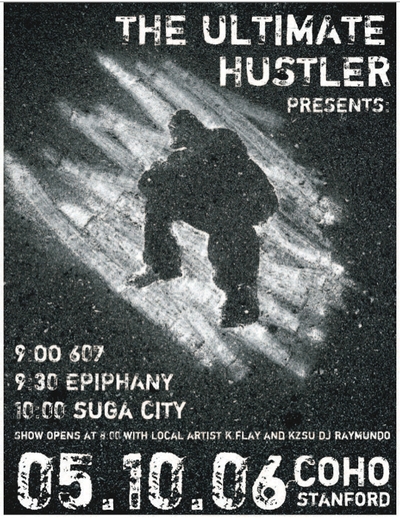
more CIA from the CoHo

Can design thinking move the needle on hip hop?

I think so.  How about pushing together hip hop lyric writing with an open source approach to content development we saw in the world of Firefox?  Why not?  Here it is:  www.onerhyme.com

11 May 2006 | Permalink | TrackBack (1)

| |

more Creating Infectious Action

D_1

Can design thinking be used to further the careers of various hip hop artists?

We'll find out tonight.

Creating Infectious Action

10 May 2006 | Permalink | TrackBack (0)

| |

Venture Design, part 14

What are you really selling?  A product?  Goods?  Services?  An Experience?  A Story?  Community?

How about all of the above?:  Peet's Global Journeys

08 May 2006 | Permalink | TrackBack (0)

| |

The most important Long Tail

Tom Guarriello hits the nail on the head:  The Long Tail of Reputation

04 May 2006 | Permalink | TrackBack (1)

| |

Unabashed Gearhead Gnarlyness

8v_1

The Fiat 8V

02 May 2006 | Permalink | TrackBack (1)

| |

It's About Storytelling

Dan Pink, author of A Whole New Mind, keeper of the fantastic Orange is the New Pink blog, and a fellow reader of Oprah magazine, has a really cool article in this month's Wired called Rise of the Neo-Greens.  In it he describes the rise of the green aesthetic, whose adherents "...are charting a third way, triangulating between the hippies and the hip."  Of course, it's more about the stories people tell themselves than it is about the actual eco-impact of the offerings they consume.  As he notes:

But regardless of age or income, consumers buy cars with gas-electric engines primarily because of what the vehicles say about them - to themselves and to everyone else.

If all marketers are liars, then all consumers are believers.  That's not a value judgment so much as it is a insight to guide design work.  We live in an age where marketing -- the process of deciding what to make -- is overlapping with the design process.  If you're only designing the object and not paying attention to the story surrounding it, you're abdicating your opportunity to craft something that's truly infectious.

01 May 2006 | Permalink | TrackBack (3)

| |

Creating Infectious Action Mini-Conference

We're holding a mini-conference this coming Thursday, May 4 as part of our Stanford d.school class on Creating Infectious Action.  We're starting at 3:30 and will run until 7pm.  Our current speaker lineup is:

  • Paul Saffo, IFTF
  • Peter Ebert, SAP
  • Jamie Shandro, Stanford
  • Steve Jurvetson, DFJ
  • Paul Moore, Yahoo
  • Perry Klebahn, Hasso Plattner Institute of Design

If you're interested in attending, contact me and I'll send you more info.

29 April 2006 | Permalink | TrackBack (0)

| |

Creating Infectious Action: Spreading Firefox

Wow!  We held another session this evening of Creating Infectious Action at the Stanford d.school.  And I have to say that my hat was knocked into the creek. 

Two weeks ago the six student teams were charged with the assignment of spreading Firefox to a target population of non-consumers.  This was not a fictional project.  The masterminds from Mozilla were in class the day we assigned the project, and any marketer out there knows how hard it is to go after people who really could care less about using your offering. 

So.

Since this is a class taught in a design school, we asked the students to use design thinking to come up with human-centric solutions that will help spread Firefox to audiences not currently using it.  Here are some of the solutions -- remember, these represent just two weeks of work.  Done by people who just met each other and were assigned to teams.  And who have lots of other classes to attend to. 

In the solution category of making Firefox more accessible by linking it to pop culture:

www.celebrityfirefox.com
www.firefoxies.com

From the school of tipping-point-maven-connector theory:

www.savegranny.org
www.thesafeinternetguide.com

Targeting a specific, highly connected, maven-centric psychographic lifestyle segment:

          www.faithbrowser.com

Tapping into the "sheep that shit grass" dynamic:

www.foxytee.com

And, one team of students put together an ambitious and compelling paper-based campaign to promote Firefox adoption in a viral, pass-along way: www.firefoxkids.org

Two weeks.  That's a lot of innovation and discovery.

28 April 2006 | Permalink | TrackBack (0)

| |

Organizing for Routine Innovation

Hon2005120570916_pv

When it comes to innovation, it's sexy to think about how to make disruptive innovation happen, but it's routine innovation -- making mainstream offerings better for existing users -- that brings in the cash that keeps the lights on.  Autoweek recently ran an article about what it feels like to develop new products at Honda.  I think it's a valuable look inside a high-functioning organization designed to serve up innovation on a routine basis. 

Here are some of the key things that Honda does to increase the odds of making good cars, year-in, year-out:

  1. Know how to turn bubble-up ideas into tangible offerings:  the Ridgeline wasn't something that popped out of a strategic planning initiative, but came from passionate people cobbling together a prototype which proved it could be a viable, mainstream offering so that Honda's decision making process could then allocate the resources needed to get it to market.  Many organizations don't know what to do with good ideas which don't come out of their strategy group, even if they recognize them as good ideas.
  2. Make clean, efficient decisions:  fly to Japan with a solid business case which points to a proof-of-concept prototype.  Make a quick decision.  Spend little if any time ever debating or defending that decision again.  Focus scarce energy instead on making the Ridgeline or the Civic as good as it can be.
  3. Practice evidence-based management: when the Civic development team believed in a specific product feature (summer tires instead of all-weather tires), but knew that a senior manager did not value those tires, they were able to put together a case which was not only heard, but allowed to lead to a favorable outcome.  This is an example of management relying on evidence and not just opinions to guide decision making.  When management forces its opinions even though real marekt evidence exists to the contrary, the odds of creating good stuff really drop.
  4. Know by doing:  as the leader of the Ridgeline project, Gary Flint wasn't isolated from reality by layers of managers.  He lived the details of the project to the point where, as he says in the article, he would even dust the office.  If you're in there dusting, you're probably also walking around, hearing and seeing the realities of the project.  And if you know those, you'll know the critical things to focus on.  Honda has a long culture of knowing by doing, and of putting people in leadership positions who know -- really know -- the nuts and bolts of the business.
  5. Solve for happiness:  Honda has long believed in creating an environment where people who design, make and market things can be happy.  When it comes to innovating on a routine basis, I think the biggest thing an organization can do is set people up to be happy -- routinely -- as they go about their work.

25 April 2006 | Permalink | TrackBack (2)

| |

Think Big

My latest BusinessWeek Online column is now live. It's titled Think Big, which isn't a reference to the size of my skull (which is rather large), but to the idea of designing market offerings from a larger point of view which includes -- but is not limited to -- the surrounding business context.

I wrote it to accompany a story called On the Real Cutting Edge, which looks at the work of ten leading design thinkers across a variety of domains.

24 April 2006 | Permalink | Comments (1) | TrackBack (2)

| |

Director's Commentary: Lutz & The Sky

Lutz_saturnsky2 Another example of the Director's Commentary for design thinkers:  Lutz on the Saturn Sky

One could do worse (a lot worse) than to spending a few minutes learning about what makes the Sky tick from The Man.

19 April 2006 | Permalink | TrackBack (1)

| |

« Previous | Next »

Categories

  • designing
  • innovating
  • leading
  • marketing
  • meta metacool

search


About

Subscribe to this blog's feed

    follow me on Twitter

    Favorite Posts

    • A million reasons why...
    • Mo Cheeks and a fundamental question of leadership
    • Innovation Lessons from Garage Majal
    • From Obama to Pink to Oprah
    • Shinya Kimura and the primacy of doing
    • A tribute to friends and friendship
    • Strategy that makes your hands bleed
    • Quality in a switch
    • Travis Pastrana and the future of the world economy

    on the nightstand

    • : The Great Bridge

      The Great Bridge

    • : Porsche - Origin of the Species

      Porsche - Origin of the Species

    Principles for Innovating

    • 1: Experience the world instead of talking about experiencing the world
    • 2: See and hear with the mind of a child
    • 3: Always ask: "How do we want people to feel after they experience this?"
    • 4: Prototype as if you are right. Listen as if you are wrong.
    • 5: Anything can be prototyped. You can prototype with anything.
    • 6: Live life at the intersection
    • 7: Develop a taste for the many flavors of innovation
    • 8: Most new ideas aren't
    • 9: Killing good ideas is a good idea
    • 10: Baby steps often lead to big leaps
    • 11: Everyone needs time to innovate
    • 12: Instead of managing, try cultivating
    • 13: Do everything right, and you'll still fail
    • 14: Failure sucks, but instructs
    • 15: Celebrate errors of commission. Stamp out errors of omission.
    • 16: Grok the gestalt of teams
    • 17. It's not the years, it's the mileage
    • 18: Learn to orbit the hairball
    • 19: Have a point of view
    • 20: Be remarkable

    CC

    • Creative Commons License