metacool

thoughts on the art & science of bringing cool stuff to life, by Diego Rodriguez

Why Cadillac will soon be back on top

"We are in a long-term campaign to close our credibility gap.  The reality of our hardware and the general misperception of the overall buying public still exist.  The V-Series is shouting that we have performance and to take a look.  We want to bring the general public up to speed on what's happening at Cadillac.  Part of that is getting the right kind of drivers into our products who will spread the news by word of mouth.  If we give them a piece of hardware that is satisfying to drive, we've got them in our boat and have made them all advocates."
-- Jim Taylor, General Manager, Cadillac

How do you build a brand?  The people at Cadillac are rebuilding their brand piece by piece, and they're doing it right:

  • Creating great individual products
  • Creating a product family where each member contributes to the bigger brand in a unique but complimentary way -- for the first time in years, Cadillac is selling cars that aren't a Chevy underneath. 
  • Pricing products so that they're a good value, but not so low that they smell of desperation.  Nobody likes being seen in a devalued product -- that's what happened to the Ford Taurus
  • Racing the cars to gain credibility with gearhead mavens who dictate automotive goodness, which is how BMW grew to be the Ultimate Driving Machine from a nothing brand in the 60's (it worked for Subaru, too)

It's not about creating an expensive advertising campaign, holding your breath, and hoping the suckers don't notice that their purchase doesn't live up to your promises.  Build it right, get the mavens to come, and then everyone else will come.

PS:  If you're asking "Why so many cars on this blog?", here's my answer.

26 January 2005 | Permalink | Comments (6) | TrackBack (2)

| |

Good marketing takes guts

Good marketing takes guts.  Sure, analytics are important and you need to have them if you want to avoid blowing both halves of your promotional budget on negative NPV efforts.  But analytics aren't sufficient.  Good marketing means taking unquantifiable risks once in a while.  Really, what do you have to lose?

That's why I was thrilled last week to see that Footnote No. 2 on the iPod Shuffle product page said "Do not eat iPod Shuffle".  Even with the lowliest footnote, here was Apple being Apple, thinking different, not afraid to poke fun at uptight lawyers and all the CYA footnoting typical of consumer product marketing.  This was about being fractal, being willing to be as hip and daring in something as trivial as a footnote as Apple is with big things like messaging, industrial design, and channel strategy.  Somewhere in Cupertino sat a brilliant, grinning brand manager, and I wanted to hire them on the spot. 

So imagine my dismay today when I went back to the Apple site to write a post about that brilliant brand manager and found that their cheeky disclaimer has been replaced by this piece of paralegal drivel:

Music capacity is based on 4 minutes per song and 128Kbps AAC encoding

Perhaps the other thing was just a joke.  Or perhaps some gutsy brand manager or web developer got their wee wee hit by the hard hammer of the CMO.  In the end, boring won out over brilliant.

Bummer.  Good marketing takes guts.

Feb 4 update:  I ate iPod Shuffle

25 January 2005 | Permalink | Comments (3) | TrackBack (1)

| |

Good brands are fractal

Definition of fractal, from Hyperdictionary: 

A fractal is a rough or fragmented geometric shape that can be subdivided in parts, each of which is (at least approximately) a smaller copy of the whole. Fractals are generally self-similar (bits look like the whole) and independent of scale (they look similar, no matter how close you zoom in)

Good brands are fractal.  Every interaction you have reflects the interaction you'll have with every other piece of the whole, as well as the whole itself.  Since "brand" is shorthand for the total experience you get from buying, using, servicing, and disposing of a product, creating a great brand requires taking a fractal point of view to the process of designing total experiences where everything -- large and small -- is consistent and mutually self-reinforcing.

What's the implication for creating cool stuff?  I haven't fully thought this one out, but I think it all boils down to leadership.  Behind every great product is someone who had a vision of the end thing in mind and was able to say "yes" and "no" to help the development team understand that vision.  In a way, great products require a kind of fractal leadership able to recognize the right texture for a button, the right message for the box, the right approach to customer support and service.

What do you think?

24 January 2005 | Permalink | Comments (4) | TrackBack (3)

| |

Five alternatives to a keyboard

Menu_2003_o_1_1
Some Sony designers have come up with five prototypes showing alternatives to the standard keyboard/mouse computer interface.

I find the Gummi-Bend concept particularly compelling.  With commercially viable flexible electronic "paper" right around the corner, Gummi shows how this technology could be used to help people get more out of maps.  Having recently spent four days tromping around Manhattan with only one, fixed-scale map in my pocket, Gummi would have been very useful.  It looks like a lot of fun to use, too.  And when it comes to designing interfaces, pleasure matters.

19 January 2005 | Permalink | Comments (0) | TrackBack (0)

| |

Promoting for the long haul

A few weeks ago I bemoaned the lack of attention paid to the temporal aspects of designed objects.  The same criticism can be applied to the world of brand promotional activities.

Promotions are one way in which we can shape the reflective aspects of a design.  We typically think about promotional campaigns as only impacting relatively brief spans of time -- say an hour (Super Bowl commercial), a day, a week, a month, or even a year.  But what would happen if you challenged your marketing crew to come up with promotional strategies that span decades, even generations?  I bet you'd be dished up some innovative campaigns -- and I'd wager many of those would yield a positive net present value (or positive ROI).  By investing for the ages, you simply have to shoot to create something intrinsically valuable.

Take BMW's Art Car  Collection, for example.  Starting in 1975 with Alexander Calder's painting of a tasty BMW 3.0 CSL Le Mans racer, the Art Car Collection has continued more or less uninterrupted up through the present day.  Some of the resulting artwork is simply stunning, some is less so, but all of it serves to underscore several key elements of the BMW brand: audaciousness, sensitivity to form, and a belief that each car is a unique and valuable work of kinetic, industrial art.  Instead of dropping thousands of dollars on a few TV commercials, BMW instead chose to create something of intrinsic worth.  The payoff for BMW is that it can now add spice to any public event simply by rolling out a few of the Art Cars, so weighty is their physical charisma. 

A very special moment for me indeed was being able to sneak up and caress the rear fender of Calder's car as it sat, unattended, at the Monterey Historic Races a few years ago.  As a young boy I saw a photo of driver Sam Posey sawing away at the wheel.  Seeing it in the flesh was like touching the very soul of BMW.

Isn't that a better investment in the brand than a few TV commercials?

18 January 2005 | Permalink | Comments (0) | TrackBack (0)

| |

On Passion, Brands, & Bob Lutz

Where do brands come from?  Robert Lutz gets it -- over at FastLane he's explained what the Chevrolet brand means to him.  Notice that he's not using abstract language to talk about brand; instead, he talks about actual cars and their qualities, because it's product that creates brand meaning and value, not the other way around.  For Lutz, brand is also about passion:

... I do love the passion with which the Camaro faithful express their undying commitment to the object of their affections... At the end of the day, that's what our business is all about - inspiring passion among the faithful. That's what has allowed me to spend my life's work in an industry I'm passionate about. We should all be so lucky.

Creating and sustaining a brand that people really want to make a part of their lives is about connecting functionality and emotion and meaning.  Your products and the services you build around them are what bring it all to life.  Passionate people are the means to that end.

14 January 2005 | Permalink | Comments (0) | TrackBack (0)

| |

metacool Thought of the Day

"Sometimes it seems like the very best stuff sells itself... Sometimes, salesmanship is overrated. What matters more is real marketing, marketing that involves making the right product, not hyping it." - Seth Godin

13 January 2005 | Permalink | Comments (0) | TrackBack (0)

| |

A Brand in a Starter Button

All of a sudden, Aston Martin is the "It" brand of the automotive world.  To be sure, the Aston Martin of the 70's, 80's and 90's had a certain cachet, but it was a cigar-smoke-and-over-stuffed-leather-chairs-British-men's-club kind of cachet.  No more.  Now Aston Martin is sexier than Ferrari, sportier than Porsche, manlier than Lamborghini.  The new DB9 is the first modern GT car design of the 21st century. 

This is a true brand renaissance, brought about not by the machinations of a branding firm or an advertising agency, but via  a product development team that reached back to the golden days of Roy Salvadori and James Bond, distilled the essence of Aston Martin into something actionable, and then went to work. 

Easy for me to say, but what does it mean, and how did they do it?  They did it by taking something as familiar as the process of starting the motor and asking "What could be uniquely Aston Martin about this experience?"  Here's what Aston Martin designer Sarah Maynard says about the start button on the new DB9:

It seemed wrong to us that most car starter buttons - the first point of contact between driver and engine - is a plastic button. We wanted something better so decided on crystal-like glass. The Aston Martin logo is sand etched into it. It's lit red when the ignition is on, and afterwards changes to light blue. I think it's a really cool piece of design.

Glass.  Etching.  Not the usual way of doing business.  More expensive than plastic.  But special, and evocative of the way British cars used to be.  And incredibly good for the Aston Martin brand, and perhaps even a good reason to spend so much on a car.  This is great example of decisions made using not the data of a cost accountant, but with the judgment and deep experience of a trained designer who lives and feels and loves brand.

12 January 2005 | Permalink | Comments (2) | TrackBack (0)

| |

Blink + The Wisdom of Crowds

Malcolm Gladwell (Blink) and James Surowiecki (The Wisdom of Crowds) are having a fascinating exchange of letters on Slate this week.  It's a worthwhile read if you're at all interested in how to structure decision making processes to better foster innovation.

11 January 2005 | Permalink | Comments (0) | TrackBack (0)

| |

Unabashed Gearhead Gnarlyness

The Wally 118 wallypower

read more about the 118

10 January 2005 | Permalink | Comments (0) | TrackBack (0)

| |

Bob Lutz in the FastLane Blog

Stop the presses!

Bob Lutz (aka The Man) is blogging up a storm over at FastLane Blog. 

So far as I can tell, the content (if not the typing) really does come from Lutz, not from some junior MBA over at GM.  And as one would expect from the premier product guy of the Known Universe, his blog, though young, already contains many tasty bits, such as this thought about Saturn:

What would you do if you had a brand whose customer service  reputation was that high for that long despite having a narrow, aging product lineup? I, for one, would first get down on my knees and thank the Maker for the finest retail network in the industry. Then, I would set to work replenishing the product portfolio.

And this one on design thinking:

The creative process is not, nor will it ever be, “scientific.” You cannot start with quantitative research to find the “big idea.” Whether it’s cars or movies or clothes, a company needs inspired, free-ranging discussion among its top creative people.

Beyond the massive wisdom about design, innovation, marketing, and leadership to be found in Mr. Lutz's blog, we also need to celebrate FastLane as a milestone in the history of corporate blogging.  A while ago I praised the actions of Honda CEO Takeo Fukui, and asked the question "What if the CEO knew his products?"  With Lutz raising the ante, maybe the right question to ask now is "What if the CEO could write a believable blog about his products?"

Bob Lutz blogging?  This bodes well for the future of mankind.

09 January 2005 | Permalink | Comments (0) | TrackBack (0)

| |

Fortune on Blogging for Dollars

Fellow bloggers, members of the blog-reading community, and Web Dudes (you know who you are), I have to admit that my last few posts have been merely annotated links to third-party content rather than the stimulating, original material you've come to expect as a discerning reader of metacool.  Why?  I've had a helluva cold so far in 2005 and I'm not feeling too generative.

So, here's another annotated link:  Fortune recently published an insightful article on the state of business blogging.  It briefly mentions The Official QuickBooks Online Edition blog I started at Intuit (I wrote the majority of the content on the QuickBooks Online blog before October 2004 -- my name got overwritten when I left the company due to a bug in the TypePad software). 

Blogs are fast becoming a critical part of the marketing mix, so it's worth your while to give the article a read.

06 January 2005 | Permalink | Comments (0) | TrackBack (0)

| |

Green Eye for the Conventional Guy

Green Eye for the Conventional Guy

Let's face it: as a society we're never going to have our environmental act together 100%.  So instead of waiting for that magic day when everthing goes cradle-to-cradle, why not start making better purchase decisions today?

For example, I'm going to make a personal eco-babystep by finding a way to reduce the quantity of paper cups and plastic lids I use from Peet's.  And while I'm there I'll ask for a fillup with Fair Trade brew.

05 January 2005 | Permalink | Comments (0) | TrackBack (0)

| |

Tsunami Overview

The New York Times has designed an excellent overview of the physics, timeline, and impact on humanity of the tsunami.  More than any report I've read in the paper or seen on television, this multidisciplinary piece of design work makes me feel and understand what has happened there. 

In some sense it's shallow to crow about the power of integrative, design-led thinking in the context of such a disaster.  On the other hand, perhaps our future ability to reduce the damage from this type of disaster will be realized using just this sort of integrative thinking and doing.

link awareness courtesy of Design Observer

02 January 2005 | Permalink | Comments (0) | TrackBack (0)

| |

Cool Books of 2004

Another list.  Here are my favorite reads of 2004. No claims to comprehensiveness or consistency, and not all were published in the past year; just a list of books that made me think different in 2004:

On Intelligence, by Jeff Hawkins:  an elegant book on the nature of intelligence and how the brain works.  The good news for metacool readers is that "real intelligence" is the way that designers think.

The System of the World, by Neil Stephenson: third in the baroque triology, capable of stimulating latent nerdism, and a helluva of a long book, it continues Stephenson's fascinating journey through the origins of modern finance and computing.  I loved every page of it.  Not for everyone, which is refreshing.

The Innovator's Solution, by Clayton Christensen: forget the hype, the content is outstanding.  Clay tested the ideas in this book on my class at Harvard Business School, and yet I still find something fresh and interesting each time I go back to its pages.  The chapters on need-based market segmentation strategies are excellent.

Porsche: Excellence was Expected, by Karl Ludvigsen:  perhaps the best business book of 2004, unfortunately Excellence is marketed as a car book, which will keep it out of the mainstream.  In a world where marketing-led "brand building" is an oxymoron, Ludvigsen shows how Porsche built a brand with deep integrity piece by piece, slowly evolving it over time.  His discussion of the genesis of the Porsche Cayenne SUV also shows how quickly a brand can be diluted and maimed by managers out to make a quick buck.

Orbiting the Giant Hairball, by Gordon MacKenzie:  any book recommended by both Richard Tait and Bob Sutton (both proponents of humane business practices, and really good guys themselves) has to be good, and Hairball delivers.  Look, any organization will have its problems, and those problems can seem particularly nasty when seen from the inside.  The real question is: do you care enough about those problems do something about them?  Hairball is a guide to engaging with an organization to help solve its problems without losing your soul.  It also contains some great advice about dealing with nasty behaviors in the workplace, including teasing, which has run rampant in every org I've ever worked in.

Emotional Design, by Donald Norman:  if you haven't noticed, I'm quite taken by this wonderful piece of thinking.  His Visceral-Behavioral-Reflective model of human cognition is a powerful way to understand slippery concepts like brand and meaning, making this one of the most important books on marketing (where marketing is the process of understanding human needs and creating offerings to meet those needs) to come out in years.  His message about beautiful things working better is important, too.  Read this one.

30 December 2004 | Permalink | Comments (0) | TrackBack (0)

| |

That's like, soooo 20th Century...

John Moore of Brand Autopsy came up with this nifty comparison of old school / new school marketing philosophies:

Old School:
Reach  | Frequency

New School:
Remarkability | Fanaticism

29 December 2004 | Permalink | Comments (0) | TrackBack (0)

| |

metacool Thought of the Day

"In life there is nothing more foolish than inventing."

- James Watt

26 December 2004 | Permalink | Comments (0) | TrackBack (0)

| |

Collins on Drucker

"His generosity of spirit explains much of Drucker’s immense influence. I reflected back on his work, The Effective Executive, and his admonition to replace the quest for success with the quest for contribution. The critical question is not, “How can I achieve?” but “What can I contribute?”

Drucker’s primary contribution is not a single idea, but rather an entire body of work that has one gigantic advantage: nearly all of it is essentially right."

- Jim Collins

23 December 2004 | Permalink | Comments (0) | TrackBack (0)

| |

meta metacool 24 2004

Some business bloggers (including yours truly) are collecting their top 24 personal blog posts of 2004 over at A Penny For.  So without further ado, here's the metacool Top 24 for 2004:

Design

  • Jolie-Laide
  • How will it look in a month?
  • Do it to the hilt!
  • Getting Visceral in Wetsuits
  • Laide, no Jolie
  • The Bimota Tesi Millenium
  • iBag
  • When the Prototype Becomes the Product

Innovation

  • Soichiro Honda on Enjoyment and Innovation
  • Teamwork & Creativity
  • Using Option Value to Win the X Prize
  • You can prototype with anything
  • Iridium, Steve McQueen, and Venture Design

Leadership

  • A lesson in avoiding assholes, from Sir Richard Branson
  • Cranium Wisdom from Richard Tait
  • Vartan Gregorian on Liberty
  • Vartan Gregorian on Organizational Leadership
  • What if the CEO knew his products?

Marketing

  • Sixten Sason, Brand Creator
  • Tanks and Chunks
  • It's Cool to be Keen
  • How Does One Say "Poison Your Brand" in German?
  • You'll Find Google's Brand in the Trash
  • Subaru is the New Saab

22 December 2004 | Permalink | Comments (0) | TrackBack (0)

| |

Designing Adidas, Designing Zissou

Wes Anderson designs every element of his movies.  While most motion pictures are staged sets overlaid with a thin veneer of reality, Anderson's movies are true portraits of alternate realities where every detail is premeditated.  In The Royal Tenenbaums, for example, he needed to film the Tenenbaums in a home-like setting, so he went out and converted a grand old New York house into a functioning movie set.  The Real Deal.  Part of the pleasure watching an Anderson movie is picking out all the interesting stuff on screen -- he has an eye for interesting designs. 

That's why I'm so stoked to see The Life Aquatic with Steve Zissou.  It looks to be full of cool stuff from the golden age of Cousteau.

10jan04 Zissou Update:  for those of you trying to find Team Zissou Adidas shoes, they don't exist.  But they might soon if you bug Adidas enough.  Go to Josh Rubin's blog to send them an email, or sign Reuel Alvarez's online petition.  Customer evangelism, indeed!

21 December 2004 | Permalink | Comments (3) | TrackBack (1)

| |

What will it be like in motion?

A while back I argued that the temporal aspects of design often get ignored by designers.  Most designers, I'd wager, don't think about how their design will look in a year, let along five or ten.  Similarly, many don't think about what their design will look like during use -- what will it be like in motion?

There are exceptions.  Good software designers obsess over this question.  After all, the quality of a user interface is dictated in no small part by the way in which it helps a user move through a single task, and then from one task to another.  Spend any amount of time designing a software interface, such as a website, and you'll become very sensitized to how your solution works when it is in motion.

In my opinion, not many designers of physical products think about their product in motion, but they should.  Most products get designed on a piece of paper or on a screen, so it becomes easy and normal to think of them as Platonic forms existing on a still life of white or black.  But when designers do take into account motion, cool things can happen.  For example, some cars that seem ugly sitting in the driveway become objects of beauty when seen carving their way up a curvy, mountain road.  A knife can have a more or less appealing form, but its true beauty comes with use.

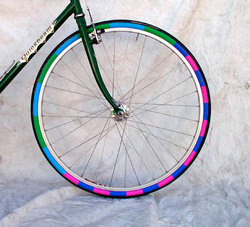
So what would happen if we thought of all designs in terms of movement?  Grant Petersen of Rivendell Bicycle Works (the most vibrant, real brand on the planet, in my opinion) took that idea and came up with a patented innovation, the SpeedBlend bike tire:

10054

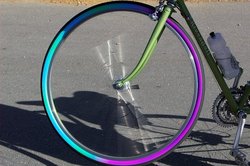
The colors on the SpeedBlend tire sidewall are interesting when seen standing still, but come alive when spun -- which takes Petersen's design from just another eccentric bike tire to something more about magic and fun:

Fa1g3679

20 December 2004 | Permalink | Comments (0) | TrackBack (1)

| |

Design for Free Culture

In early November I attended the pod casting discussion at BloggerCon.  Toward the end of the pod casting session, Larry Lessig pointed out that it would be great if technologists driving the design of podcasting software could do it in such a way as to make the entire domain of pod casting hard for would-be naysayers to grok.  Essentially, his point was that technology creators and facilitators should think about the larger societal context in which pod-casting operates in order to keep the copyright fun sponges out of the picture. 

Too often designers and technologists completely avoid asking the question "Who will expend energy actively blocking this innovation of mine?".  It would be a great thing if that question started getting asked with more frequency.  Even better would be to involve legal types in the early design phase of a new technology so as to design in barriers to prevent the naysayers from dictating how people should and can use a particular technology innovation.

17 December 2004 | Permalink | Comments (0) | TrackBack (1)

| |

More Firefox Customer Evangelism

Earlier this year I talked about the remarkable, user-driven Firefox ad campaign.

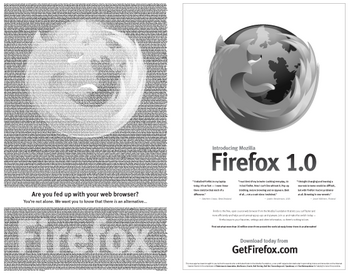
Well, I'm happy to say that today I joined over 10,000 other web browser geeks to run an ad in the New York Times with each of our names writ small -- very, very, very small:

Nyt_ad_2004


Now, it's not an outstanding ad as far as ads go.  And since it ran in a newspaper, it has next to nil staying power (we would have done better to put a Firefox sticker on the dashboard of Dale Jr.'s NASCAR Monte Carlo).  But it certainly is a milestone in the history of customer evangelism.

Have you tried Firefox lately?  Over 11 million people have so far, because it's a great product worth talking about.

16 December 2004 | Permalink | Comments (3) | TrackBack (0)

| |

Unabashed Gearhead Gnarlyness

The 2005 Aston Martin DBR9

15 December 2004 | Permalink | Comments (0) | TrackBack (0)

| |

Playing with Brand Fire

Here’s the headline of an article I just read:

Ferrari Outsources F1 Engine Design Work

Shocking!  It got me all worked up.  My mind filled with visions of hell freezing over and Enzo Ferrari’s body spinning (at 19,000 RPM, mind you) in his grave.

I have nothing against the concept of engineers from India working on Ferrari motors.  Bear in mind that the day of tragic, cigarette-smoking Italian craftsmen hammering out Ferraris from stolen Cinzano signs is long gone; today Ferrari’s general manager is French, the chief of design is American, and its head mechanic is British.  No, what matters to the Ferrari brand is that the motors and cars continue to be designed and built in Italy.  So, no matter where they were born, the designers at Ferrari need to feel, act, and think Italian, imbibing lambrusco, eating pork products and parma cheese, and dreaming of screaming motors whenever they look out at the foggy expanses of Emilia right outside their drawing offices.

But.

Read the article carefully and you’ll see that Ferrari isn’t outsourcing anything.  They’re just buying design software created by the Indian company Tata, and some Indian engineers are going to live at the Ferrari factory (lucky bastards!) to support it.  No engine design work will occur outside of Italy. 

The lesson here isn’t that outsourcing is bad, it’s that the essential Ferrari brand idea that Italy is Ferrari is Italy should be guarded as if it were a life and death matter.  At the very least, Ferrari’s business development people should have put a gag order on Tata. 

Often times effective brand management is more about influencing what other people say about you, not what you say about yourself.

14 December 2004 | Permalink | Comments (0) | TrackBack (0)

| |

Choose Happiness

"Any person or nation can grow fatter and fatter, richer and richer, sleepwalking toward disaster. Or we can choose to remain lean and quick, wealthy in beauty and time  and, that word that inspired our forefathers, wealthy in happiness."
-- Yvon Chouinard & Nora Gallagher

Get Chouinard's complete ChangeThis manifesto here: Download 10.02.DontBuyThisShirt.pdf .

13 December 2004 | Permalink | Comments (0) | TrackBack (0)

| |

Hammers & Nails

If you ask a group of mechanical engineers to create a land mine detection system, they'll likely develop a system which prods the ground.  Electrical engineers might create a detector using magnetism.  In contrast, the biologists at Aresa Biodetection are using a color-shifting, genetically modified plant to signal the presence of land mines:

Plant_land_mine

In the presence of chemical compounds released by explosives into the soil, the Aresa plant turns pink.  While there are certainly ecological and political barriers to implementing this solution, one has to admire its elegance.

If you're a hammer, the world looks like a nail.  Aresa's plant is a wonderful example of how innovative solutions often arise when technical domains and professional disciplines collide.  While you're probably not creating landmine detection systems, you could be doing this today.  For example, if your goal is to create an innovative, record-setting promotional campaign, why not add a nuclear engineer to your existing marcomm team?  Mix some screwdrivers in with the hammers and good stuff will happen.

10 December 2004 | Permalink | Comments (0) | TrackBack (0)

| |

metacool Thought of the Day

Cont7_1

"I never knew I was going to get to the result until I got there." -- Pablo Pardo

09 December 2004 | Permalink | Comments (0) | TrackBack (0)

| |

The Dreaded Knowing/Doing Cat

Though I spent a couple of years getting my MBA (which was a great, fun thing to do), I'm a bit wary of the whole MBA thing in general.  The degree is getting a bit too rubber stamp-ish for my comfort level, as exemplified by this excerpt from a Slate article:

The Pennsylvania attorney general's office Monday sued an online university for allegedly selling bogus academic degrees -- including an MBA awarded to a cat.

Thing is, I bet the cat made some pretty good contributions to the class discussion.  At least enough to get a "2".  Takeaway?  Assess the person, not the degree.  Did they really learn anything?

08 December 2004 | Permalink | Comments (0) | TrackBack (0)

| |

Buying Word of Mouth

Great article in today's NYT Magazine on creating (and paying for) formal mechanisms to foster word of mouth communication around a market offering.

So long as they keep things real, agencies like BzzAgent and Tremor offer a fantastic addition to the traditional marketing mix.  Of course, as with all promotional activities, formal word of mouth campaigns should only be used in addition to, rather than in lieu of, having a remarkable, human-centric offering worth talking about in the first place.  Even better, that offering should be designed to foster word of mouth behavior on its own, so that most of your word of mouth can be earned, rather than bought.

05 December 2004 | Permalink | Comments (0) | TrackBack (0)

| |

Mr. Butt's Human Approach to Retail

There are blogs that focus on original (or somewhat original) content and thinking, and there are blogs that focus on cataloging and linking to interesting things.  metacool is mostly about the former, but once in a while I find something remarkable that I want to pass along, like this:

I've built my professional life around putting humans at the center of business activities.  To that end, I love this Cool News bit about a Mr. Butts of HEB, my favorite (really!) grocery store in Texas.  Want to create a better offering?  Create a culture of deep empathy for your users -- HEB gives employees $20 and tasks them to see what it really feels like to feed a family of four for a week on that bill.

02 December 2004 | Permalink | Comments (2) | TrackBack (0)

| |

Pagani, Successful Automotive Startup

I was fortunate enough to spend an afternoon hanging around the Pagani factory a couple of years ago.  Actually, to call Pagani's facility an automobile factory is quite misleading, as the term conjures up visions of dirty wrenches, flying sparks, and piles of sheetmetal.  If anything, the Pagani factory resembles an Intel chip fab -- clean, quiet, and orderly.  And the cars produced inside are exquisite.

Located a short drive outside of Bologna, Pagani sits but a stone's throw from the headquarters of Ferrari and Lamborghini -- part of the high performance internal combustion industry cluster that's existed in Emilia-Romagna since the 1920's.  The factory is very compact and sits, almost invisible, in a quiet suburban neighborhood.  It is divided into three main areas, each sitting side-by-side: a carbon fiber fabrication area with several autoclaves, an assembly area (big enough to fit three cars on jack stands) and an entrance lobby/museum.  The design offices sit above the museum, and the entire facility oozes quality and attention to detail, as do the fabulous cars that roll out the front door.  For example, most Pagani owners choose to have their car painted, but one car being assembled during my tour had been left in its natural carbon fiber finish.  Why?  Because the carbon fiber layup at Pagani is done with care and workmanship worthy of fine jewelry; every adjoining weave pattern met up with its neighbor with the unwavering precision of a Savile Row pinstripe.  Simply gorgeous, technically superb, utterly and completely to the hilt:

How to the hilt?  Well, when you order a Pagani Zonda, you also receive, at no additional cost, a pair of achingly beautiful leather shoes crafted in Bologna out of the same custom leather used to cover the interior of your car.

Amazingly, Horacio Pagani has been able to buck the odds (I reckon the last successful automotive startups were Honda and Ferrari, and those started in the unusual economic circumstances of the aftermath of WWII) to create a real, going automotive concern not unlike the famed atelier of Ettore Bugatti.  Conventional wisdom tells us that it's impossible to start a new car company.  Perhaps.  But Horacio Pagani built his venture in a smart, calculated way not unlike that of Burt Rutan at Scaled Composites: first, he paid his dues (learned the trade at Lamborghini) to pick up tacit knowledge, then started a composites fabrication business to get some cash flow and create option value.  Only once those steps were successful did he begin making cars with the passion of someone doing what he truly loves. 

Pagani is a great example of designing a venture and building it via an iterative process.

01 December 2004 | Permalink | Comments (0) | TrackBack (0)

| |

Unabashed Gearhead Gnarliness

The 2005 Ducati 999R
to my new friends at Ducati North America, all I can say is, "You guys rock!"  Forza Ducati!

29 November 2004 | Permalink | Comments (0) | TrackBack (2)

| |

Sixten Sason, Brand Creator

Swedish designer Sixten Sason was the man responsible for creating the aesthetics of of the Hasselblad camera in the late 1940's, a design so compelling that today it defines not just a product but an entire brand:

501cms_1

A remarkably prolific and flexible designer, Sason also drove the aesthetic design of Saab automobiles up through the 1960's.  The unique design language he coined lived on into the early 90's before GM bought Saab and lost the trace.  He started it all off with this iconic piece of work, the 1949 Saab 92001, which pretty much says all you need to know about what Saab-ness is:

Saab20001_1

Where do brands come from?  What we call "brand" is the sum of all the decisions you make to shape a user's experience of your offerings.  Brands are designed and built layer by layer over time.  As I've written before, your brand does not define the character of your offerings. Instead, your offerings (and the layers of sales, service, support, and meaning creation surrounding them) define your brand.

Want a strong, vibrant brand?  Make “brand building” the job of your product development group and your brand team.  If you still need convincing, just think about the incredible amount of brand equity created by Sixten Sason over the course of his career at Hasselblad and Saab, and how quickly Saab lost it once his influence was gone. 

28 November 2004 | Permalink | Comments (1) | TrackBack (0)

| |

Alex Zanardi on Courage and Passion

“In life… when you find something that you love so much, as much as I did love motor racing, and as I still love motor racing, you will find in yourself the determination to go out and really bring the best out of yourself.”
– Alessandro Zanardi

[In 2001 champion race driver Alex Zanardi’s legs were cut off above the knee in a horrific racing accident.  Zanardi battled back from the brink of death to once again carry his baby son on his shoulders… and in 2004 to race a BMW in the Italian touring car series (that's him in the car above).  Intrinsically motivated to race and win... stubborn, courageous, and passionate to the core of his being, Zanardi is proof positive that racers make great role models. Forza Zanardi!

24 November 2004 | Permalink | Comments (0) | TrackBack (0)

| |

Tanks and chunks

Forging an enduring bond with customers is at the core of what a brand is all about.  What if you could add depth, vigor, and passion to that relationship by encouraging your customers to participate in the creation of the very offering they consume?

For example, Virgin Atlantic recently held an open competition to create the graphics for 20 different airsickness bags.  Called Design for Chunks, the contest -- nicknamed "retch for the sky" -- attracted hundreds of submissions and resulted in some tasty (ahem) creations.

Over at Ducati, with an offering miles more complex than an air sickness bag, the potential for user involvement in the design process is lower.  Simply put, you can't have laypeople mucking about with the design and engineering of a superbike.  Even so, working within that constraint, Ducati tries hard to make the Ducatisti feel like they're part of the development process by encouraging them to vote on the details of future products, such as the fuel tank of the 2005 model year 999.

999_red_votes

Examples of this kind of participative marketing are manifold, from Firefox soliciting its user base for help with product logos to Guy Kawasaki holding a design bakeoff for the cover of his new book.  The point is, why not tap into the collective genius of your users?  If in open source software development many brains make deep bugs shallow, then with participative marketing many brains can make shallow offerings deep. 

Embrace and engage your users, get deep passion.

21 November 2004 | Permalink | Comments (1) | TrackBack (0)

| |

10x10

10x10

Frequency

Color

Pattern

Gesture

Ranking

Form

History

10x10 is a good example of how innovations in interface design can take us beyond accepted communication norms such as the newspaper headline.  And it demonstrates the potential of RSS feeds very well.

I can think of several examples where a 10x10-type interface would open up new possibilities for insight and understanding:

  • An email inbox
  • A 360 degree performance review report
  • The seat assignment screen on United's self-serve check in kiosks
  • An accounts receivable aging report

Can you think of others?  Drop me a line or leave a comment below.

18 November 2004 | Permalink | Comments (2) | TrackBack (0)

| |

Simplicity of Use

A second (see prior discussion here) way to explore the future of the sports car is via the concept of simplicity of use. 

Simplicity of use involves creating an offering experience accessible by non-expert users. As the Stanford historian Joe Corn notes, one hundred years ago the car was an ornery beast, and its “users” had to bring their own “IT department” along in the form of a riding mechanic or chauffeur.  In the intervening years, automobile designers have added layers of technology between the driver and the base mechanicals so that the overall use experience became less complex; mechanical and electrical complexity went up, but experiential complexity dropped.  For example, these days it’s possible to maneuver a bling-bling three-ton Cadillac Escalade with no more than your right foot, index finger and thumb – all due to the miracles of integrated circuits, advanced hydraulics, and servo motors.  The trick in designing sports cars is to achieve simplicity of use without adding weight – the source of the wide experiential gulf between a 2005 Porsche 911 and its 40-year-old great-grandfather, the 356C.

Perhaps the best example of simplicity of use in the sports car realm was the first-generation Mazda Miata.  The MG TC may have been fun to drive because of agricultural directness, but keeping it on the road required a high level of mechanical skill, or at least a good relationship with a mechanic named Nigel.  In terms of reliability, the 356 was much better, but only so far as contemporary state of the art would allow: park one in your garage, and your living room will soon reek of Shell’s finest!  The Miata raised the standard of simplicity for the sports car ownership experience by adding a layer of sophisticated Japanese engineering between motor and driver to make everything as reliable and bulletproof, yet lightweight, as possible.  Want a motor that only really gets broken in around the 100,000-mile mark?  Check.  No more oil leaks?  Check.  A top that keeps the rain out?  Check.  All with delicious handling?  Check.  If that isn’t simplicity of use, I don’t know what is.  The magic of the Miata is that the sophistication was engineered in without creating a lardy car. 

Simplicity of use and simplicity of specification must inform the point of view for the sports car of the future. That car is many ways already here: the Lotus Elise, which employs an elegant aluminum chassis, simple plastic body panels, a reliable Toyota four-cylinder motor, and lots of lightness to create the delicious feel of a MG TC or 356, only better.

17 November 2004 | Permalink | Comments (0) | TrackBack (0)

| |

metacool Thought of the Day

"If you are a marketer who doesn't know how to invent, design, influence, adapt, and ultimately discard products, then you're no longer a marketer.  You're deadwood."

- Seth Godin

16 November 2004 | Permalink | Comments (0) | TrackBack (0)

| |

Retro Design the Right Way: the 2005 Ford Mustang

This week the New York Times talks about the intensely emotional reaction people are having to the new Mustang.  While the 2005 Mustang doesn't deliver innovation at the Behavioral level of design (it still has a live rear axle -- so 1960's, eh?), it is a sublime mix of Visceral and Reflective design.  Viscerally, the shape is compelling in and of itself (love those tailights); Reflectively, it says "I'm a Mustang and you can project all the good things you know and feel about Mustangs on to me."  It's a great example of the product marketing itself -- meaning is embedded into every curve, rather than being forced on the design via a copywriter's slogan.

Retro design has its critics, but as evidenced by the overwhelmingly positive reaction to its new Mustang and GT designs, Ford is striking a decent balance between something new and something old.  Better than Chrysler and its PT Cruiser, as good as VW and the New Beetle.  Not quite as brilliant as the BMW Mini.

PS:  If you're asking "Why so many cars on this blog?", here's my answer.

13 November 2004 | Permalink | Comments (0) | TrackBack (0)

| |

Simplicity of Specification

Simplicity provides a good frame for yet another answer to the question “Will sports cars die?”  As I stated earlier, a better question is “What form will the sports car take?”, and simplicity, expressed two ways, also provides answers.

The first answer comes from the idea of simplicity of specification.  The MG TC, which introduced the sports car idea virus to the United States, was an incredibly simple machine, almost to the point of being crude and agricultural.  Four cylinders, ladder frame, cycle fenders, and little to no weather protection, it was an elemental design.  But its very simplicity created its value: next to the average American lead sled, the MG TC was light and nimble and immersed its pilot in an intensely visceral driving experience: wind, noise, oil everywhere, steering kickback, blatting exhaust. 

Joining the MG TC in the ranks of all-time great sports cars is the Porsche 356, also a machine of simple specification, a far cry from lardy descendants such as the Porsche Cayenne.  A sophisticated design for its epoch, the 356 was derived from one of the simplest of cars, the VW Beetle.  The 356 provided a drive with more protection from the elements than did the MG TC, but still made him a full participant in the process of getting down the road.  356Even today, to drive a 356 is to experience a car as almost a living, breathing animal. To illustrate how compelling the 356 driving experience is, I have several friends who own both a modern Porsche 911 and a 40- to 50-year-old 356.  These are cars separated by 1000+ pounds of curb weight, as well as by two extra cylinders and 200 horsepower.  But to a person, they prefer the 356.  Simply put, its Visceral-Behavioral-Reflective signature hits the enthusiast driver’s sweet spot. 

Both the MG TC and 356 were simple machines, even for their time. Where they excelled was in the sense of lightness that comes with a simple (but elegantly executed) mechanical specification, resulting in a direct, stimulating driving experience.  From a pure feel point of view, there’s no substitute for “adding lightness” to a car.  Heavy designs can be made to handle well – and elephants can be taught to dance – but if you want to float like a butterfly, why not start with a butterfly? Significantly, neither car was about heaps of horsepower.  Both, in fact, were rather slow relative to contemporary family sedans.  There’s a lesson here for designers of future sports cars: as I’ve noted earlier on this blog, the automotive world is in a wild upward spiral of horsepower; it’s a place where a $32,000 Subaru can give a $70,000 Porsche a run for its money.  Within a few years, any marque, be it Ford or Ferrari, will be able to deliver a reliable, 600 horsepower street car, and at that point, the only way to create a truly differentiated driving experience will be via feel.  And the best way to create good feel is by designing around a simple, even spartan, point of view. 

As such, the Porsche 356 is the template for future sports cars. 

I’ll discuss the second expression of simplicity later this week.

12 November 2004 | Permalink | Comments (0) | TrackBack (0)

| |

Helping Evangelists Craft the Message

The marketing people at Mini do so many things so very well, it's hard to know where to start.  So let's begin with the lowly Mini bumper sticker:

Mini_sticker

I created this sticker in just two minutes at the Mini website.  What's happening here is quite cool: rather than printing a jillion stickers, dropping them in the mail, and then hoping that someone slaps one on a car (or even worse, selling the stickers, which is what most automakers do), Mini lets you design your own, and provides you with instructions on how to turn it into a sticker.  Odds are only a few Mini whackos will take the time to create a sticker, print it out, and place it ever so carefully on the boot of their Mini.  But imagine the deep and passionate conversations these Mini ambassadors can have with civilians around the world! 

As a marketer, you want evangelists talking about your offering because their voice rings true and pure in a way that yours can't.  So why not enable them to create true and pure marketing collateral, too?

11 November 2004 | Permalink | Comments (0) | TrackBack (0)

| |

A lesson in avoiding assholes, from Sir Richard Branson

I just caught the premier episode of The Rebel Billionaire, Sir Richard Branson’s answer to Donald Trump.  I had three takeaways from the show, two trivial, one deep.

First, the trivial:

  • If you want to get on a reality TV show, you must dye your hair blonde, or for bonus points, burn it extra crispy white.
  • And/or: do something strange with that hair.  Shave it.  Grow a jazz dot.  Stick it up with glue. If all else fails, dump a dorky hat over it. 

Perhaps this is Branson’s way of poking fun at Trump – “Look mate, I can gather a load of people with hair at least as silly as yours.”  However, as with the extreme sports activities which make up the bulk of the show, hair has very little to do with business acumen or success.  As I said, these are trivial points.

Assholes, on the other hand, are not (for those of you not paying attention, this is the “deep” takeaway).  Organizational behavior expert Robert Sutton has written extensively on the effect that assholes have on coworkers.  We’ve all been there: you’re sitting in a staff meeting, trying to act like an adult, and then someone in the room has a hissy fit.  Or think about the low-level teasing that inevitably accompanies someone wearing what they want to wear to work.  And then there are the folks who, plainly put, treat people below them (such as janitors and exec assistants) like shit.  All the work of assholes, and all bad news; as Sutton points out, “…there is substantial evidence that anger and hostility are contagious, so if I am nasty to someone, they will be nasty to me, and a destructive cycle will commence.”  Sound familiar?

What if you could have an asshole-free workplace?  I worked in one such place, and it was the best four years of my professional career.  Sure, we had a few total jerk-offs here and there, but in general our hiring process was all about establishing a shock-proof, bullet-resistant asshole detector, and it worked.  Here’s how:

  1. We generally only accepted interviews from candidates referred via word of mouth.  In Seth Godin speak, we looked for Purple Cows.  Resumes were a bad thing… piles of references were golden!
  2. We phone screened for technical competence before you walked in the door.  It’s one thing to be an asshole, it’s quite another to be an incompetent asshole, or even worse, an incompetent nice person.
  3. Once in the door, you spoke to at least 12 people.  You had lunch with them.  You walked around.  You talked.  You answered questions.
  4. Any hire candidate got interviewed by people in the org who would be above, below, or to the side of them, status-wise.  And by people in totally unrelated disciplines.  That way, if you did get hired, you felt that the entire company wanted you, not just one specific high-status manager, who by the way, might or might not be a total asshole herself.  This method also keeps assholes in a hiring position from replicating.  Assholes tend to stick together, and once stuck are not easily separated.
  5. We took you to lunch.  Decisions you made at the restaurant mattered.  A lot.

I know this isn’t the norm out in industry.  Not many HR professionals are ready to cede so much power over the hiring process to the rest of the organization.  This is too bad.  As Sutton writes:

For starters, I am surprised by how few senior managers act to avoid hiring jerks in the first place, or to stop abusive employees in their tracks once they reveal their true colors. The key is to make explicit to everyone involved in hiring decisions that candidates who have strong skills but who show signs they will belittle and disrespect others, cannot be hired under any circumstances.

Sir Branson took an innovative approach to the asshole problem by donning Scooby-Doo-ish makeup and mask before picking up would-be contestants from the airport in a London taxi cab.  Disguised as an arthritic old cabbie, Branson was able to observe these would-be Trumps interacting with a “little” person, a situation which is to an asshole what buried truffles are to a pig – an invitation to root around and generally make a boor of one’s self.  Not surprisingly, three contestants showed their true colors in short order, and Branson kicked two of them off.  A strong cultural statement, eh?

On Branson’s show, the jerks – wait, by willingly going on a reality TV show they’re all grade-A assholes, right? – okay, the really, really big jerks get kicked off first.  But that doesn’t happen in real life workplaces, at least not quickly enough to matter in most situations.  What to do?  Sutton advises that there “… are times when the answer is indifference, when the wisest course is to go through the motions, learn not to care, and just get through the day until something changes on your job, or something better comes along… I am starting to believe that, as a management professor, part of my job is to teach people when indifference is more useful than passion.”  I tend to agree with him. 

10 November 2004 | Permalink | Comments (2) | TrackBack (1)

| |

Unabashed Gearhead Gnarlyness

The Ducati PaulSmart 1000

09 November 2004 | Permalink | Comments (0) | TrackBack (0)

| |

James Dyson on Alec Issigonis

CNN is running a nice piece on Alec Issigonis, father of the (original) Mini.  What's notable about this brief bio is its author, James Dyson, father of the eponymous vacuum that never loses suction.

Issigonis was a genius on many levels.  As Dyson notes, the father of the Mini was nothing if not elegant in both his design solutions and his structured approach to problem solving:

Sir Alec Issigonis... came up with his ingenious idea while sipping on a gin in a hotel in Cannes -- a very civilized approach to engineering.

If this article is indeed written by Dyson and not some pathetic PR flak, it poses an interesting question: why not have real, working designers write the history of design?  Why leave it up to non-pracitioners who don't know really understand the design process?  I'd like to see more designers follow Dyson's lead.  Gin or no gin.

08 November 2004 | Permalink | Comments (1) | TrackBack (1)

| |

metacool Thought of the Day

Eamesstuhl

"We used to bring a piece of furniture we were working on home to look at it, because at the office everything was out of scale."  - Ray Eames

[You've got to get out and see how your offerings work in context.  Needs are verbs, and your end users probably don't speak the same language you do.  Get out and see, hear, listen.]


06 November 2004 | Permalink | Comments (2) | TrackBack (0)

| |

See you at BloggerCon III

I'm stoked to be attending BloggerCon III tomorrow.  If you'll be there and would like to meet in person, drop me a line. 

05 November 2004 | Permalink | TrackBack (0)

| |

Building Marketing into Your Offering

Change This is passing the 100k mark for manifesto downloads from their site, and reckons that if you add in pass alongs enabled by the "smoothness" features built in to those manifestos, the total number is more like 250k.  Since August.

Wow.

This is proof that, at least in the case of fostering word of mouth on the internet, if you're smart about building in smoothness and pass along functionality, people will spread your stuff.  In addition to designing the tools correctly, Change This set up the human incentives right, too -- they enlisted blogging mavens and connectors (including yrs trly) to host manifestos, and rewarded those uber bloggers with increased traffic and prestige.

04 November 2004 | Permalink | Comments (1) | TrackBack (0)

| |

Apple, could you design a simple voting process for us?

Ivotedstars_1What's that sound? Oh, it's just my hand patting myself on the back.

But seriously, folks, I just voted, and what I saw, heard and experienced scared the bejeezus out of me. I'm talking about the electronic, touchscreen voting booth which I just used to decide the fate of the planet. So many aspects of the design sucked, it's hard to know where to start. Here are the problems I had:

1) I was issued a magnetic card "key" to allow me to use the voting machine. It fit into a slot on the front of the voting machine. I expected the machine to grab the card upon insertion and pull it in, much like an ATM machine would (as a society, we've been trained to have cards sucked in). But it didn't. My card just sat there, limp and inert. Finally, my inner mechanical engineer spoke up and I rammed the card home. Bling bling! The touch screen awoke and I could now do my civic duty.

2) Each screen had two or more votable items displayed at a time, which a big yellow "next screen" arrow in the lower right. Thing is, I was able to press the yellow arrow and skip a votable item without the system giving me any feedback that I had skipped an item. Folks, the self-serve kiosks at United Airlines work better than this. Lucky for me I'm a software industry veteran and was able to go back a page. But what if I was an "analog", part of the population who has never used a computer, let alone a web browser-style interface? What if, for example, I was an 80+ year-old woman wearing those big wraparound sunglasses and trying to vote with this damned thing?

And there she was: next to me an elderly woman sat there trying to stick her card in for about 45 seconds. She muttered and cursed and finally called an attendant for help.

Then there was the elderly gentleman on the other side of me. He stood there motionless the entire time I was voting, and then asked the attendant for help. Seems he couldn't find his candidate on the touchscreen (video monitors are hard to read -- we read better on paper). It took a while for the local "IT department" to sort of his problem. The answer? The poor guy was trying to vote for "Laura Magenta", one of the sample candidates from the paper instructions he had in his hand. It wasn't his fault. Just a stupid, poorly-conceived and implemented voting process.

God help this country of mine. Or better yet, get Steve Jobs and crew to design a simple, effective voting process for us.

02 November 2004 | Permalink | Comments (0) | TrackBack (1)

| |

Simplicity that Works

Trick or treat!

Several dozen kids yelled that at my front door this Halloween evening, but for most of the night I felt like my new IBM T42 ThinkPad was also shouting the same thing. Why?  Because I spent over two hours trying to get this brand new computer to stop:

1)  Crashing every 5 minutes

2)  Losing its connection to my home wireless network every 30 seconds

IBM Trick No. 1: As of last week I used another ThinkPad with the same operating system (XP), and it had no problems working with my network

IBM Trick No. 2: When I called IBM ThinkPad support, they said, and I quote this verbatim: "We only make the computer part, we can't help you with the software stuff."   What an incredibly poor response, one that betrays a lack of understanding of the business they're in.  What I need from from IBM is a total solution -- if I wanted to spend a perfectly beautiful California evening hacking on a crappy PC, I would have bought some no-name brand, and not spent a premium for a ThinkPad.  IBM seems to be competing with Handspring for the worst customer service on the planet, but that's a story for another time.

Treat:  this week's Economist has a special section on IT complexity, which made me feel feel better about the fact that my new PC has worse manners than a new puppy -- everyone has the same problems with this horribly complex technology. 

What I want is simple: simplicity that works.  A few months ago in this blog I touched on the theme of simplicity; I'm looking forward to revisiting it over the next week.

31 October 2004 | Permalink | Comments (2) | TrackBack (0)

| |

« Previous | Next »

Categories

  • designing
  • innovating
  • leading
  • marketing
  • meta metacool

search


About

Subscribe to this blog's feed

    follow me on Twitter

    Favorite Posts

    • A million reasons why...
    • Mo Cheeks and a fundamental question of leadership
    • Innovation Lessons from Garage Majal
    • From Obama to Pink to Oprah
    • Shinya Kimura and the primacy of doing
    • A tribute to friends and friendship
    • Strategy that makes your hands bleed
    • Quality in a switch
    • Travis Pastrana and the future of the world economy

    on the nightstand

    • : The Great Bridge

      The Great Bridge

    • : Porsche - Origin of the Species

      Porsche - Origin of the Species

    Principles for Innovating

    • 1: Experience the world instead of talking about experiencing the world
    • 2: See and hear with the mind of a child
    • 3: Always ask: "How do we want people to feel after they experience this?"
    • 4: Prototype as if you are right. Listen as if you are wrong.
    • 5: Anything can be prototyped. You can prototype with anything.
    • 6: Live life at the intersection
    • 7: Develop a taste for the many flavors of innovation
    • 8: Most new ideas aren't
    • 9: Killing good ideas is a good idea
    • 10: Baby steps often lead to big leaps
    • 11: Everyone needs time to innovate
    • 12: Instead of managing, try cultivating
    • 13: Do everything right, and you'll still fail
    • 14: Failure sucks, but instructs
    • 15: Celebrate errors of commission. Stamp out errors of omission.
    • 16: Grok the gestalt of teams
    • 17. It's not the years, it's the mileage
    • 18: Learn to orbit the hairball
    • 19: Have a point of view
    • 20: Be remarkable

    CC

    • Creative Commons License