"I might look successful but I've had many failures. People take failure too seriously. You have to be positive and believe you will find success next time."
source: Monocle, Issue 22, p. 81
"I might look successful but I've had many failures. People take failure too seriously. You have to be positive and believe you will find success next time."
source: Monocle, Issue 22, p. 81
28 March 2009 | Permalink | Comments (1) | TrackBack (0)
|
Here's another stab at articulating this foundational concept:
Prototype as if you are right but listen and observe as if you are wrong: this approach develops better solutions faster, and forces you to never settle.
What do you think?
27 March 2009 | Permalink | Comments (3) | TrackBack (0)
|
My colleague Bob Sutton has a great set of "15 Things I Believe", which you can find along the left side of his blog. No. 5 is one of my favorites:
I was thinking about Bob's belief today in the context of innovating on a routine basis. What if I built on his belief but modified some of the language? Here's what I came up with:
What do you think?
23 March 2009 | Permalink | Comments (1) | TrackBack (0)
|
This awesome Director's Commentary focuses on the thinking behind the reworked BMW 7-series. Narrated by BMW design maestro Adrian Van Hooydonk, it's important on two levels.
First, it's amazing to hear an expert take us through the intricacies of making a car look good. Cars can be magnificent works of scuplture, but rarely does success come by accident. As we listen to Van Hooydonk describe the interior and exterior design details, we get a glimpse at the extreme amount of attention to detail required to pull off a product experience as complex and multifaceted as a car. Such is the state of technology and design process at BMW, even a rear tail light has become a sophisticated mechanical-eletronic subsystem, and one designed to the hilt. What a far cry from the incandescent-bulb lit taillamps of my old 1969 1600-2!
Second, once again we see the importance of having a clear point of view to guide design decisions. Listening to Van Hooydonk, it's clear what is important when it comes to the design of a 7-series: power, sport, elegance, strength, authenticity. Staying on brand means designing to those parameters and throwing out everything else. Which sounds a lot like the art of strategy making to me; perhaps the most important aspect of designs informed by a strategic point of view is that the design does come to embody that strategy and as such forms the basis for a completely coherent brand identity. In my experience it's much easier to have effective marketing communications if your offering actually is designed in manner that's congruent with your messaging.
I consider organizations such as Apple, BMW, Zappos, and Pixar to be part of a select few capable of nailing a complete and compelling user experience. They each do so by betting on the talent of their designers and creators. Clear and compelling vision, coupled with quality execution, does in fact win over the long haul.
17 March 2009 | Permalink | Comments (1) | TrackBack (0)
|
You heard it here first: I've fallen in to a classic creative trap called "how can I ever be as good as [insert existing thing here]?
A few weeks ago I ripped off a quick post about Travis Pastrana and the future of the world economy. It took me 15 minutes, I'm not sure where it came from, and it was easy, easy, easy to write. Largely because I wasn't worried about who would read it, words just poured out of my fingers. I just wanted to catch the thought and get it down on paper. The thing is, people liked it. People really liked it, and since then I've been spending a lot of time -- too much time -- thinking about what I could write that would be as good as that one, and in the process of doing so I've stopped writing.
What a mistake. I've fallen in to a classic creativity trap. And I should know better.
The reality about bringing cool stuff to life is that you actually have to bring a lot of crappy stuff to life along the way, and sometimes good stuff happens. And sometimes great stuff happens. But spending your time doing nothing in the name of perfection is a sure recipe for failure. In other words, for something great to happen, things first need to happen. If anything, 2009 is a year for all of us to laugh in the face of perfection and embrace sins of commission. The good stuff will come.
It's hard, though. Be strong.
12 March 2009 | Permalink | Comments (2) | TrackBack (0)
|
"The best measure of a blog is not how many people it reaches, it’s how
much it changes what you do. Changes your posture, your writing, your
transparency, your humility. What blogging has done for me is made me
think. I get to think about how the outside world will understand
something I’m trying to do, for example."
- Seth Godin
25 February 2009 | Permalink | Comments (0) | TrackBack (0)
|
While not trying to be flip about such a weighty topic as the state of the macro international economy, I believe this daredevil bigwheel jump by Travis Pastrana elegantly captures some of the key elements that will help consumer-facing brands thrive over the next few years.
(No, it's not about shooting bottle rockets at night in your underwear. Skip ahead six seconds)
I reckon there are five in total:
Many thanks to my friend Reilly for pointing me to this video. The weird resulting thoughts, however, are those of yours truly, and should not be blamed on him.
17 February 2009 | Permalink | Comments (6) | TrackBack (0)
|
As I've said before, while I work at IDEO, this is not a blog about IDEO and I don't talk much at all about what's going on there. However, I wanted to point out two cool things involving IDEO which I think have broad appeal to all of us trying to make a dent in the universe.
The first one is about David Kelley. I hope you can read it. After my parents and my family, he's way up there in my personal you-changed-my-life-forever-and-ever category. He's been a teacher, boss, fellow gearhead, accomplice, hero.
The second is Fast Company's list of the world's most innovative companies. Yes, IDEO is in there (we're in the top 10! Woo hoo!), but it's also super instructive to read through the list of 50. It's also a really nicely designed web experience. For me, it's affirming to see that so many innovative companies are also ones whose brands are part of my life or consciousness. If I were to draw up this list on my own, it might look a bit different (where's Mozilla?), but here are some of the Fast Company 50 that are part of my life (some are major time sinks: hello Hulu and Facebook and Zappos!):
Enjoy! Have a great weekend.
13 February 2009 | Permalink | Comments (2) | TrackBack (0)
|
Here's a fabulous talk from last week's TED conference.
Listen as Elizabeth Gilbert provides us with a Director's Commentary about her own creative process, and then shows us why we might be better off if we thought differently about where creative leaps come from.
09 February 2009 | Permalink | Comments (0) | TrackBack (0)
|
04 February 2009 | Permalink | Comments (5) | TrackBack (0)
|
I'm a big believer that brands are about what you do in the world, not what you say you do. This often leads me to say things like "Subaru is the new Saab", or "Pontiac is the new BMW". I heard a lot of agreement on the former but was virtually tarred and feathered for the latter. But I stand by my judgments of those brands, because they really are delivering compelling experiences in a way that they didn't before, and arguably better than their vaunted competitors. When organizations focus on making really good stuff, then it's relatively easy to talk about that truth and have it stick in the world.
Truth is much stickier than myth.
So here I go again: the Hyundai Genesis Coupe is the new Mustang. It pairs a sophisticated powertrain with a modern design approach to suspension (read: no live axle out back), and wraps it all up with some provocative styling. It's a great example of an automaker really nailing it in terms of visceral, behavioral, and reflective design. The reflective (designing meaning) part of that triad is being played out this weekend with the debut of this massively gnarly commercial during the Superbowl:
That's truly one epic lap, and a big leap forward for Hyundai. The Genesis is the new Mustang.
30 January 2009 | Permalink | Comments (1) | TrackBack (0)
|
via FFFFOUND!
29 January 2009 | Permalink | Comments (1) | TrackBack (0)
|
Can I say that?
"Stuff I'm liking." Grammar? I think it works. It's somewhat Borat-ish, but I think it works. Hey, if I have a blog, and I publish something to the web, then it exists, right?
Here's some stuff I'm liking, with commentary as to what I see in it:
I'm really liking all of it!
19 January 2009 | Permalink | Comments (2) | TrackBack (0)
|
"There have been several times in my life when I owned something so special that I worried I would lose it or it would be stolen or be abused by the kids. A pen knife collection that my Dad gave me was one such treasure. So I hid it. I didn’t want anyone to use it or steal it so I found a hiding place for it. The problem was I forgot where I hid it. It took years of searching and I finally found it again hidden in the garage. There have been other times where I have hidden something from the world and the one who couldn’t find it was me, the one who couldn’t enjoy it was me and the one who was in misery because something so nice was lost was me.
The only one that suffers from holding back is you and your career. Imagine Steve Jobs or John Chambers or the Google Guys holding back. Those innovation ideas or process flow improvements or your creativity and sense of humor should be brought forward now, not next time. Next time may be too late. The more you add the more you will see. Too often, people hold back and stuff the value they can add in the lower right desk drawer waiting for a better time. That time is now. Get the recognition now, get the satisfaction that you made the place better now."
15 January 2009 | Permalink | Comments (2) | TrackBack (0)
|
I really enjoyed the recent conversation here on metacool about the meaning of designing. A bunch of us took at a stab at completing the sentence "Designing is...". Check out the comments here to see some of the thinking. I'm still mulling this stuff over; there's some good provocations there.
Now, what does innovating mean to you?
Innovating is...
14 January 2009 | Permalink | Comments (16) | TrackBack (0)
|
Besides metacool shipping another release to market, one of my peak life moments in 2008 was getting to hang out with an amazing group of people at the Philip Johnson Glass House. There we held a salon of sorts, and talked about simplicity, among other things. You see more about this awesome day here and here.
I just discovered this awesome video of John Maeda talking about our day on the day. Looking back on that moment in time, I really appreciate his ability to take me back to what I heard, thought, and felt.
If, as I learned that day, knowledge is the beginning of practice, and doing is the completion of knowing, then surely YouTube is the resolution of being. Many thanks to the people who put this video together for enabling us to remember and share and learn.
I'd love to participate in more salons like this. And even host and curate them. Not necessarily at the Glass House, but anywhere a good conversation is to be had. I think I'll do that.
13 January 2009 | Permalink | Comments (0) | TrackBack (0)
|
My New Year's Resolution for metacool is to publish more original stuff, more often. Here's a step in that direction, and perhaps a step too far: I didn't have time to craft a brief post, so I pounded out a long one. I'm sorry.
As of late I've been thinking a lot about the difference between managing and leading, whether creativity can be led or managed, and what might happen if you pushed those two questions together. Here's an in-progress answer:
Hang around long enough in around the coffee stations of any Fortune 100 company, and you're bound to hear the question "how can we better manage creativity around here?". While it may taken different forms, this is not just a tough question, it's also the wrong question. We can't manage creativity. Period. We can't implement a process that will create creative outcomes with a high degree of reliability. If you look around, the killer innovations of our time are coming from organizations like Google, Mozilla, and the X Prize Foundation, who've each stopped trying to manage innovation in traditional, top-down ways in favor of leading it. And they lead it in a very specific way: they see the leadership of creativity, in all its facets and complexity, as something akin to the act of cultivating a garden. Particularly when it comes to harnessing the power of emergent behavior, where creativity morphs in to world-changing innovations, leaders must all -- in fact, can only -- tend to their gardens. They must learn to become cultivators of creativity.
Some essential thoughts on creativity. We at metacool hold these truths to be self evident, that everyone is potentially creative, that creativity is endless, that each individual is capable of being an agent of change in the world when properly supported by their surrounding ecology and society. We do not subscribe to the myth that there two types of people: "creatives" and everyone else is not an idea that will sustain modern organizations. To be certain, differences in life experience enable some folks to be more creative, but a critical task of leadership is to enable every individual to be as creative as need be, rather than to choose the seductive path of tapping a select few to do the dreaming for the rest of the pack.
With the challenges we face in the world, it is incumbent upon leaders to unleash the creativity of the many, not the few. Modern organizations tasked with delivering ever more holistic customer experiences must be able to tap in to the creativity, intelligence, and initiative of everyone affiliated with the brand, not just the talent of a select creative few. If the success of an open sourced Firefox over "closed" competitors such as Microsoft's Explorer can show us anything, it is that charging the generation of new sources of value and wealth to a limited few results in suboptimal outcomes in the form of disgruntled users and unhappy shareholders. Firefox is created largely by a community thousands of volunteers who work for ego satisfaction alone, organized by a small group of people -- creative cultivators -- wholly responsible to that community. Cultivating creative behavior within this type of community has much more in common with behaviors and attitudes associated with the successful cultivation of gardens than it does with traditional, top-down, centralized, command-and-control notions of what effective management looks like.
To realize a community, organization, or even an entire society capable of reaching its creative potential, we need a wholesale shift in our conception of what effective organizational leadership looks like. That leadership model can be found in the following four defining behaviors of creative cultivators:
1) Being at the bottom of things
Flourishing gardens come from being at the bottom of things. Instead of pursuing the traditional management goal of being on top of things -- with the lucrative by-product of being at the top of things -- the leader-as-cultivator makes it their job to live simultaneously at the bottom and in the middle and on the edges, dealing with things that might seem like plain manure to outsiders. Unfortunately for those caught in old models of leadership, it's not lonely at the bottom. The bottom can be a messy place, but it is the wellspring of success when it comes to fostering creativity. With plants, as with people trying to act in creative ways, you can't tell them what to do, but you can try to support what they need to do, matching essential resources to tasks at hand. This is not traditional, I'm-the-heroic-boss leadership. Instead, the creative cultivator takes satisfaction from tending to the health of the overall garden, and wisely leaves the kudos for smelling great and looking good to the roses.
2) Trusting what is there
Creative cultivators trust what is there. A wise cultivator resists the temptation to "dig up the seed", as it were, to check if people are being creative enough. Many breakthrough innovation initiatives are stifled by linear project timetables more appropriate to incremental efforts. The paradox of cultivating creativity is that confidence in outcomes is the fundamental enabler of creativity itself; a wise gardener knows that roses are the best authorities on the creation of rosiness, and until they bloom, only checks in to see if they need more food and water. Furthermore, creative cultivators trust that the right answers -- though not the ones they would have thought up themselves -- will emerge from their gardens. Cultivators at Wal-Mart chose to move the needle on sustainability by engaging thousands of their store associates in a Personal Sustainability Project, with each individual choosing to reshape a life behavior. Trusting what was there, Wal-Mart rewarded "crazy but good" ideas emerging from the PSP program by promoting them across the company network. Likewise, ideas bubbling up within the PSP system which were negatively deviant -- like a strange tomato that received too much fertilizer -- were treated as a positive learning opportunity for the originator. So much about what makes a creative organization tick is tacit. It's about what's there and what it creates, rather than what a few brains wish to have happen via explicit processes and goals.
3) Seeing the ecosystem
By their nature, gardens are part of larger ecosystems. As shown by the recent success of P&G in bringing in outside sources of innovation in to the company, healthy gardens readily accept inputs from the outside world. Rain, water, seeds, nutrients -- we don't care where they came from, we just care about their integrity and how they help us grow good stuff. Encouraging variance -- the creation of weird or unexpected ideas -- is a key goal for someone cultivating a creative culture. Anything that encourages variance through the cross-pollination of ideas from outside sources (very much the function of bees) should be reinforced. And as we're sadly seeing out in the world, gardens without the benefit of bees soon stop producing. Thinking about the long-term health of all stakeholders in an ecosystem is also a signature act of the leader as cultivator. Innovating is a long-term endeavor and requires a great deal of patience, investment, and fortitude. Actions that value short-term productivity over the long-term health of the garden and its larger ecosystem are ultimately anti-creative.
4) Taking a bird's eye view
Finally, creative cultivators do all of the above while simultaneously curating the garden from a bird's eye view. Managing a portfolio of creative endeavors requires knowing how many plants a certain piece of land can support and then pruning or as culling appropriate. Steve Jobs has stated that the iPod's development would have been impossible to support had the company also invested in other attractive opportunities, such as a PDA. This notion of garden as portfolio extends to strategy and brand: creative cultivators recognize that terroir matters, that some things (think wine grapes) just grow better, taste better, in certain places. Doing the most with the resources at hand, listening to what works and what doesn't, and guiding growth to be something unique and wonderful – that is the essence of strategy, and of gardening as well. Most importantly, a creative cultivator creates the context for plants to grow in accordance with a strong vision of how the garden should evolve. In organizations, this means having points of origin that can inspire individuals to be creative in certain ways, and not others, and to innovate in certain directions. For example, Whole Foods has created tremendous value based on the proactive decision-making skills of thousands of employees, each guided by a carefully crafted set of Core Values. BMW, Virgin, Prana, and a host of other strong brands do this well, too.
Taken together, these four ways of leading should help creativity and its children grow and flourish. Instead of trying to manage creativity, we must move to a model of leadership that's all about cultivating it.
12 January 2009 | Permalink | Comments (4) | TrackBack (0)
|
This should be a really interesting movie! Comes out later this year.
And be sure to catch Helvetica tomorrow night on PBS.
05 January 2009 | Permalink | Comments (0) | TrackBack (0)
|
One of my resolutions for 2009 is to do more original thinking (via my writing here) and less pointing to other stuff. 2008 was a very busy year for me on many levels, which led to less writing and more pointing. And to be honest I lost some interest in this blog in favor of thinking about gnarlyness on one of my other blogs, but after some reflection over the past couple of weeks -- as well as the inspiration of meeting (!) some life heroes and observing how they've found ways to live their lives to the fullest (hint: cancel your cable TV subscription, fly to England when you want to, don't be afraid to let it all hang out, communicate with integrity and passion), I now have a crisper point of view about where to go with things here, and I hope you'll like it. I hope most of it means back to the future. Without promising too much, hopefully the quality and frequency will both go up. As a wise man once said, do both!
So, less pointing, more thinking.
Of course, since I'm an imperfect man living an imperfect life as best I can, allow me the liberty of pointing to something right now: Walking Eagles
Let's hope 2008 was the year where walking eagles did their stuff, and that in 2009 we can all soar.
02 January 2009 | Permalink | Comments (3) | TrackBack (0)
|
... creating choice out of constraints
... linking needs with desires
... moving the baseline with intent
More? What do you think?
29 December 2008 | Permalink | Comments (11) | TrackBack (0)
|
I always try to treat a mundane food-shopping trip as an expedition to an exotic marketing laboratory. Viewed through that filter, there's usually something interesting going on.
Case in point is this yogurt case at Whole Foods. Hanging out on the top shelf are some granola-type bars. These particular bars are sold by a firm called Attune and are infused with probiotics. So selling them in the yogurt section makes perfect sense: it's about being placed in a way that embraces the shopping experience and needs of the human at the end of the supply chain, rather than efficiencies of layout and inventory stocking. For example, before I arrived at this display, I had no idea that you could get the outcome of yogurt consumption in a solid food experience. Had these Attune products been located in the activity bars section, I would have missed them amongst all the brand shouting.
When it comes to innovation, there's as much or more that can be done with all of the layers of product experience around the core offering as with the core offering itself. And in this day and age, running some experiments with three of the four P's -- place, promotion, price -- is likely to yield some quick and productive results. Always ask, "So where are we going to sell this?"
22 December 2008 | Permalink | Comments (2) | TrackBack (0)
|
In his latest column, Tyler Brûlé explains his simple, "everything matters" test to assess a hotel's capabilities: order a club sandwich.
He explains:
Focusing on the very basics, it starts by sampling the quality of 10 everyday ingredients (bread, lettuce, tomato, egg, bacon, chicken, mayonnaise, butter, potatoes and cooking oil) and how well (or not) all of these can be worked up into a club sandwich.
As with many things in life, if you can nail the simpler, smaller things, then the rest tends to fall into place. This is particularly true of hotels and how they deal with toasting bread, frying eggs, arranging lettuce, crisping bacon and cooking French fries.
15 December 2008 | Permalink | Comments (0) | TrackBack (0)
|
Here's a Director's Commentary by Dan Hill, who played a key role in the design of Monocle, which is not just one of my favorite magazines, but also a brand being successful at the seemingly impossible task of building something new and different in a down economy. In reading his detailed account of how the design of Monocle came to be, I was struck by two big things:
First, the all-important commitment to a strong, focused point of view. In this case, the brains at Monocle chose to be ever calm and centered:
In terms of rhythm of updates, we deliberately decided less is more, and flying in the face of conventional wisdom (if you can have wisdom in a medium only a decade old) we produced editorial at a steady rate - essentially a well-made film or two per week - rather than bombarding the user with content. Deciding to filter, reflect and craft rather than immerse the user in a constant flow of data in lieu of information... this sense of quiet calm exuding from Monocle was another important statement: that you don’t have to clutter websites with every possible bit of information you can. And that - particularly for the busy people that enjoy Monocle - information overload is not something we wished to contribute to.
The second notable aspect of their approach is a strong dedication to smoothing friction in every aspect of the user experience. They took a human-centered approach to almost every detail of Monocle, including the structure of each URL used on the Monocle website:
In terms of user generated content, or user discussion of Monocle pieces, my view was that we didn't need comments on the site as people increasingly have their own spaces to talk, discuss, comment - whether that's blogs and discussion fora, or the social software of Facebook et al. So a more progressive approach would be to ensure that everything is linkable and kept online - with clean, permanent URL structures - thus encouraging people to point to articles from the comfort of their own sites... The web is intrinsically designed for linking and archiving, so I ensured that Monocle.com would do that. A simple point, and one the industry discovered long ago - in my case, after much work at the BBC - but fundamental nonetheless. It’s still surprising how often it’s forgotten by new entrants, given this basic premise of pointability has underpinned almost every mature online success, from Amazon to YouTube.
As such, it's worth pausing to note that the URL structure was considered as part of the design job. See later on multidisciplinary teams, but the architecture of the site, and further, the environment it sits within, are as key to me as the visual layer pinned on top. I always reference the Eliel Saarinen quote: "Always design a thing by considering it in its next larger context - a chair in a room, a room in a house, a house in an environment, an environment in a city plan." The larger context for this site is that portion of the web that cares about Monocle, or the topics covered, and designing for that environment includes making elegant URLs - as the tokens by which Monocle.com is referenced. Thus, the pointablity, linkability, permanance and appearance of those URLs and site structures become fundamentally important.
Thus, the URls might not be as clean as they could be - it took a bit of negotiation to get EPIServer, a .net based CMS, to output them - but they're fairly understandable e.g.:
http://www.monocle.com/sections/affairs/Web-Articles/Christine-Loh/
http://www.monocle.com/sections/design/Web-Articles/Beijing-Olympic-gold-rush/
http://www.monocle.com/sections/business/Magazine-Articles/Spot-the-shopper---Beijing/
i.e. type of section / type of content / title of content
It's no accident that Monocle is such an engrossing experience. This kind of total experience rarely happens by accident.
04 December 2008 | Permalink | Comments (2) | TrackBack (0)
|
I'm now contributing an occasional bit about what's cool and interesting over at the The Daily Beast's Buzz Board.
To date I haven't found a good way to include book reviews and the like here at metacool, so the Buzz Board should be a good outlet for that stuff.
01 December 2008 | Permalink | Comments (0) | TrackBack (0)
|
"When you're making something of high quality, you have to polish it a certain number of times. This is actually a number of trial and errors. When you think about how much you can polish something in a four-year development period, you're talking about how many times you can do trial and error and then speed becomes the defining factor. When you all share that speed as a team, you can polish a car like never before. It's that simple, really."
- Kazutoshi Mizuno, Chief Vehicle Engineer, Nissan GT-R
I love this insight of Mizuno's, because it speaks to one of the fundamental aspects of design thinking as it relates to the process of innovation: iterate, iterate, iterate. I often relate "business by design" to "business as usual" by using a sporting analogy: business as usual is about efficiency and accuracy, about swimming as fast a race as one can. And there's a time and a place for that. Business by design, in contrast, would be a swim race where you where rewarded based on the number of laps you could get in within a certain amount of time. You want to do lap after lap, because with each stroke through the water, you gain the opportunity to learn something new, to try a different approach. The sum of all those small learnings and insights -- together with the occasional big leap -- is what ends up being called innovative behavior.
But I like Mizuno's notion of polishing more than I do that of laps. Lather, rinse, repeat. Keep trying for perfection even though you know it will never come in a full sense, but with each try some new learning emerges.
So how quickly can you polish and iterate?
quote source: Gran Turismo TV, "The GT-R Legend Inside Story"
30 November 2008 | Permalink | Comments (2) | TrackBack (0)
|
If you have a minute, read this awesome blog post by my friend Bob Sutton
I hope you have a good Thanksgiving.
26 November 2008 | Permalink | Comments (0) | TrackBack (0)
|
Sure, you can call me anal-retentive (which I'm not -- I think "perfectionist" is a more accurate term, but without the connotation of stasis that comes with it), but I love what I see in the photo above. I took it at a hotel I visited recently.
What do you see?
I see the mark of someone who cared. I see someone who was paying attention. I see a belief in quality and the pursuit of perfection. I see a work culture where people are able to exercise their need to do good work.
All this in eight screwheads aligned on the same plane, plus four switches located correctly within their assigned cutout (if you've ever put one of these panels together, you know how hard this is to do). Quality experiences and offerings are fractal in nature, and rely on the largest and smallest elements to all be in sync. Being a guest at this hotel -- from the bed to the room to the food to the views -- was a marvelous experience, and looking at this panel none of that news should come as a surprise.
Again, everything matters.
24 November 2008 | Permalink | Comments (4) | TrackBack (0)
|
Just the other week I met with the teaching team for the 2009 edition of Creating Infectious Action (CIA) at the Stanford d.school, and we spent a few hours coming up with a new point of view for the class. In previous years we've focused students on building something up, from finding ways to spread the idea of saving money to recruiting more users of Firefox. This year, however, we want to try something different: we're going to have students try to take something down. Really take it down, down to downtown.
The mission of CIA 2009 will be to kill gas. As in the gasoline you put in your car. How can we spread the idea that gas is not the only answer? We'll find out in the Spring of 2009.
Nothing is set in stone, however. We're just prototyping the idea, which means that I'd really appreciate any feedback you have on this theme. Can you imagine projects we can do? Or organizations to work with? Drop me a line or leave a comment below.
This should be a really interesting class, and I'm looking forward to learning a ton from the rest of the teaching team: Perry Klebahn, Joe Mellin, and Bob Sutton.
12 November 2008 | Permalink | Comments (1) | TrackBack (0)
|
As I've learned over the past few years of teaching the Creating Infectious Action course at the Stanford d.school, it is possible to consciously design something to be viral. If you have a remarkable offering and a system to spread the word, all you need to be viral is a sticky, memorable message. Easier said than done, but at least there's a list of reliable design guidelines. That's progress.
Last week Tom Perriello won the battle for the congressional seat of the 5th District in Virginia. An underdog in the race, Perriello won the election in no small part because of effective messages, such as this remarkable commercial:
This is nothing if not a memorable, sticky message, artfully designed. It is so because Perriello hews closely to the "SUCCESs" algorhthym laid out by Chip and Dan Heath in their wonderful book Made to Stick. Deconstructing this ad shows us these component parts:
While I don't know if the Perriello campaign used the SUCCESs guidelines in designing this commercial, as a finished piece it is a great benchmark of what a truly sticky message should be.
10 November 2008 | Permalink | Comments (1) | TrackBack (0)
|
I participated in The Business Summit at Harvard Business School earlier this month. If you were to plan the most interesting time possible to gather 2,000 business leaders from across the globe, you couldn't have found a better time than October, 2008.
A highlight of the conference was hearing Professor Niall Ferguson lecture on the origins of the current macro economic climate. His lecture was instructive and riveting. You can see the video here.
He also penned a great article for Time magazine earlier this month: The End of Prosperity?
30 October 2008 | Permalink | Comments (1) | TrackBack (0)
|
At IDEO (the firm I work at), we recently held a "chain reaction" event across all of our offices: Shanghai, Munich, London, New York, Boston, Chicago, San Francisco, and Palo Alto. Self-nominated teams in each office crafted their own chain reaction experience, each of which was triggered by another chain reaction experience sitting in another office. It all took place on one Friday morning...
Why? Because... just because. Because it is fun. Because it is there. Because cultures that play on a routine basis are more likely to be innovative routinely. Because the question "how can we be more innovative?" is better couched as "how can we be more comfortable acting in innovative ways?". It's about encouraging a behavior, not a thing. A verb, not a noun.
Since innovative behavior is about both the practitioner and the environment they live in, why not do something that buffs both?
You can see more about this grand world exercise at IDEO Labs
PS: the "trick" in the NYC/SF transition was done using a body double
29 October 2008 | Permalink | Comments (4) | TrackBack (0)
|
Here's a great interview with Roger Martin, Dean of Rotman.
He provides a very crisp definition of what design thinking is about. Design thinking is about creating better things, while traditional analytic thinking is about choosing between things. We need both, but surely the world would be in a better place if there was a bit more design thinking in play out there. Which is why we now have places like Rotman and the d.school and the entire design thinking movement.
By the way, if you don't read Rotman magazine, you should. And if you haven't read Martin's book The Opposable Mind, go out an grab a copy today!
24 October 2008 | Permalink | Comments (0) | TrackBack (0)
|
Exactly: a point of view is the set of conscious constraints a design thinker adopts in order to make a specific statement. In the case of Anathem's Millenium Clock, it is about a design which can be complex and nuanced because of a ready supply of labor to run and maintain its myriad mechanisms. Another point of view could have been to design a very simple clock with few moving parts, the extreme version of this point of view being a sundial.
I submit to you that, as a rule, things that are remarkable are born from a strong point of view. Those that are not remarkable are often the result of a muddled point of view, or no point of view at all. Having a point of view requires making choices among many possible alternatives. Having a point of view means having a vision of what good looks like as a means to make those choices. You can feel it when something was created with that vision in mind. And when that vision was not in play, you can feel the lack of it.
21 October 2008 | Permalink | Comments (3) | TrackBack (0)
|
"To create is to potentially embarrass oneself in front of others. It is about the courage to be oneself and to be seen as oneself. Putting ink to a page, or pressing one's fingers against clay, or typing a line of computer code, or blowing glass and realizing mistake. Or success. With everyone watching. But most importantly, you.
So it dawned upon me how important it is to be creative. Because it means you have within you infinite capacity to experiment. You are unafraid to go somewhere new because you are creating a new thought process about your own creativity. You know that if you stop and no longer challenge yourself, you cease to be creative. You become still, silent, and the bow no longer connect with the strings and music is not made. And you do not exist. You show you do not have the courage to exist.
Creativity is courage. The world needs more fearless people that can influence all disciplines to challenge their very existence. Creativity is reflection aimed not at yourself, but at the world around you."
18 October 2008 | Permalink | Comments (2) | TrackBack (0)
|
Last year I participated in a Harvard Business School colloquium titled Creativity, Entrepreneurship, and Organizations of the Future. I had a great time contributing to the conversation there and learned a lot, too -- in other words, it was a classic HBS experience (I really love the place).
The October issue of Harvard Business Review has a summary of the colloquium written by professors Teresa Amabile and Mukti Khaire. It is titled "Creativity and the Role of the Leader", and it's available for free right now on their site. I'm quoted in it, and so is my blogging and teaching buddy Bob Sutton, among others.
Here's my favorite portion of the article:
By the colloquium's end, however, most attendees agreed that there is a role for management in the creative process; it is just different from what the traditional work of management might suggest. The leadership imperatives we discussed, which we share in this article, reflect a viewpoint we came to hold in common: One doesn't manage creativity. One manages for creativity.
What do you think?
10 October 2008 | Permalink | Comments (2) | TrackBack (0)
|
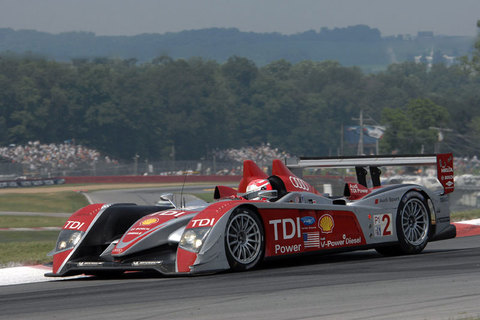
This past weekend I watched some fantastic racing at Road Atlanta courtesy of the American Le Mans series. Audis were dicing with Peugeots, Ferraris with Porsches, Porsches with Acuras, and Corvettes with Aston Martins, among other marques. All of it awesome, technology-centric racing put on by the American Le Mans Series (ALMS).
What made this particular running of Petit Le Mans unique was the debut of something called the Green Challenge. An innovative behavioral incentive program developed jointly by the ALMS, the US Department of Energy, the Environmental Protection Agency, and the Society of Automotive Engineers, the Green Challenge allows racing teams to score points for sheer speed and for energy usage and carbon footprint. Teams are evaluated on the total greenhouse gas life cycle of the fuel type they use in the race, which could be cellulosic ethanol, bio-diesel, and ethanol/petroleum blend, or a hybrid internal combustion/electric source. For the gearheads among you, the following formulas are used to evaluate Green Challenge performance:
As a general rule, competition is good for spurring on innovation. From high-minded endeavors such as the X PRIZE, to the (very scary) technological leaps seen during WWII, high stakes seem to breed a combination of focus and access to resources which help support innovative behavior. In the parlance of Ways to Grow, competition helps set the context for revolutionary innovative outcomes. To that end, here's what Margo Oge, Director of the Office of Transportation and Air Quality at the EPA, has to say:
Automobile racing spurs innovation in safety, performance, and now, we are happy to say, clean technologies. Racing is the ultimate test track.
Amen.
I admire this high-minded, innovative approach on the part of the American Le Man Series. Rather than take a pessimistic, let's do less-bad approach to racing -- which would have gone in the direction of greatly restricting fuel consumption, which is terrible for competition -- they chose to pursue an optimistic, pro-fecundity and consumption approach to being green. As Bill McDonough has shown us, we can make a paradigm shift to a system where inputs and outputs flow in ways that enable consumption without harming our environment, rather than assume that all consumption must trigger an increase in entropy. This initiative is only the tip of the iceberg, but it is a fantastic start. I tip my hat to the leadership of ALMS.
And the title of this post? It refers to an article I wrote for NZZ Folio a year ago, called Who will be the next millionaire? My point then was that we need to find ways to go green while going red, which is my code for maintaining our ability to enjoy things that are sexy, fast, and cool. I still believe this is true, and that we are in the early days of making green tech and clean tech sexy. This is one of the reasons behind my new blog Unabashed Gearhead Gnarlyness -- it's an exploration of what makes red red.
For those of you who didn't catch the race, here's the last lap. Allan McNish is a hero, a pure racer. Here is a drive worthy of the great Nuvolari. Very inspirational stuff:
08 October 2008 | Permalink | Comments (1) | TrackBack (0)
|
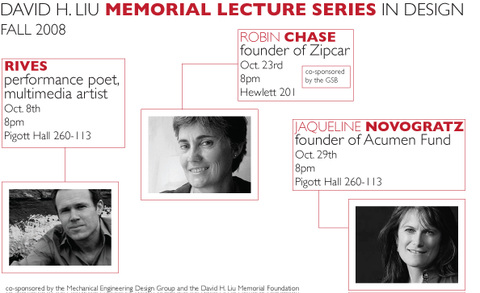
Check out the Fall lineup for the Liu Lecture Series at Stanford! I've heard each of these wonderful people speak at TED, so this is a real (and free!) treat if you happen to be around Stanford on these dates.
Be sure to check out the Liu Lecture website for any last minute room or date changes.
06 October 2008 | Permalink | Comments (0) | TrackBack (0)
|
The New York times ran a great article yesterday called "Design is more than packaging". Of course, if you're part of the metacool community, you already know that. But it is great to see this meme getting out there and sticking. I'm very happy to see that the article was published in the Business section. Cool!
Among others, the article mentions IDEO, my employer, and the Stanford d.school, my other employer.
A couple of quotes.
Tim Brown:
Design thinking is inherently about creating new choices, about divergence. Most business processes are about making choices from a set of existing alternatives. Clearly, if all your competition is doing the same, then differentiation is tough. In order to innovate, we have to have new alternatives and new solutions to problems, and that is what design can do.
George Kembel:
It would be overreaching to say that design thinking solves everything. That’s putting it too high on a pedestal. Business thinking plus design thinking ends up being far more powerful.
Well put, gentlemen!
05 October 2008 | Permalink | Comments (0) | TrackBack (0)
|
At TED in 2007 I heard TED Prize winner James Nachtwey say:
"I'm working on a story that the world needs to know about. I wish for you to help me break it, in a way that provides spectacular proof of the power of news photography in the digital age."
Tonight his wish comes true. You can go to www.xdrtb.org to see more. These photos will be seen across the world tonight when they are projected in 50 different cities.
03 October 2008 | Permalink | Comments (2) | TrackBack (0)
|
A pleasant surprise showed up a few days ago in my mailbox: the October edition of one of my favorite magazines, Monocle. I wasn't expecting to see this issue because I mistakenly allowed my subscription to lapse.
A second surprise awaited me when I opened up the shipping wrapper (Monocle ships in a protective packet):
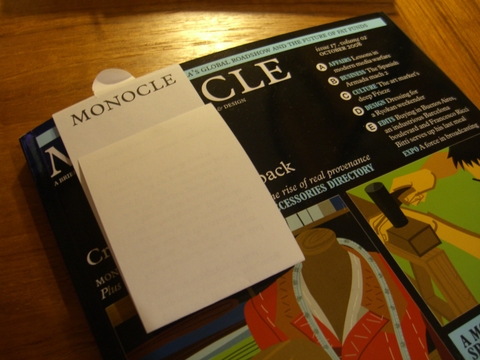
As you can see, a paper flap was tucked in to the cover. Here's what this paper flap said when opened:
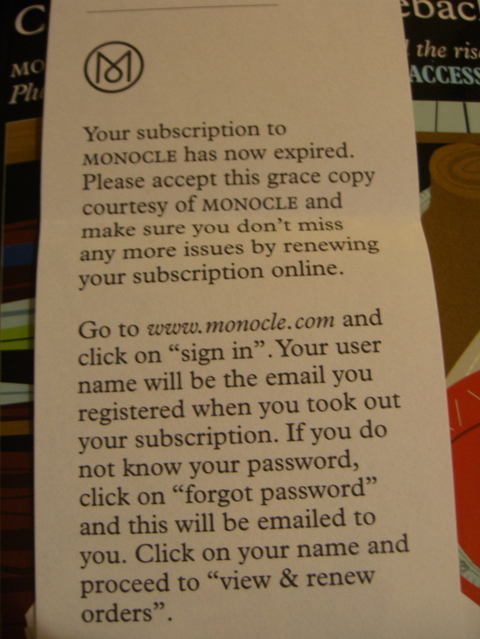
When it comes to caring about all the little things that add up to a superior experience, this little flap is extremely telling of the care that has been poured in to the Monocle brand.
First, its language and form are consistent with the brand voice used across rest of the publication. Who wrote it? Likely a member of the editorial staff. The tone and the layout read just like anything else branded "Monocle". Most magazines forget their voice when it comes to this, the most personal of communications they ever have with a subscriber. In this situation, why would you speak to anyone in anything other than the editor's very best voice?
Second, the content is not sales content. It is relationship content. They're speaking to me as an adult. No weird offers, no tricky language. No shouting. No desperation. Unlike many magazines, which start bugging you to renew months before the end of the subscription with exaggerated offers and wacky incentives, this statement is gracious, factual, pleasant, business-like, and polite. Just the same as everything else at Monocle -- which is the point of having a brand in the first place.
Everything matters.
01 October 2008 | Permalink | Comments (1) | TrackBack (0)
|
But now I do. The remarkable, inspirational, crowd-sourcedable, springwise
A great source of inspirational kicks in the pants for all of us generative business designers. Wow.
23 September 2008 | Permalink | Comments (3) | TrackBack (0)
|
If I knew then what I know now, and if the Acumen Fund had existed then, I would have applied to be an Acumen Fellow.
If you are someone -- or know someone -- who is able and interested in making a change in the world, please tell them about this program.
11 September 2008 | Permalink | Comments (0) | TrackBack (0)
|
"Courage is being scared to death and saddling up anyway."
- John Wayne
10 September 2008 | Permalink | Comments (0) | TrackBack (0)
|
Reilly Brennan has a great post over at his blog about the need for better "push" marketing tools: Nobody has figured out push media on the internet yet
Here's an excerpt:
... push’s shortcomings in the internet era have driven us to a lot of pull. People have just become omnivorous pullers—a day spent checking bookmarks across dozens of websites. Of course, that’s not all bad. Pull can be fun—we want to hunt when we want it. Plus, I don’t really want a potato salad subscription—I just wanted one recipe.
When he's not thinking critically about the future of marketing, the multi-talented Mr. Brennan gets to test drive sweet rides like the new Corvette ZR1. Which definitely qualifies as a "push" car.
09 September 2008 | Permalink | Comments (0) | TrackBack (0)
|
Little did I realize upon starting this humble blog several years ago that it would be a ticket to some strange and wonderful trips. For instance, over the past year this blog has introduced me to many of the folks behind the magazines (this was pre-web browser historical timeframes) that taught me about the worlds of cars, engineering, aesthetics, design and marketing. These new friendships have been very meaningful to me.
And now I'm writing about glamour. Deep Glamour, that is. If you've ever met me in person, you know that I'm not quite a full-blown sartorialist (though I'd like to be). So thinking about what glamour is and what it does is a nice challenge from a personal growth standpoint, and an exciting one. Deep Glamour looks like it will be a fun and interesting blog about all the things that orbit this fuzzy but oh so compelling notion of glamour. I hope to post something every week or so as long as the management will have me.
Part of being innovative and creative is finding safe ways to take a first step. So, faced with an unknown domain, I wrote about cars, which is a cozy domain for me.
My intent in writing metacool was to have a personal sandbox for playing with ideas, so there you go. Please check out Deep Glamour -- I've been a huge fan of Virginia Postrel for many years, and in fact her writing was a significant point of inspiration behind my return the mainstream of design thinking a few years ago. As you'll see on the blog, her thinking is deep and will make you think and think and think.

08 September 2008 | Permalink | Comments (0) | TrackBack (0)
|
I snapped this photo of three Breezer bikes outside a Palo Alto cafe. Three women rode up separately and then sat together for a chat and some coffee. This photo says everything about the state of marketing and product design today. That is, marketing = design = marketing. You can design a bike to market itself, and you can design your marketing to make your product design more meaningful.
I've written before about the great bikes designed and marketed by Breezer. They are what they are: a turnkey commuter bike, all sorted out for you, ready to ride and fun to ride, with just enough aesthetic flourishes to make you look back at the bike once or twice once your reach your destination. In a world captivated by spandex-carbon-fiber-titanium-tour-de-france bikes, the Breezer bring a little bit of the Dutch bicycle aesthetic to the US, leavened with some wild California hippie mountain bike DNA. It's the kind of product that makes for happy owners, and happy owners like to tell other people about their happy experiences (as I'm doing now). In the parlance of Godin, they sneeze, and other people catch the virus. In this case, it's a Breezer virus, transmitted from friend to friend.
The good news is, it's easier than ever to take a remarkable offering and then get the sneezers sneezing. Why? Because of a pattern of behavior in the US which the author Bill Bishop calls the "Big Sort". Here's an excerpt from an Economist article by the same name:
Because Americans are so mobile, even a mild preference for living with like-minded neighbours leads over time to severe segregation. An accountant in Texas, for example, can live anywhere she wants, so the liberal ones move to the funky bits of Austin while the more conservative ones prefer the exurbs of Dallas. Conservative Californians can find refuge in Orange County or the Central Valley.
Over time, this means Americans are ever less exposed to contrary views. In a book called “Hearing the Other Side”, Diana Mutz of the University of Pennsylvania crunched survey data from 12 countries and found that Americans were the least likely of all to talk about politics with those who disagreed with them.
Intriguingly, the more educated Americans become, the more insular they are. (Hence Mr Miller's confusion.) Better-educated people tend to be richer, so they have more choice about where they live. And they are more mobile. One study that covered most of the 1980s and 1990s found that 45% of young Americans with a college degree moved state within five years of graduating, whereas only 19% of those with only a high-school education did.
Severe segregation is a societal ill, but is in some ways a boon to marketers. Make a bike that appeals to wealthy, liberal, educated, gregarious, retired boomers? Super! Now you can target them by zip code. Once you get one maven in there with your offering, you can find creative ways to help that maven spread the word... and as they sneeze, the virus will spread fast and wide and deep.
Again, the three key steps behind designing for (marketing for) infectious action are:
02 September 2008 | Permalink | Comments (1) | TrackBack (0)
|
I was floored by this opening paragraph from a recent Economist article about Barack Obama:
Eight years ago Barack Obama was thoroughly humiliated at the Democratic Convention in Los Angeles. He had recently lost a congressional primary in Chicago, and both his political and personal bank accounts were empty. The rental car company rejected his credit card. He failed to get hold of a floor pass and ended up watching the proceedings on a big screen in a car park. He returned home with his tail between his legs before the week was out—and left the celebrations to the people who mattered...
Imagine that: Obama's credit card was rejected and he watched from the outside. And yet today he is in the middle of it all. How do you go from the parking lot to the center stage in just eight years? There is much suffering in life, and also the potential for great happiness and accomplishment, and often the difference between the two is a matter of persistence. Luck plays a part, but by exerting energy toward a goal, you can make your own luck.
This is what Dan Pink means when he says that "Persistence trumps talent" in his book The Adventures of Johnny Bunko. Persistence trumps talent. In other words, all things being equal, those that try are more likely to be the ones who do. Here's an excerpt from Obama's acceptance speech from this evening that echoes that sentiment:
And when I hear a woman talk about the difficulties of starting her own business, I think about my grandmother, who worked her way up from the secretarial pool to middle-management, despite years of being passed over for promotions because she was a woman. She's the one who taught me about hard work. She's the one who put off buying a new car or a new dress for herself so that I could have a better life. She poured everything she had into me. And although she can no longer travel, I know that she's watching tonight, and that tonight is her night as well.
Someone who would agree with Obama on these points is Oprah. And, as you know, she has. I have to thank Dan Pink for introducing me to Oprah's magazine in his book A Whole New Mind. I'm avid reader of Oprah magazine. I find it to be a reliable monthly source of a good kick in the pants. It's a monthly reminder to be think big and to be persistent. I've been reading it for about four years now. As an aside, I'm mildly tickled to tell you that I'm briefly mentioned (and only by first name) on page 307 of the September issue of Oprah. Check it out.
But I digress.
In life, pick where you want to go as much as you can, work like hell to get there, and be persistent. Learn all the time. Do good. Engage everyone around you by pursuing your passions. Help others. Do good work. Bring cool stuff to life. Above all, start.
28 August 2008 | Permalink | Comments (5) | TrackBack (0)
|
Seth Godin posted some interesting thoughts earlier this week in a post called 'Where to' might not be as important as 'how loud'. Here's an excerpt:
In marketing (and thus, in life) it might be a lot more important to know, "How are you going to do the next thing?" or "How are you going to do your vacation?"
Direction is drilled into us. Picking the right direction is critical. If you don't know the right direction, sit tight until you figure it out.
The hyperactive have trouble with this advice. So they flit like a hummingbird, dashing this way and that, trying this tactic or that strategy until something works big, then they run with it.
What we're seeing, again and again, is that both of these strategies rarely work...
The alternative is to do your best to pick a direction (hopefully an unusual one, hopefully one you have resources to complete, hopefully one you can do authentically and hopefully one you enjoy) and then do it. Loudly. With patience and passion. (Loud doesn't mean boorish. Loud means proud and joyful and with confidence.)
This feels similar to what I said the other week about the benefits of startegy over strategy (and I'm happy to thinking anything remotely close to Seth). What do you think? Should I keep pursuing this startegy thing here at metacool? Is it of interest? Is it cool? Please give me some feedback with a comment below or drop me an email.
Thanks.
27 August 2008 | Permalink | Comments (4) | TrackBack (0)
|
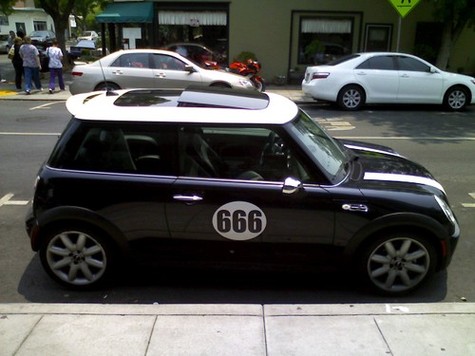
The Mini brand is all about fun and owner-specified (if not always owner-created) customization. Take a look around Flickr and you'll see an amazing display of creativity. Mini fans are taking the brand ball and running with it.
As a marketer, the tradeoff is one of control. Traditional marketing communications, PR, and branding was all about control: say this, don't say that, stay on the straight and narrow, conform to this set of brand guidelines or else. Or else you'll lose your chance at a promotion to group brand manager of whateverthislatestthingisthatwe'retryingtoflog. We can see this mindset at work in the current US presidential campaign, where the natural charisma of candidates is strangled by their handlers. But the "new" marketing, as it were, is all about being open and releasing control. It's built around trust, and works from an optimistic point of view which assumes that most everything done with the brand out in the marketplace will be good for the brand. Brands that work in this new world are those which strive to authentic and speak from a position of truth rather than myth; when you are about truth, then even deviance is not really "off brand", it just adds an additional element of complexity. And complexity makes things more interesting.
Such is the case with with this Mini I spied on the street. If you're Mini, how might you respond to this case of owner customization? Aside from the content, which may be too edgy for some folks, the customization has been executed very well. The white of the roundrel matches the white of the hood stripes and roof. The font used for the numbers is clean and modern. Even the license plate was carefully considered: it read "VI VI VI". If I were Mini, I certainly wouldn't try to shut down this deviance, or even venture to educate it. No, I'd send this owner a coupon for 20% off their next Mini. This car is brand-enhancing. If anything, it raises the bar for clever customization among Mini loyalists, and as such is a wonderful example of creating infectious action.
21 August 2008 | Permalink | Comments (1) | TrackBack (0)
|