"It's a bridge with great character. It tells a story."
-- Santiago Calatrava, on his new Sundial Bridge in Redding, California
"It's a bridge with great character. It tells a story."
-- Santiago Calatrava, on his new Sundial Bridge in Redding, California
15 July 2004 | Permalink | Comments (0) | TrackBack (0)
|
"You see this? This is this. This ain't somethin' else. This is this!"
-- Robert De Niro in The Deer Hunter
14 July 2004 | Permalink | Comments (0) | TrackBack (0)
|
Just read an interesting article, Artisan Bakers Prosper in Low-Carb World. As people figure out that Bimbo white bread makes them go blimpo, they’re also learning that real bread made from real ingredients by real bakers like Red Hen Baking can be something else altogether. Something really good, in fact. Says Gina Piccolino of the Bread Bakers Guild of America:
[Artisan Bakers have] taken the time to educate customers on what it is they are actually buying when they're buying artisan products… Multigrain, whole-grain, whole-wheat kinds of products are good for you.
There’s a lesson here for all of us trying to create winning products in the 21st century. Gone is the day where brilliant packaging and glossy advertising wrapped around a mediocre product create winning offerings. No, now people want Acme Walnut Levain instead of WonderBread. They want a soulful Mazda 3 instead of a Ford Focus. They want a burrito from Andales, not Taco Bell.
The market winners of today are those products which stand on their intrinsic merit alone, not on what their creators say we should think about them. We the consuming populace are the final arbiters of quality and we want great stuff created by product crazies who couldn’t – and wouldn’t – be doing anything else.
13 July 2004 | Permalink | Comments (1) | TrackBack (0)
|
Probably because they are by definition uniquely personal works, hot rods are hotbeds of “doing it to the hilt”. A few weeks ago we examined the Zausner Torpedo. Jay Leno has something well, a bit bigger to show you.
Jay Leno knows what it means to take something and really do it to the hilt. His latest hot rod is powered by the motor from an old M-47 Patton tank. For those of you out there who aren’t exactly into tanks, you’re not really supposed to put tank motors into a car. It’s just not right. But it is to the hilt. Here’s what Jay has to say about it:
The car weighs 9500 pounds--nearly 5 tons, but only one-twentieth of what the tank weighed. This thing is faaasssttt. Best of all, it's hilarious to drive. The size is what's the funniest. The engine alone is 6 ft. long. The car looks like a roadster on steroids.
Man, it’s great to see someone doing things to the hilt.
08 July 2004 | Permalink | Comments (3) | TrackBack (0)
|
"When I was at Audi, it took us 15 years to change the company... By the time the Ford brand is really where I want it, I will be ready to retire. I have 10 to 12 years. You scratch away at it one car at a time."
-- J Mays, Ford
(Your products drive the brand and ultimately the value you create in the marketplace; brands on their own don't create value)
06 July 2004 | Permalink | Comments (0) | TrackBack (0)
|
My latest book review is live and in living color at 800 CEO READ Blog
I reviewed Lovemarks, by Kevin Roberts. An interesting read with some stimulating ideas, but not a stellar book.
05 July 2004 | Permalink | Comments (0) | TrackBack (0)
|
John Maeda of MIT is leading an effort called the Simplicity Design Workshop. As quoted by Jessie Scanlon in the New York Times, Maeda says that "simplicity is an endangered quality in the digital world, and it is time to break free from technology's intimidating complexity."
Along with several other designers, Maeda has formulated a list of the fundamental tenets of using simplicity as a way to design technological solutions:
1) Heed cultural patterns
2) Be transparent
3) Edit
4) Prototype
What I find stunning about these design principles is that they apply equally well to the domain of designing business models and venture structures appropriate to the realities of the 21st century. We need ventures that are willing to live in symbiosis with the cultures that surround them. We need ventures that are willing to be honest and transparent in the financial dealings -- more of the old HP Way and less Enron kniving. We need ventures that edit what the scope of what they do, so that what they do end up taking on is rich with meaning; we've got too much generic, me-too crap in the world today. Finally, we need ventures that are willing to prototype their way to a better and ever-evolving state of being.
02 July 2004 | Permalink | Comments (0) | TrackBack (0)
|
I recently spent a fine Saturday morning sipping Bluebottle Coffee outside San Francisco’s Ferry Building Marketplace. As I sat there under an open sky watching traffic trickle by on the Embarcadero, it occurred to me that I’m a bit weird when it comes to cars. As in “I can tell the brand of car just from its exhaust note” weird.
Here’s a list of the notable automobiles I heard go by:
Yes, they’re all sports cars – products designed to deliver an emotional use experience. And isn’t it cool that each of these remarkable products delivers a substantial portion of the brand experience via the ears? Believe you me, this stuff doesn’t happen by accident; Mazda is famous for squadrons of engineers who methodically try out umpteen combinations of induction/exhaust components until they reach that indescribable point of aural perfection.
What’s the sound of your brand?
30 June 2004 | Permalink | Comments (0) | TrackBack (1)
|
"The reign of the poetical has started."
- Philippe Starck
29 June 2004 | Permalink | Comments (0) | TrackBack (0)
|
Google is hot because they let their products do the talking for the brand. If you think about it, the Google brand is synonymous with the Google use experience, and isn’t the result of some expensive “brand building” campaign. No, those crazy Google people spend their dollars on product. At Google, everyone – the engineers, the graphic designers, the cooks in their fabulous cafeteria – owns the brand.
You can see this in Gmail. Google took free email and said “How would the Google experience work here?” This kind of thinking led somebody at Google to place a wickedly brand-defining message in, of all places, the Trash box (see above). This is brilliant. Like 99.99% of all adult males, I skipped all the marketing messaging when I cranked up Gmail. Sure, I knew going in that it had 1 Gig of memory reserved for me, but this little surprise in my Trash really drove the value proposition home for me. Brilliant.
All experiential elements of your offering can be, should be – must be – thought through and consciously designed to define, embody, and amplify your brand’s unique song.
Good on ya, Google!
28 June 2004 | Permalink | Comments (0) | TrackBack (4)
|
Wonderful things are brewing at Stanford University in the form of the d.school. You're undoubtedbly familiar with "B Schools" (business schools), but the d.school is something entirely different: its goal is to help people learn to use the process of design to solve problems beyond the traditional domains of industrial design, product design or architecture.
Simply put, the d.school will train leaders who are able to think and do. And we'll all be better off for it.
24 June 2004 | Permalink | Comments (3) | TrackBack (0)
|
“We became a $6.6 billion brand because of design. To compete, we knew 10 years ago with the original founding team that we had to have a design group, because that would be our competitive advantage over value players such as Kmart or Target. We create our lines and the whole experience around design. If we were just another value player, where would we be today?”
– Jenny Ming, President, Old Navy Gap Inc.
23 June 2004 | Permalink | Comments (0) | TrackBack (0)
|
The June 18th edition of The Economist discusses using the rapid prototyping technique of building plastic and metal parts layer by layer – someday – to “print” replacement organs one cell at a time. Living cells grown in a culture would be loaded into the hopper and then mechanically spit out to create a new liver, tongue or eyeball.
In my mechanical engineering days, I employed this layer-by-layer technology to create prototypes of my designs. The purpose of these prototypes was to fine-tune the metadesign before releasing it to production, where it would be churned out in the thousands, millions, or billions. Designers love the ability to print out parts, as it enables a high level of fidelity with quick turnarounds, on the cheap.
In fact, some designers (for example, Karim Rashid talks about this) go so far as to envision a future where everyone could design, modify, and print out their own special products. In reality, for most arenas of material culture, allowing anyone to customize and print out products doesn’t quite jive, for a multitude of reasons ranging from safety to performance to IP to aesthetics. For example, would you really want to mess with the professional design expertise embedded in your iPod just to have a personalized shape or interface? Myself, I’d gladly pay for Mr. Ive’s aesthetic values over my own.
In contrast, there’s an obvious and compelling value proposition in using rapid prototyping to create custom versions of anything that becomes part of the body. In some ways this degree of customization is already being achieved today, albeit with ancient casting techniques, in the domain of custom replacement dentures. But just imagine what happens when we get new organs designed, built and delivered expressly for a market of one.
22 June 2004 | Permalink | Comments (1) | TrackBack (0)
|
I’m an unabashed fan of Vartan Gregorian, and was quite taken with his thoughts in Ken Burn’s film The Statue of Liberty:
"If you could say one single force that is threatening liberty, in my opinion, it’s ignorance.
Second, is to treat ourselves as only economic units, rather than as spiritual beings.
America is not an actuality, but is a potentiality. We have to remember that the Universe is not going to be seeing somebody like you again in its entire history of creation. So it’s up to you to become a dot, a paragraph, a page, blank page, chapter in the history of creation."
The modern corporation is one of the finest inventions of past 500 years; it has helped create an elevated state of innovation unknown to all previous generations of mankind. However, it often suffers from a lack of respect for the individual humans who sustain its economic well-being. Though they are its lifeblood, these people all too often are regarded by the corporation’s management as mere “resources” or cost centers to be dealt with as primarily economic units, rather than as unique individuals. I don’t think corporations are going to become more humane and respectful of the individual anytime soon.
But individuals can make a difference. If you work for a corporation that mistreats its employees or the society in which it operates in the name of maximizing shareholder value, try to make it more humane from the inside, or vote with your feet. Just do something -- start making changes yourself within the company, or take your once-in-the-Universe potentiality somewhere else. It’s hard to do, I know. But if we all did it, our society would benefit from a powerful opportunity to balance the liberty-threatening power of the modern corporation.
21 June 2004 | Permalink | Comments (0) | TrackBack (0)
|
I consider Bob Lutz to be the epitome of the designer/product guy as business person. He gets great product at an elemental, instinctive level, and couples that facility with deep execution skills in the business arena. As evidenced by the changes he's wrought at GM (400 horsepower, 6-speed Cadillacs!), he's a walking, talking example of what happens when you smash Knowing-Doing gaps to oblivion.
And how can you resist the dissonant charm of a Cohiba-puffing, Cobra-driving, jet-flying ardent vegetarian?
Lutz's "Strong-Held Beliefs" memo, published upon his arrival at GM, is a classic piece of product development wisdom. Here are the big ideas:
Strongly-Held Beliefs, by Bob Lutz
1. The best corporate culture is the one that produces, over time, the best results for shareholders.
2. Product portfolio creation is partly disciplined planning, but partly spontaneous, inspired all-new thinking.
3. There are no significant unfilled "Consumer Needs" in the U.S. car and truck market (except in the commercial arena).
4. The VLEs (vehicle line executives) must be the tough gatekeepers on program cost, content, and investment levels.
5. Much of today's content is useless in terms of triggering purchase decisions.
6. Design's Role Needs to be Greater.
7. Complexity-reduction is a noble goal, but it is not an overriding corporate goal.
8. We all need to question things that inhibit our drive for exceptional, "turn-on" products.
9. It's better to have Manufacturing lose ground in the Harbour Report, building high net-margin vehicles with many more hours, than being best in the world building low-hour vehicles that we make a loss on.
10. We need to recognize that everything is a trade-off, that we can't maximize the performance of any one function to the detriment of overall profit maximization.
11. Remember the Bob Lutz motto: "Often wrong, but seldom in doubt."
See the full memo here
18 June 2004 | Permalink | Comments (0) | TrackBack (0)
|
"I see us as being in the art business. Art, entertainment and mobile sculpture, which, coincidentally, also happens to provide transportation.”
-- Bob Lutz (aka The Man)
16 June 2004 | Permalink | Comments (0) | TrackBack (0)
|
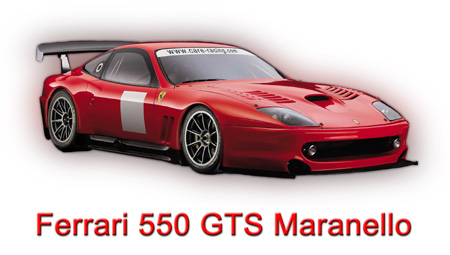
(ah.... the Care Racing Development Prodrive Ferrari 550 GTS... it shares almost no body panels with the street version, but looks oh so much better... AESTHETICS MATTER, AND AESTHETIC DETAILS MATTER EVEN MORE!)
15 June 2004 | Permalink | Comments (0) | TrackBack (0)
|
“Design can unlock the technological performance we build into a product and help the consumer see it, touch it. Good design is serious business.”
– A.G. Lafley, Chairman, Procter & Gamble
14 June 2004 | Permalink | Comments (0) | TrackBack (0)
|
I’ve been writing about how anything can be designed and prototyped, even a venture or a business. Nailing a concept design is critical to long-term success, as both flaws and strong points telescope out far into the future. A rich example of how very critical concept design is can be seen in this thought from Dr. Mario Theissen, Director of BMW Motorsport. Here he’s talking about the design of their Formula 1 car:
"If you look at this small line between success and failure - the big difference there is whether your concept is right or not. If the concept of the car or the engine is not right, you won't be able to fix it in the running season, you'll have to come up with a new concept and that takes time and it requires total focus. If the concept is right - and that's what we found out last year after a few races - and you just have not been able to exploit the potential of the concept, then you can make it."
Imagine if BMW Motorsport didn’t have to wait until the Formula 1 season started to know – really know – whether or not their fundamental car concept was quick enough to be a winner. The payoff would be tremendous, as it takes about $300 million to campaign a season of Formula 1, and for that kind of money, you might as well win a few races. You can prototype anything, and should. But doing it is quite another thing.
10 June 2004 | Permalink | Comments (0) | TrackBack (0)
|
“At some point, you’ve got to cut through the analytical logic that’s driven the automotive business for the past 30 years and say, 'Hey – what’s going to turn people on?'" -- J Mays
08 June 2004 | Permalink | Comments (0) | TrackBack (0)
|
Download BzzAgent_HBS_CaseStudy_Sum.pdf
John Moore (who is one of my book reviewing peers at 800-CEO-READ-BLOG) turned me on to this summary of an HBS case on BzzAgent. It’s a nice overview of how word of mouth marketing (aka customer evangelism) is affected by network types and the players within them.
The most interesting – and counterintuitive – assertion in this piece is that the most influential source of incremental word of mouth marketing comes from individuals with weak ties to your organization, meaning that they’ve only experienced your brand once before, as opposed to being repeat or long-term customers. The reasoning behind this is that more loyal individuals have already saturated their networks with talk about your offering, while less loyal folk offer virgin fields, so to speak, for you to plow.
This is a nice way of thinking about the dynamics of word of mouth for established brands. For nascent players or offerings, however, you’d have to alter your tactics, because very few individuals, if any, are loyal to you, and in order to cross the chasm you’ve got to establish some pockets of deep loyalty.
07 June 2004 | Permalink | Comments (0) | TrackBack (0)
|
"I don't understand why enduring design is better than disappearing design"
-- Ettore Sottsass
04 June 2004 | Permalink | Comments (0) | TrackBack (0)
|
Do something to the hilt, and you’ll end up with something that makes you want to cry “mama mia”.
How does a built-from-scratch hot rod with a 5.5 liter, 485 horsepower Ferrari V-12 grab you? Draped in aluminum bodywork still dripping from the classic Alfa + Touring gene pool, with an interior of ostrich hides and precision, machined controls. Craftsman Steve Moal and patron Eric Zausner did it, and they call it the Torpedo.
Too cool!
03 June 2004 | Permalink | Comments (0) | TrackBack (0)
|
Bluebottle Coffee Company, an artisan microroaster, is a purveyor of Way Beyond Critical to Quality (WBCTQ). In the minutes leading up to a sip of Bluebottle espresso, my knees go giddy with anticipation, because they know I’m about to have the best damn coffee around, crafted with care by one James Freeman. Like Woody Allen, Freeman is a clarinetist when not laboring for his art, and that art is sublime: watching him whip up a cappuccino from beans roasted not more than 24 hours ago is a deep lesson in passionate product creation. He’s serious about brewing coffee to the hilt:
The highest achievement, I think, is just a straight shot of espresso. Coffee itself is very sexual. Espresso is nerdy. You have to have the soul of a poet and the heart of a band nerd to get everything right.
Freeman takes things beyond sane limits because it’s the only way he knows – it’s about Way Beyond Critical to Quality (WBCTQ). Ettore Bugatti and Enzo Ferrari understood WBCTQ . Yvon Chouinard, Steve Jobs, and Quentin Tarantino are instinctive WBCTQ’ers. Bluebottle Coffee is using WBCTQ to create what, one day, will be a widely-renowned brand. Doing things to the hilt is how great brands get made.
02 June 2004 | Permalink | Comments (0) | TrackBack (0)
|
“I used to say for years that story was the most important thing to us. Then I realized that all the other studios were saying the same thing. They say that and then they go and produce crap. What you say doesn’t mean a damn thing. It’s what you do that matters.”
-- Dr. Ed Catmull, President, Pixar
(Pixar gets things done using a “fail early to succeed sooner” rapid prototyping process where story concepts go to the big screen early so that bad ideas get surfaced fast)
01 June 2004 | Permalink | Comments (0) | TrackBack (0)
|
I believe in products that go beyond the ordinary to deliver memorable experiences. There’s so much clutter in the marketplace that merely competent functionality is, for the most part, a given. What matters more than ever are products which solve real problems in spectacular ways, creating deep meaning for users along the way. True product standouts come from people who take something and do it to the hilt.
Doing things to the hilt means going beyond what is “reasonable” or “expected” by the market. There’s a product development baseline out there which all know and recognize. This is the world of the Ford Taurus, Budweiser, and Taco Bell – all entities where advertising is used to create and push products, because the products largely can’t stand on their own. Why? Because each was developed to a specification of “market demands” laid out in a book, and the very act of writing guidelines down limits the potential for something wonderful happening. Some people call these specifications “critical to quality” metrics, or “CTQ” for short.
Screw CTQ. CTQ’s give us Velveeta, which is congealed boredom. Why not do things to the hilt instead? I want a rich, sublimating cheese that makes my nostrils flip out and my tongue go furry. How about replacing CTQ metrics with “Way Beyond Critical to Quality” (WBCTQ)? We need more people creating things born out of intense, total passion. Making things remarkable. Surprising. Blow-your-hair-back-and-part-it-down-the-middle-wow. Way Beyond Critical to Quality.
31 May 2004 | Permalink | Comments (0) | TrackBack (0)
|
Innovation is a big word in business these days, but the phrase "let's be innovative" can trigger a flood of procrastination and fear which does anything but encourage innovative behavior.
The good news is that you can become more innovative just by taking some action, however small, today. My favorite book on this subject is The Knowing-Doing Gap. In one section of the book, 49ers coach Steve Mariucci explains how he stamps out inaction by not sporting a watch:
I always know what time it is. It is always NOW. And NOW is when you should do it.
Go on! Go innovate! Just do something, no matter how small it may seem to you. Worlds will open up.
Catch my review of The Knowing-Doing Gap at 800-CEO-Read-Blog
27 May 2004 | Permalink | Comments (0) | TrackBack (0)
|
My peer, coconspirator, and friend John Kembel turned me on to this statement from MIT Media Lab prof John Maeda:
Amidst all the attention given to the sciences as to how they can lead to the cure of all diseases and daily problems of mankind, I believe that the biggest breakthrough will be the realization that the arts, which are conventionally considered "useless," will be recognized as the whole reason why we ever try to live longer or live more prosperously. The arts are the science of enjoying life.
A very compelling idea. And if you substitute the word “aesthetics” for “art”, you get very close to the “aesthetics matter – a lot” thesis advanced by Virginia Postrel. It's all good.
25 May 2004 | Permalink | Comments (1) | TrackBack (0)
|
In today’s New York Times, Jamie Kitman tells a sorry tale of the demise of Saab. In an earlier post I asserted that “Subaru is the new Saab”, and unfortunately that’s literally true: the new Saab 9-2 is but a badge-engineered Subaru. Kitman agrees that the WRX is the car that Saab should have been building all along:
"Authenticity issues aside, the turbocharged, all-wheel-drive WRX is, at least, the sort of car that Saab might have built today if it had only received enough financing in the 1990’s. Like the rally-winning Saab 96’s of the 1960’s, the 9-2X wrings maximum advantage from being a light car with a small engine and loads of grip."
In contrast, Kitman describes the new Saab 9-7X (which is really a Chevy truck) as “… the very antithesis of the Saab ethos,” and he’s right. Just because you hang a badge on it and put the ignition in the floor doesn’t mean it’s a Saab, no more than lipstick on a bulldog makes a fashion model. In Popeye’s parlance, things are what they are, and your brand (an odious word) is the sum of the feelings your products evoke. A Chevy with a V-8 just can’t feel like a Saab.
Kitman attributes Saab’s crash to a lack of leadership. I would go beyond him to say that leadership was surely lacking, but management, particularly “brand management,” was in no short supply at GM and Saab. The old Saab was run by rally junkies who wore blue and gold underwear; it was run into the ground by a bunch of pin-striped, brand-managing fun sponges whose only gold is on their wrist.
24 May 2004 | Permalink | Comments (0) | TrackBack (0)
|
Cereality is a new venture which seeks to Krispy-Kreme-ize that great American breakfast staple, cereal. I’m more of a plain oatmeal kind of dude, but on the road I’d much rather slurp up some Lucky Charms than a greasy Egg McMuffin, eh? It’s a cool idea.
I think these guys are going to make it, largely because they’re employing a prototype-driven process to figure out what their offering should be (as opposed to what they think it should be). As mentioned in USA Today, Cereality has been running a prototype shop at Arizona State University for the past eight months, and are going to try and roll the concept out to more locations later this year.
By prototyping their concept in a financially lean way, and in a low-exposure setting (i.e. Arizona vs. Times Square), Cereality has undoubtedly gotten deep learning on the cheap, without a lot of drama. Future iterations will be more and more dialed in, and customers will find it really groovy. It’s a smart way to go about building a venture – you can truly prototype anything, even sugar pops.
21 May 2004 | Permalink | Comments (1) | TrackBack (1)
|

A few days ago I was explaining the art of prototyping to some formally-trained businesspeople, and when I mentioned that Lego made a good prototyping tool, their eyes glazed over. I knew I had lost them. “Surely you can’t spur innovation with a stupid plastic toy,” their inner investment banker asserted. “Innovation has to be expensive and exotic.”
Not only can you prototype anything (see my Steve McQueen riff below for that discussion), you can prototype with anything.
While the CubeSolver isn’t a prototype of anything, it is an existence proof of how seemingly simple (but not simplistic) tools can be used to prototype quite complex systems on the cheap. How cheap? Well, if I asked a crack team of engineers from HP Labs to make me a Rubik’s Cube solver, I’m sure they would create something brilliant, but I’m equally confident that, compared to this Lego wonder, their solution would be complex, expensive, and require many, many man hours to complete. Those of you who’ve ever worked at HP will note that I made no mention of multiple project cancellations and restarts, as well as a crew of waffling middle managers with bad shoes. But I digress.
If you’re prototyping things right, you’re cheating and stealing. Cheating, because you use things like Lego to better focus your energy on solving high-payoff issues instead of the mundane. Notice how the CubeSolver doesn’t use any custom parts – that would have been a waste when so many off the shelf Lego pieces are there for the taking. Stealing, because you’re borrowing forms and ideas from other designers. For example, there’s nothing innovative about the grabber mechanisms – they’re a pretty basic, tried-and-true design. No, all the design energy went into solving the “big idea” problems.
You can prototype with anything.
18 May 2004 | Permalink | Comments (0) | TrackBack (0)
|
 Iridium. It was the ill-fated venture which placed 66 (out of a planned 77) communication satellites into orbit before finding out that the value proposition was fundamentally flawed. Millions of dollars were lost along the way. Could this fate have been avoided?
I think so. Had the Iridium venture been staged using a prototype-driven, do-and-learn go to market philosophy, its deep flaws would have surfaced well before the big bucks were spent. Much to the dismay of their users, Iridium handsets didn’t work under bridges or inside buildings – a showstopper? Imagine if Iridium had run a prototype service just in Australia; they would have learned all the killer handset lessons in time to correct course before running aground, and for less money.
You can prototype anything. Before filming his epic movie Le Mans, Steve McQueen actually took an entire film crew to the French race a year early, shot an entire movie, and then threw most of the exposed stock away. Why? Because he knew that they best way to learn how to shoot a great movie at Le Mans was to first shoot a crappy movie there. His camera people gleaned deep insights into camera placements, mounts, and techniques which put them in good stead when it came time to shoot the real movie. And the value of the tacit knowledge transfer involved cannot be underestimated: rather than try to explain to new camera people what he wanted, McQueen could point to actual film clips and say, “This is good.”
Prototypes aren’t just for physical products. Even ventures can be prototyped.
16 May 2004 | Permalink | Comments (0) | TrackBack (0)
|
"Six Sigma does not create innovation. Six Sigma is not a solution for new products or a break-through strategy." - Jay Desai, GE Six Sigma expert
Six sigma doesn't drive breakthrough innovation. New market innovation from divergence, while six sigma is all about convergence.
Want to be innovative? Fool around with a lot of ideas, quickly. Only then should you employ six-sigma to drive variance out of the processes needed to bring something to market.
15 May 2004 | Permalink | Comments (0) | TrackBack (0)
|
Remember Saab? The world-conquering rally cars? The firm whose machines were hallmarks of iconoclastic engineering that coupled functionality, rationality, with understated yet compelling design forms? The crew who brought us ignition on the floor, turbos under the hood, and huge fifth doors which opened up to a cavernous cargo hull?
Well, that Saab is dead, victim of a relentless drive up market to the fairyland of bigger margins and “aspirational” customers. Somewhere along the way, Saab stopped racing and stopped loving cars. They axed the hatchback (you can just see the PowerPoint deck and the MBA voiceover “… the hatchback segment share of market is decreasing year over year…”) and they lost their soul. Only a soulless firm would slap a Saab badge on a Chevy truck, Saab's next big move.
On every parameter of what once made up “Saab-ness”, Subaru is, well, firing on all four horizontally-opposed cylinders. World-conquering rally cars? Check. And piloted by a charismatic Nordic race driver who grew up driving Swedish cars, to boot. Iconoclastic design sensibilities? More than a heaping spoonful: expensive boxer engines justified on the basis of lower CG, rounds of raucous turbos for the entire bar, and all-wheel drive on all models. What Subaru has done is to whip up a distinctive mix of ingredients and pour it into cars that drivers love. Then, instead of blowing their marketing budget on just the usual media mix, they’re out there mixing it up – and winning – in the World Rally Championship across every continent save Antarctica, letting the car-crazies among us know that Subaru creates exceptional driving experiences. And as Malcolm has taught us, those Mavens are the key to word of mouth…
Your brand does not define the character of your products. Your products (and the layers of sales, service, and support surrounding them) define your brand. A brand is not about words and pictures, it’s about feelings. And it’s the product (or the service or both) your company delivers that generates those feelings.
Want a strong, vibrant brand? Make “branding” the job of your product development group and your marketing team. Let the product crazies have the run of the house. I’ll bet my TiVo that the Saab corporate lot is full of boring, unmodified Saabs driven by boring, by-the-number corporate zombies. And the lot at Subaru? Do I have to tell you?
14 May 2004 | Permalink | Comments (2) | TrackBack (2)
|
Marketers, engineers, and designers are people too, and they are as much a product of their environment as the next guy. Their daily life experiences inform their way of thinking, which in turn shapes their professional output. The culture in which a product is developed becomes embedded in that product.
Fiat is a good case in point. Throughout its history, Fiat has been able to make fantastic, tiny cars, like the 500 Nuovo (whose design was cribbed in part from competitor Iso, which eventually became a BMW, but that’s another story). Its success in doing so stems from multiple factors, from the political landscape (tax laws based on engine displacement), to the state of the market market (expensive gas, relatively low per capita earnings), and culture (how and where do live and what do we value). In terms of automotive design, I find the cultural one to be the most influential: if you live in a city with small streets and limited parking, you’ll naturally develop spidey-senses that guide you toward tight, elegant, low-mass vehicular solutions. If, on the other hand, you dwell in the flat and open expanses of middle America, well, you’re going to have a hankering for lead sleds that can burn across Oklahoma all day long without jostling unbelted, DVD-watching kids lounging in the back three rows of seats.
In other words, it’s no wonder why the automotive marques who built their reputations for superior handling and braking all hailed from within shouting distance of the Alps and the kinds of switchbacky roads that make tires and grown men scream.
So, when putting together project teams, try and staff them with people who “know” from experience. They’ll be able to put that experience into the end product, resulting in a better experience for users.
All of this is a long way of saying that I’m thrilled to death by Fiat’s new Trepiùno concept car. It recalls the old 500 while being new, and it's a fresh, compelling package for a small car. While I’m not positive that it was penned by a native of Turin, whoever did it really gets what a Fiat is. Let’s hope they can get it to market.
09 May 2004 | Permalink | Comments (0) | TrackBack (0)
|
The concept of jolie-laide (ugly-beautiful) isn't just about looks. An experience, a product, or a service can be simultaneously ugly and beautiful in other arenas, too, such as taste, feel, and sound.
As Seth Godin recently noted, having one part of your offering be ugly when all the rest is beautiful can be a bad thing for the brand experience you're trying to deliver. We've all had product and service experiences like this: the lobby of the hotel is incredibly clean, but your room reeks of marmot. Or the food in the restaurant is divine but the waiter is an asshole posing as a jerk -- you get the picture.
But a little bit of ugly isn't always bad. For instance, take the Finnish drink Salmiakki, which is a mixture of salty salmiakki licorice dissolved in a potent spirit, like vodka. The resultant brew is something to behold: it is highly viscous, even oily; it is black yet translucent, like tired motor oil; it hits the tongue with a syrupy sweetness, then transitions to a mouth-wrenching salty state, and finishes with a whoosh of strong alcohol vapor that takes your breath away. I've never been able to drink more than a thimble-full at one sitting (and wouldn't want to), but when I do, it's quite the rush, kind of like jumping off a roof.
Again, why not design some good tension into your product or service? Think jolie-laide.
08 May 2004 | Permalink | Comments (0) | TrackBack (0)
|
Stephen Bayley, whose writing stoked my interest in product design in the late 80's, writes:
"Presenting design as a self-dependent entity suggests that design is a transferable substance, inherent in some objects, but not in others. Instead of educating a public into an awareness that everything was designed, so therefore everything might as well be designed to please, the old-fashioned promoters of design suggested that only certain things were designed and that these were exclusive, precious, rare.
Of course, the truth of the matter is that anything which has been made has been designed: Whether it works well is a matter of engineering; whether it makes a profit is a result of strict financial controls. Whether it sells is a matter of comparative advantage and taste. All that really matters is the ability to make things, everything else is polite aesthetics."
Everything was designed. Think about it: every aspect of the built environment you inhabit was shaped by another human being. So, when people talk about Design with a capital D, or if they attach adjectives to the d-word, such as "good", "modern", "low" or "high", secure your wallet, engage your frontal lobes, and ask yourself, "what the hell are they talking about?". Just because something was created by a designer doesn't mean that its well-designed, even it is Good Design. If it works good, looks good, is a fit to nature and the environment, and adds to the sum of happiness on this blue planet, that's good design. And if someone in a village in Thailand made it, that's cool too.
Be wary of professional designers and their output. When it comes to aesthetics, creating an object or service or just a thang, is much like any other human endeavor; there are a few hideously talented individuals who make it look as easy as falling off a log, and then, well, there's the rest of us. Eminent designers like Ettore Sottsass can just see and produce things better than the average schmo, which means that when a less talented individual tries really really hard to make something notable, you can smell the over exertion a mile away. This is why I'm so wary of the kind of "high" design that's sold at museum shops and in expensive catalogs: it is generally so self-conscious, so determined to be beautiful and interesting, that it fails on all accounts.
Think of it this way: how many really interesting, timeless designs come out of the car industry in any given decade? I'm talking Porsche 911-quality designs here. One? Two? Then think about how cool the average race car or fighter airplane looks. Did a "designer" draw them? No! An engineer or some guy who just "knows" came up with their shapes. As Bayley says, it's really about being able to make things. The other stuff is just "polite aesthetics", fluff which is the realm of fashion.
Design is ultimately about the care and feeding of happiness. Designing something is not a self-dependent action, it's an expression of interdependence.
Oh my goodness, I'm beginning to sound like the protagonist of an Italian architecture manifesto, so I'd best stop while I'm ahead. My apologies.
06 May 2004 | Permalink | Comments (0) | TrackBack (0)
|
"In design there is styling, art, and other terms intermingled. Design means to me that every designing engineer has the opportunity to become at some stage an artist... that every craftsman who can do more than what he is trained to do is an artist." -- Ferdinand "Butzi" Porsche III
What is design?
Defining just exactly what design "is" can be a frustrating pursuit. To begin with, is the word "design" a noun or a verb? While I believe it is best used as a verb, I do like Butzi's definition of it as a noun -- and as the Porsche 911 is the product of his very capable hands, well, we should probably give his thoughts due consideration. And it's true: when you're a design engineer and you get into a state of flow, odds are you're going to crank out some tasty stuff. How'd you get there? Let's call it art.
03 May 2004 | Permalink | Comments (0) | TrackBack (0)
|
"It passes between rooms until it has infested not only your living room, but also your 1.5 bathrooms, your cleanly appointed kitchen, and then your entire sun-drenched, open-plan loft apartment. In the most extreme cases, it will even spread to the string-light-decorated rooftop patio overlooking your recently gentrified neighborhood."
You owe it to yourself and your loved ones to learn more about this deadly epidemic.
30 April 2004 | Permalink | Comments (0) | TrackBack (0)
|
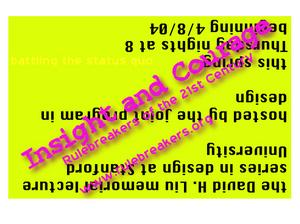
I'm posting this to all of you with a tendency to forget about cool stuff happening in your backyard (i.e., me):
The 2004 David H. Liu Memorial Lecture Series in Design at Stanford University is in swing through May 27. David was a great guy, and attending this series is a nice way to celebrate his life.
28 April 2004 | Permalink | Comments (0) | TrackBack (0)
|
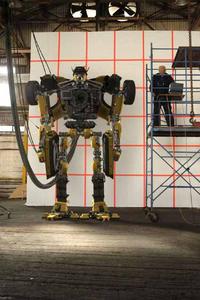
Another incredible effort from the folks at Mini.
27 April 2004 | Permalink | Comments (0) | TrackBack (0)
|
In his recent profile of Steve Jobs and the iPod revolution, the NYT's John Markoff makes the following point:
It has become apparent that the way Mr. Jobs designs products has changed fundamentally during his second tour of duty. In creating the iPod, the iTunes Macintosh and Windows software and the iTunes music store, Apple has not just designed products; it has also designed a business system.
I'm a firm believer that a good product design process -- one that is user-centric, iterative, and prototype-driven -- can also be used to design winning "business systems" like the iPod. The point is to apply a "design" point of view across the activities of the entire venture, rather than just within the product development department. By doing this, you're much more likely to come up with a business offering which users actually want.
26 April 2004 | Permalink | Comments (0) | TrackBack (0)
|
BMW's design leader Chris Bangle, as quoted in Automobile:
"The responsibility that comes with attempting to look forward is that you also have to research, to bring your research into the world and show people and generate discussion. That's something a lot of companies don't want to do... we have an obligation in the future to provide cars that owners will be proud to retore and proud to bring back, so that at Pebble Beach in fifty years, they'll be showing a 50-year-old car instead of a 150-year-old car."
I admire Bangle's guts and determination to change the face of BMW design, and on an intellectual level I understand what he is trying to do with this new design language. However, my heart says that the new designs don't sing.
I really want him to succeed, but I have yet to see a design from the house of Bangle that knocks my socks off.
26 April 2004 | Permalink | Comments (1) | TrackBack (0)
|
Ferrari's factory is off limits to mere mortals, so here's a nice peek inside from Automobile Magazine.
25 April 2004 | Permalink | Comments (0) | TrackBack (0)
|
A great thought from Seth Godin on segmentation, differentiation and their relevance to the process of creating remarkable things.
In my experience, many marketers are so hung up on crafting intricate (and basically irrelevant) segmentation schemes and buying mailing lists that they don't spend time thinking about how to make their offering so distinctive and valuable that users go out and spread the word on their own.
24 April 2004 | Permalink | Comments (0) | TrackBack (1)
|
Or in 40 years?
Over the past year I've become increasingly interested in "cradle to cradle" design solutions that consider the entire lifecycle of a product, from manufacturing to marketing to use to end of use. A critical aspect of cradle to cradle design is considering how a product will age: will it get older gracefully, building a patina which enhances its value, or will it turn into a liability -- the kind of thing that ends up in a dump or (heaven forbid) your front yard? I'm convinced that most designers - or at least the marketers they serve - don't spend many brain cycles thinking about what their product will be like a month after purchase, let alone 40 years later.
A good case in point is my Sony Playstation 2 (yes, I justified it to my wife on the basis of it being a DVD player, not a videogame console). The day exterior drawings were due, some industrial designer must have had his CAD station lock up and drew the thing with a ruler instead:
It's a great product, but all those slots and ridges in the black plastic make it a dust magnet, a real pain to keep clean. As a result, it doesn't look Darth-Vader-cool. It just looks like dusty plastic.
24 April 2004 | Permalink | Comments (1) | TrackBack (0)
|
One of the great disappointments of my post-MBA working life was being told that I would only be evaluated on projects where I was the sole "owner" of process and content. In other words, if I had contributed to an initiative run by another person, well, that contribution would count for zip, zilch, nada.
This flew in the face of everything I've ever learned about getting great stuff done. And it baffled me. I'd rather work with a group of people to do something really cool (and run the risk of losing the trail of authorship) than structure my approach to a problem in order to satisfy the needs of a backward performance evaluation process.
What's that saying -- "two heads are better than one"? The architect Renzo Piano said it best:
Teamwork is when you throw out an idea, and it comes back at you, like a game of Ping-Pong -- four can play it, or six, or eight, with the balls moving back and forth at such a speed that they are flying in both directions at once. Everything gets mixed up. When the project finally takes shape, you can no longer tell who put what into it.
In any endeavor which requires creative output, evaluating people as if they were social islands, capable of existing without interactions with other people, is not only silly, it fundamentally misses the opportunity to align incentives around the ultimate performance goal -- doing remarkable things.
17 April 2004 | Permalink | Comments (0) | TrackBack (0)
|
I'm not a bike fanatic (used to be one, though), but I still really dig a well-crafted bike. Rivendell Bicycle Works makes well-crafted bikes.
But they're about more than the bike -- they are a group of people unreasonably obsessed with workmanship and doing the Right Thing. When was the last time you came across any business with a mission statement like this?:
Our bikes are designed and built to withstand a lifetime of long, hard, fast riding and racing, if that's what you're up to, but we don't go out of our way to appeal to the rambunctious, speed-before-all crowd. It isn't us versus them, or retro versus techno, or old versus new. It isn't niche marketing in the tactical sense, either. It's the same gear we prefer and ride, every day. It is not a "market-driven" approach, which is one reason we're so small.
It's enough the make the skin of any cost-conscious, 6-sigma-driven, Excel-grubbin' business person pucker up like an old prune.
I love it.
07 April 2004 | Permalink | Comments (1) | TrackBack (0)
|
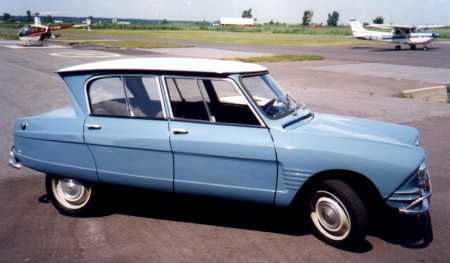
Another automotive design which I've long admired, the Citroen Ami 6. Quite polarizing, eh?
On the spectrum of "beautiful/ugly", this one is biased toward the ugly stick zone, but it does have a certain Gallic charm to it. I like the fact that it's not another anonymous, bar-of-soap-Camry-Corolla-Hyundai-rectal-suppository type of design.
03 April 2004 | Permalink | Comments (0) | TrackBack (0)
|
I was recently in a meeting where a very senior person directed a question about the presentation to another very senior person who had nothing to do with the presentation. She could have just asked the presenter, a fabulous, engaging person who knew everything about the subject at hand. Why the conscious snub? Because the presenter was of a lower "salary grade," and you wouldn't want to mix with those types, you know?
Contrast that world view with this tidbit from Vartan Gregorian, former President of Brown, describing how he approaches relationships with those "under him":
I also did something both in the library and at Brown and at Penn. I got to know the staff. By staff, I don’t mean secretaries alone. The building and ground workers, too. I used to go occasionally to the basement of the New York Public Library and have bourbon with the custodians. I learned more from them about the structural problems of the building than from anyone else. At Brown, I tried to set an example of having a lifestyle governed by modesty. For example, I took a Bonanza bus from Providence to the Boston airport for $11.25 to save money, but more important, to set a tone for the rest of the campus. I instituted a policy that nobody could travel first class. Everybody had to travel economy. No limousines, only buses and taxicabs, and no fancy meals. These were important symbolic measures so that if I cut the budget, nobody would say, “Well, the fat cats are still living high on the hog.” There were even funny moments related to these policies.Once it was raining and I had no umbrella. I was walking along and the university garbage truck stopped. “Hey, Prez,” one of the workers called out. “You need a lift?” He thought that I would not take it. I embarrassed him by climbing on and coming home with a garbage truck, and that story made the rounds.
It would be really interesting to spend a day in the shoes of an organizational snob. What a painful, limiting existence it must be.
03 April 2004 | Permalink | Comments (0) | TrackBack (0)
|